

The Aquitaine Variant Portfolio (AVP) was previously called the Aquitaine Model Portfolio (AMP). The name was a poor fit, and I’ve taken down the earlier portfolio posts. I explain both decisions at the end of this piece.
“If all the news is great and the stock isn’t acting well, get out. It’s a pretty easy concept but for some reason most analysts don’t know this.” – Stanley Druckenmiller
The AVP is a concentrated, long-only portfolio of primarily U.S. mid- to mega-cap equities, with no options or portfolio leverage. The objective is to significantly outperform the market over the long run, and I hold every position in accounts under my control, at broadly the published weights. The holdings tend to share the following attributes:
An excellent management team, above all the CEO
Growth faster than the index’s, or a clear path to it
Returns on capital well above the index’s, or a clear path to them
A balance sheet with ample room for unwanted surprises
A purchase price closer to the 52-week low than the high, in most cases
Without exception, each was bought at a substantial discount to what I thought it would be worth within ~18 to 24 months. The portfolio began on November 29, 2025, with four names: Lululemon (LULU) at ~40%, Airbnb (ABNB) and Toast (TOST) at ~25% each, and Match (MTCH) at ~10%. All four are still held today, though not all continuously, and together they now account for roughly 15% of the portfolio.
Six to Ten
The more names you own, the harder it becomes to beat the market. Bill Ruane, Warren Buffett’s longtime friend, summed it up: “I don’t know anyone who can do a really good job investing in a lot of stocks except Peter Lynch.” I am not Peter Lynch, but I do think I can do a good job owning a small number of businesses I’ve studied closely. Stanley Druckenmiller’s metaphor of choice captures the approach: “put all your eggs in one basket and watch that basket very closely.”
The range going forward is six to ten businesses, with ten a hard ceiling and six a soft floor. I’ve run far more concentrated than that in the past, the AVP’s opening four included, but I’ve opted for a little more diversification to make the portfolio useful to more readers.
Management vs. Moats
“When a management with a reputation for brilliance tackles a business with a reputation for bad economics,” Buffett wrote in his 1980 letter, “it is the reputation of the business that remains intact.” It is a hard line to argue with. More bluntly, elsewhere: “You should invest in a business that even a fool can run, because someday a fool will.” He has also confessed that several of his worst mistakes were good businesses he passed on because he disliked the people running them. (I have made the same mistake, and regrettably not just once.) So is management quality overrated?

If, like Buffett, your favorite holding period is forever, then probably. But almost nobody’s is. Dan Sundheim, who founded D1 Capital, puts it this way:
“Buffett says the business is more important than the leader; I kind of disagree with that. I think if you look over 30 years, sure. But my investing time frame is more like five to ten years, max – and I think people are more important in that time frame.”
I agree, and by today’s standards five to ten years is exceedingly patient. The shorter the window, the more of the outcome rests on the people running a business rather than on its structural economics. Pat Dorsey, a longstanding advocate of moat investing, puts it more strongly. Buffett’s advice, he says, has “probably done more harm than good,” leaving investors so focused on the business that they overlook signs of poor capital allocation, misaligned incentives, and other red flags.
That is the case against underweighting management. Gavin Baker, who runs Atreides, makes it about his own industry:
“I would submit that within any investment organization, there are between two and ten people that if they were taken out, and you had the exact same process, the results would be very different … That is a truth that a lot of allocators struggle with. Because it feels safe and good to say we have a process. And it’s repeatable.”
For an operating company, I’d go further: sometimes the number is one. Lisa Su took over AMD in 2014, when the stock was around $3, the balance sheet was heavily levered, and its products were years behind Intel’s. Today it is a low-leverage business ahead of Intel, with the stock above $450. The difficulty is spotting such operators before the results make them obvious. (Su herself had plenty of skeptics early in her tenure.) Further complicating matters is that far more executives look exceptional than turn out to be.
False Positives
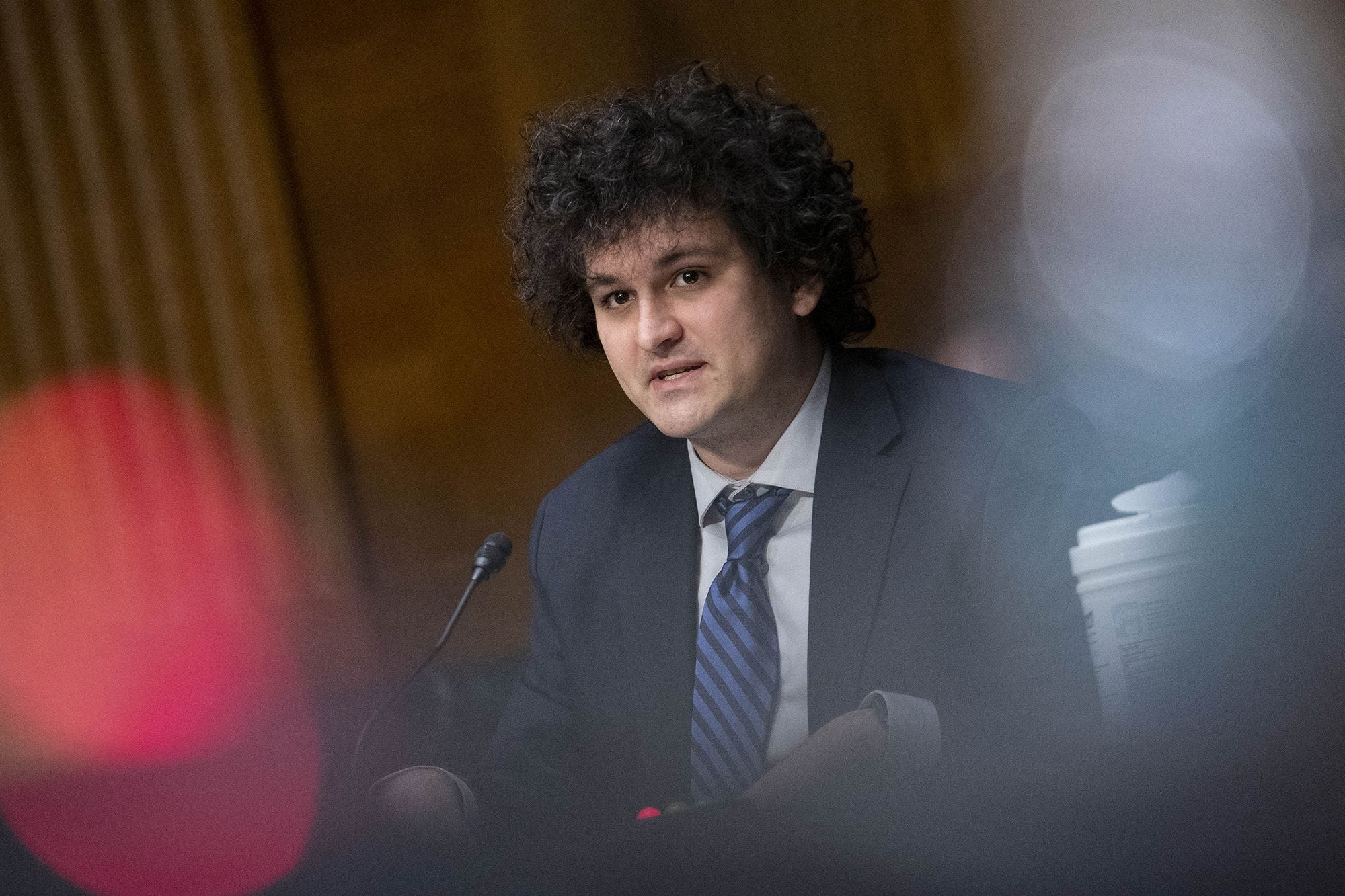
In 2021, Sequoia – one of the most successful venture firms in history – sat through a Zoom pitch from Sam Bankman-Fried and wrote it up in a profile it later deleted: the Corolla, the beanbag beside the desk, the cargo shorts, an internal chat reading “I LOVE THIS FOUNDER.” He was playing League of Legends throughout. As Paul Graham once joked, “I can be tricked by anyone who looks like Mark Zuckerberg.”
This fallibility isn’t limited to assessing management. In May 2007, with U.S. home prices already tumbling, Ray Dalio, as accomplished a student of debt cycles as the industry has produced, was asked about the risk of recession: “Everybody is flush with liquidity, and it would be shocking to me if this little subprime problem essentially spread and sank the economy.”
Clearly, neither intelligence nor experience confers immunity. As Philip Tetlock explains in Superforecasting, “our pattern-recognition ability comes at the cost of susceptibility to false positives,” which is why an intuition can be “clear, compelling, and wrong” all at once. So I try to hold even my strongest opinions loosely, and to stay alert to anything that might undermine them.
Atypical Research
Earlier I said I think I can do a good job with a small number of businesses I’ve studied closely. That doesn’t mean I know everything I’d like to know about them, of course; no matter how much work I do, I always want more. It means I have a decent map of what I don’t know. (Even getting that far takes a lot of work.) Baker again:
“It’s funny that some investors have this idea that you can do 90 days of work on a business and really understand it. I don’t think it’s possible … to do 90 days of work and have a deep, thoughtful opinion on a business.”
Such depth is clearly excessive for a well-diversified portfolio; with six to ten names, I consider it the price of entry. There is a cost to it, though. Peter Lynch ran the opposite experiment, on the principle that “the person who turns over the most rocks wins the game,” and his record speaks for itself.
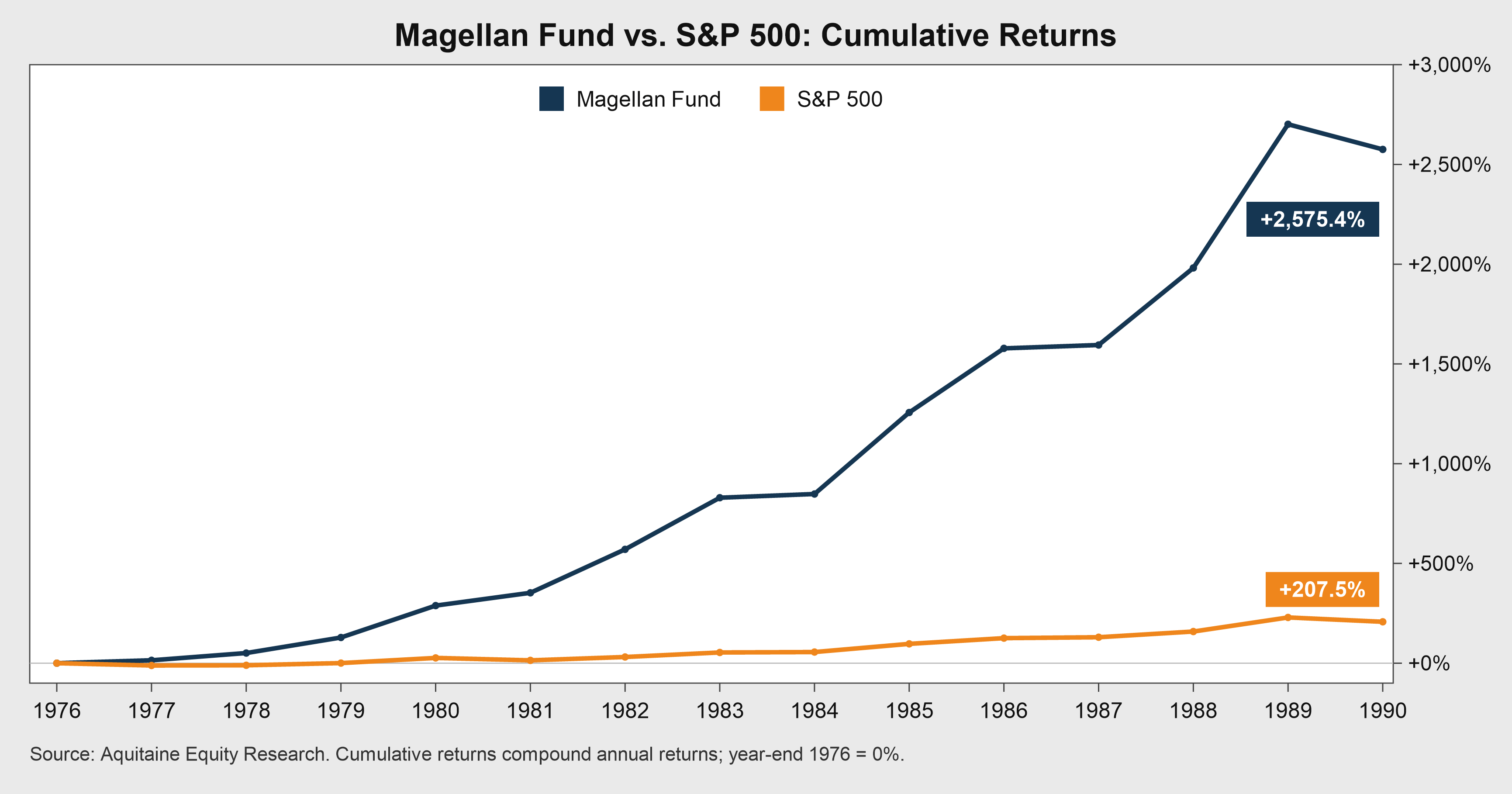
So, more rocks or longer under each? Both are right, and you have to decide which suits you. You cannot turn over many rocks while spending months under each one, and every hour spent on a new idea is an hour unavailable for testing or monitoring an existing thesis. What settles it is the cost of being wrong. Lynch sometimes held well over a thousand stocks, his largest positions rarely more than a few percent of the fund. With six to ten, each mistake carries far more weight, so I lean toward depth and accept that I will miss opportunities.
Even then, there are limits to what the work can tell you. Barry McCarthy, the former CFO of Netflix and Spotify and later CEO of Peloton, has sat on many boards and observes that “no matter how hard you try, you never really know what is going on inside a company.” Directors, he notes, depend almost entirely on the CEO and management team for their understanding of it. If that holds for someone with a board seat and access to internal information, it holds all the more for the rest of us. His conclusion is that successful investing is “all about picking the right guy or gal, because as an outsider, you can’t ever know enough to really make an informed decision,” so what you need are “the pattern-matching skills to know the difference between great and not.”
For a typical position, I’ll spend at least a dozen hours listening to the company’s executives and their counterparts, and considerably longer when the stakes are higher. That means earnings calls going back years, fireside chats, and interviews, often heard more than once. Competitors get less time, but they cannot be an afterthought. As Chris Hohn says: “The one important thing I’ve learned in my time investing is that investors underestimate the forces of competition and disruption.”
Few investors, even professionals, will sit through that much audio (especially when a transcript can be read in a fraction of the time). That is part of the appeal, though the larger reason is that a lot of valuable information doesn’t survive the page. Tone, cadence and delivery can matter as much as the words, and sometimes more. Over time, those hours accumulate into something like a mental library of executives’ communication idiosyncrasies. This helps me pick up on cues others might miss.
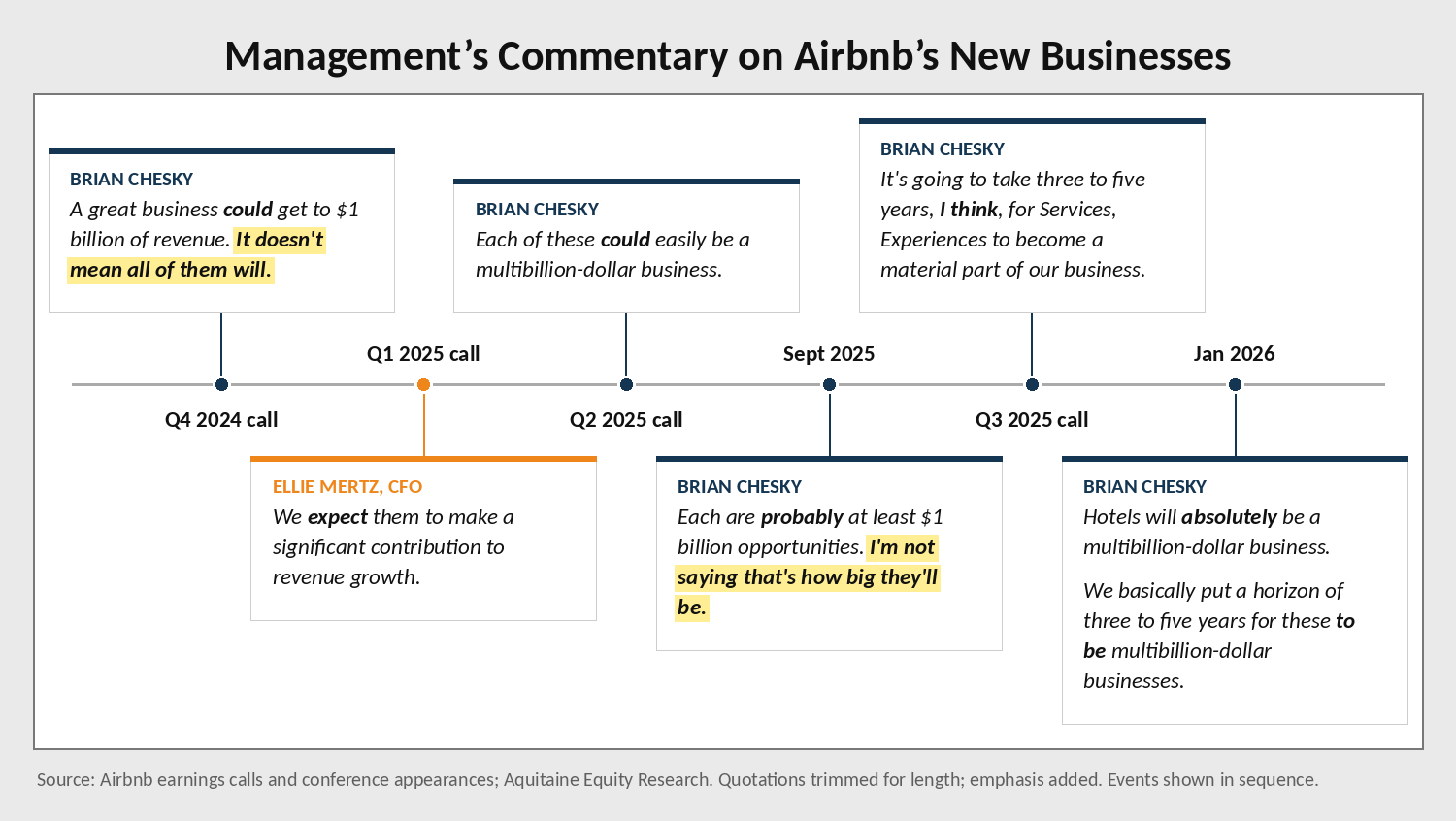
Podcasts are my favorite medium because executives tend to be less guarded, and the conversation has room to stray beyond the comms-approved script. Brian Chesky offered a useful example earlier this year. For more than a year he had described Airbnb’s new businesses – services, experiences, hotels, and (soon) advertising – in carefully hedged terms, on earnings calls and across a long media tour. Then, on a January podcast, the qualifiers came off. What he was suddenly willing to commit to implied that the consensus base case for 2028 revenue was probably at least $3 billion too low.
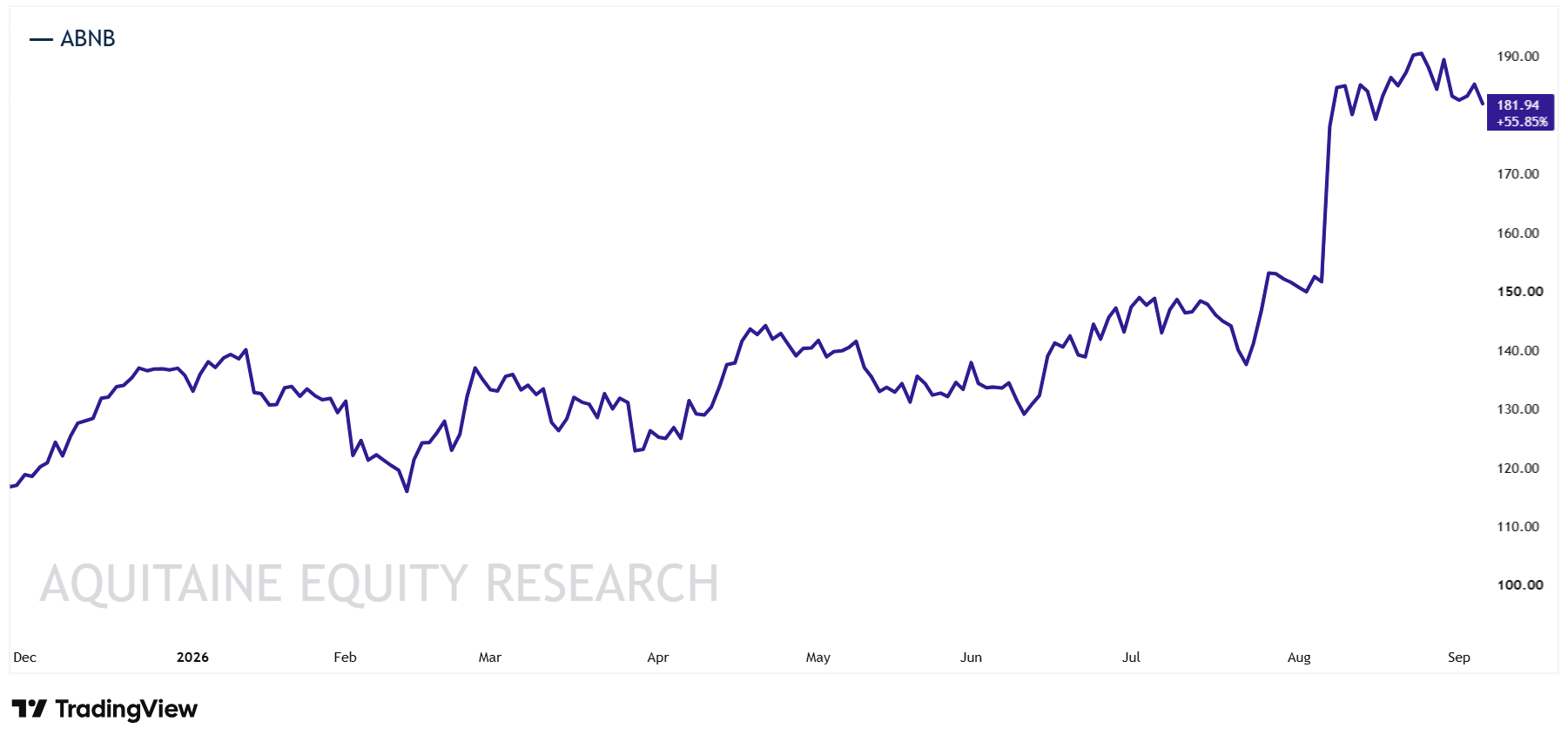
The opening of my May deep dive covered all of this, and why his stale reputation for “overhyping” made it so easy to dismiss, even for those who heard it. I had written up Airbnb in November at roughly $117, and it was about a quarter of the portfolio when he sat down for that interview. His statements prompted me to take that weight (briefly) above 50%.
Even after all that work, the picture remains incomplete. Hohn again: “Usually you don’t understand everything. And usually the things you find out are bad things.” That has been my experience too, at least when I’ve strayed from the attributes listed at the outset, especially on management quality. But when a business has all of them, above all exceptional management, the surprises have tended to be on the upside.
Managing Positions
Martin Taylor is not a household name, though Jack D. Schwager credits him with possibly the best performance record in emerging markets: a compounded net return above 27% a year from 1995 to 2011, more than double the index’s 12%. He is also, unusually for a fundamental investor, entirely unembarrassed about charts.
“Once I have done the fundamental work and decided to buy a stock, I will first look at the chart before putting on a position. If the stock is very overbought, it won’t stop me from buying, but I will start with a small position. If the stock just keeps on going up, then I am happy that I bought at least some. I will also be more willing to buy more because I bought part of the position at a lower price. Whereas, if I didn’t initially buy anything because the stock was overbought, I would then never buy any of it, which would be a dreadful mistake.”
That describes my approach exactly, at least when I’m buying during or after a rally. More often, though, I’m entering on weakness in a company already on my wish list, Netflix at ~$70 in July being a recent example. Letting winners run is another matter, and I’ve been known to trim too much and too soon, as was the case with Airbnb. I trimmed a good chunk ahead of the August 6 earnings, partly because the stock had run up on unremarkable volume (buybacks might have played a role). We’ve already established what happened next. Trimming Lululemon was the same instinct applied correctly, as discussed in my recent thesis update.
Sometimes I’ll even sell with the thesis intact if the stock’s behavior gives me reason to step aside, even temporarily. Here I can thank Mr. Druckenmiller, whose words evidently left a lasting impression on me. They opened this piece, and they bear repeating: “If all the news is great and the stock isn’t acting well, get out. It’s a pretty easy concept but for some reason most analysts don’t know this.”
Toast is a recent example. All the news was great, I thought (if broadly in line with consensus): management kept executing, and its longer-term prospects seemed as bright as ever. Yet after briefly climbing above my ~$33 cost base, the stock was dragged down in the SaaSpocalypse, despite hardware being central to its offering. Its one-month rolling correlation with IGV doubled through the selloff, from roughly 0.45 in November 2025 to 0.90 by mid-March.
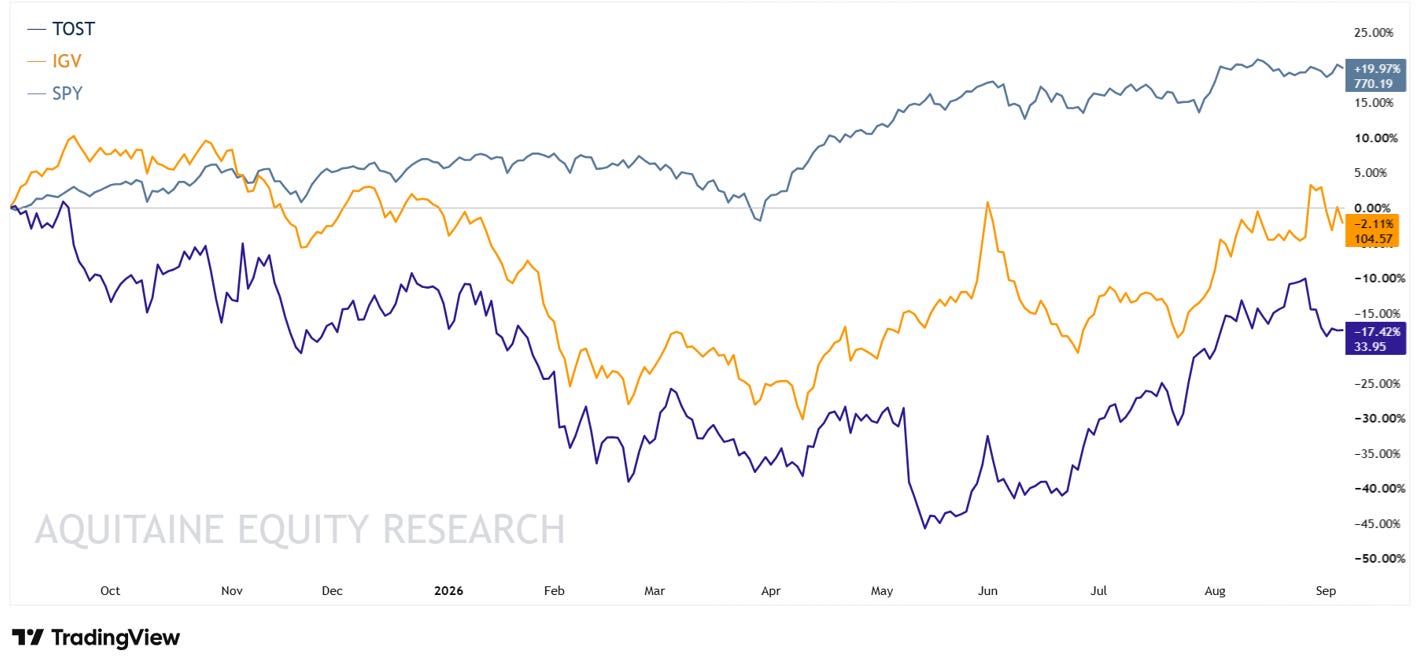
Fortunately, I had trimmed in December, sold most of the remainder in January (sensing which way the wind was blowing), and exited soon afterward. When Toast sold off again in May after what I thought was another great quarter, even as software stocks were recovering, I couldn’t resist getting back in at ~$23.
Where the Mispricings Come From
Taylor believes the best opportunities are trends the market fails to appreciate because it is “extrapolating history instead of looking forward.” That is the common thread in nearly every mispricing I think I’ve found. Druckenmiller says it more emphatically:
“The biggest mistake investors make is investing in the present. Never, ever, invest in the present … Always try to envision the situation as you see it in 18 to 24 months. And if you think the situation will be different, will security prices reflect that?”
Hence the name: the portfolio is built around a variant perception of what a business will look like ~18 to 24 months out. A variant perception need not mean taking an extreme contrarian position, though sometimes it does. Peloton was an extreme case, and it brings together much of the approach described so far.
When I published my deep dive in September 2024, Peloton’s stock was far below its pandemic-era high of ~$167. Four months earlier, Bloomberg reporter Mark Gurman had made this prediction: “I don’t think people realize how close Peloton is to bankruptcy, right? They’ll be lucky to remain on the stock market much longer, if you ask me.”
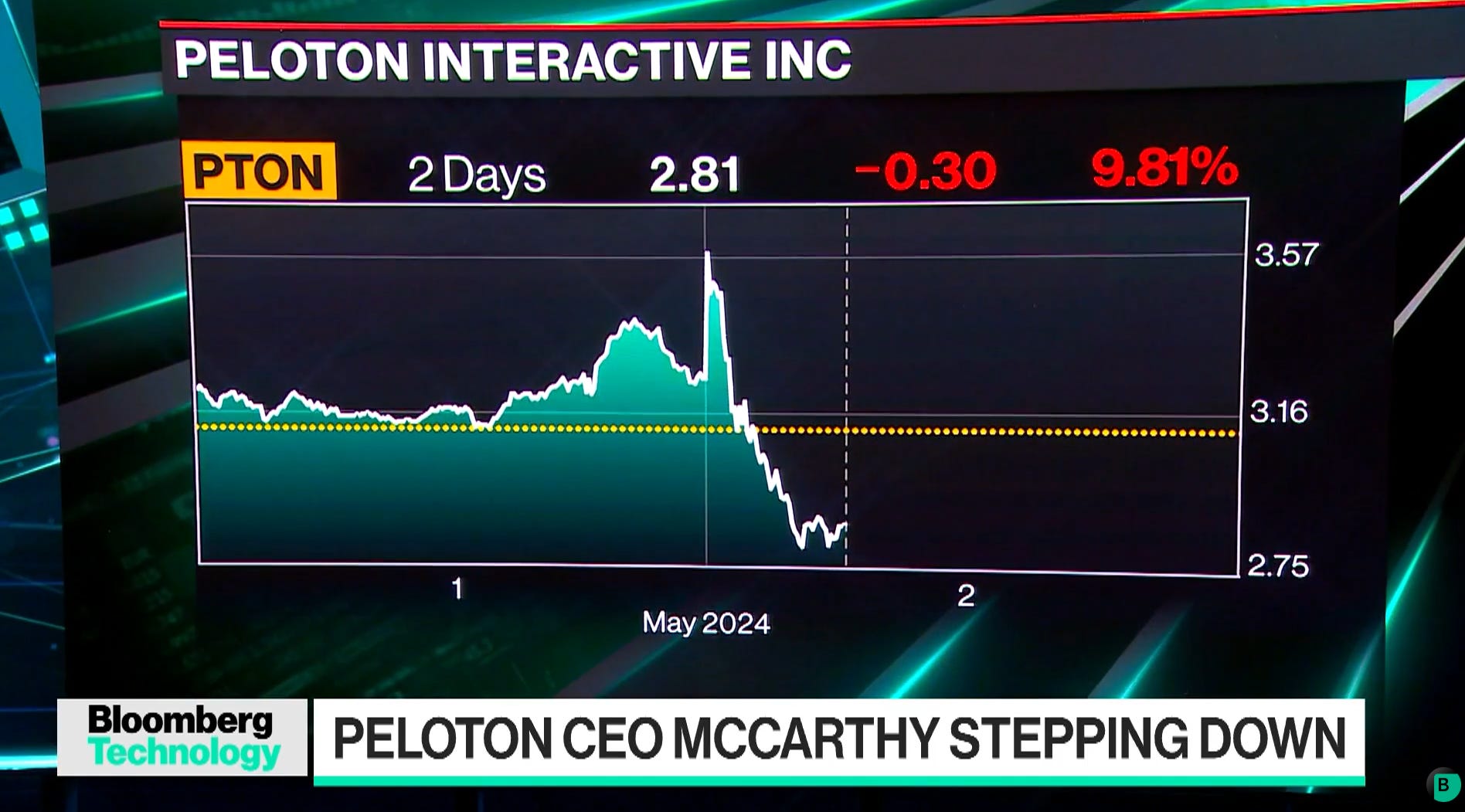
Gurman continued:
“I’m shocked that Barry McCarthy stuck around so long. There is nothing he didn’t try. There is nothing he didn’t do. He’s laid off several thousand people. He’s moved from a hardware focus to a content and subscription focus, restructured the company multiple times, hired new executives to right the ship, outsourced pretty much everything you could outsource from installation to shipping to manufacturing, and here we are missing Wall Street expectations, missing internal forecasts … Peloton is in its worst shape as it’s ever been, and they have no CEO running the company.”
Gurman’s reasoning was easy enough to follow; it was also demonstrably wrong. He seemed not to notice the contradiction in it. Having just catalogued everything McCarthy had done to slim Peloton’s bloated cost structure, he offered that same inventory as evidence the company was in the worst shape of its life.
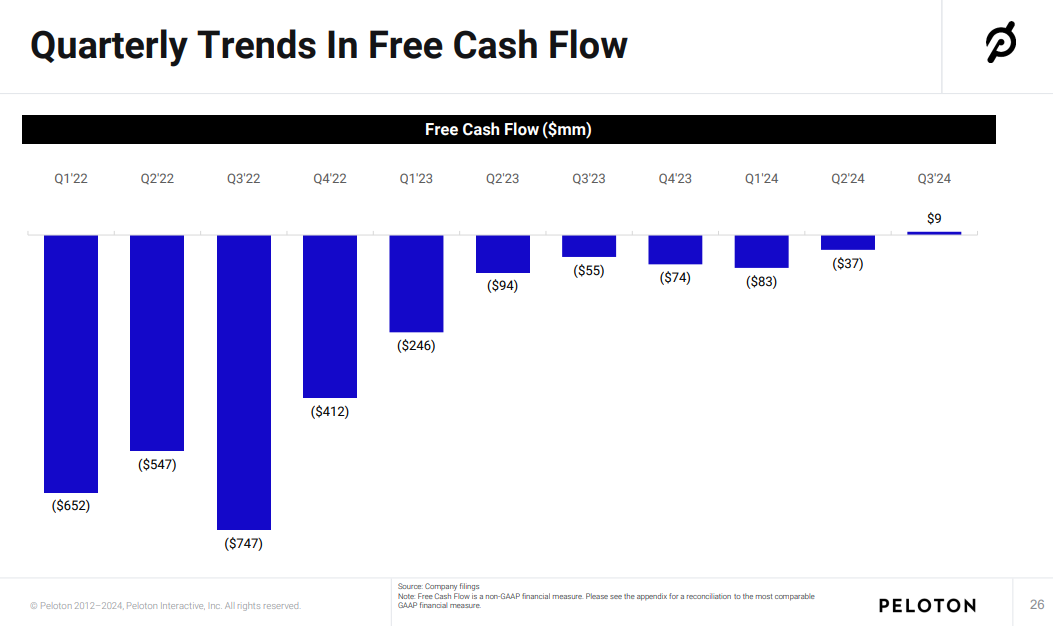
Nor had McCarthy exhausted his options. From his final earnings call:
“If you look at our balance sheet, you’ll see that the business is not going away, which for a long time was a systemic threat. So, because of that, we’re able to focus on renewed growth … I think you’re going to see significant product innovation over the next two years, which I’m very excited about because we have a real shot at changing the growth trajectory of the business.”
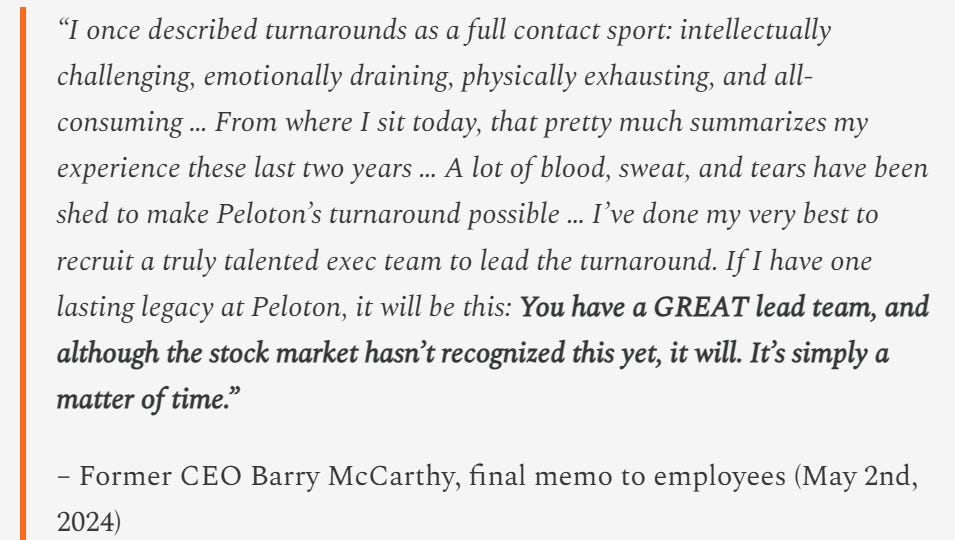
Worst of all was what Gurman’s reading implied about McCarthy himself: the captain wasn’t merely abandoning a sinking ship; he was lying to the crew on his way off it. Here is the memo he left them with, which is how I opened the deep dive:
I suspect the hosts of Acquired, who had discussed McCarthy admiringly across three episodes by then, would take issue with Gurman’s insinuation. I have never heard them introduce anyone with as much reverence as they did on the most recent of them: “THREE-TIME ACQUIRED SUPERHERO, the one and only Barry McCarthy.” As it happens, one of the reasons for their admiration bears directly on the subject at hand.
It concerns his Netflix days. On a public earnings call in 2003, McCarthy announced he was stepping down as CFO, staying on another year to manage the transition properly before finding his next challenge. The company’s future seemed secure, and he had grown bored. Then, in 2004, word got out that Amazon was preparing to enter the market:
“The stock gets hammered … And it’s crisis mode. It’s wartime again at Netflix. And Barry, one of the many reasons why we love him here at Acquired and his story, is he says, ‘I can’t leave. I’ve got to stay through this fight.’ He literally, word for word, on a public earnings call, announces that he’s staying … and his reason is, ‘You don’t leave your friends in the middle of a knife fight.’
So the question in front of me was narrow: had a man who once reversed his own resignation rather than walk out of a fight spent his last day at Peloton lying to the people he was leaving behind? Taking him at his word hardly demanded a leap of faith. (It wasn’t the whole thesis of course, which ran past 9,000 words, but it was the part that mattered most.) The stock traded near $11 a few months later and has averaged over $6 on a volume-weighted basis since Gurman’s misreading, as it turned out to be.
Beta
Martin Taylor is the reason beta gets a heading of its own. His observation reshaped my approach when I first read it several years ago, and it has held up since:
“Buying low-beta stocks is a common mistake investors make. Why would you ever want to own boring stocks? If the market goes down 40 percent for macro reasons, they’ll go down 20 percent. Wouldn’t you just rather own cash? And if the market goes up 50 percent, the boring stocks will go up only 10 percent. You have negatively asymmetric returns.”
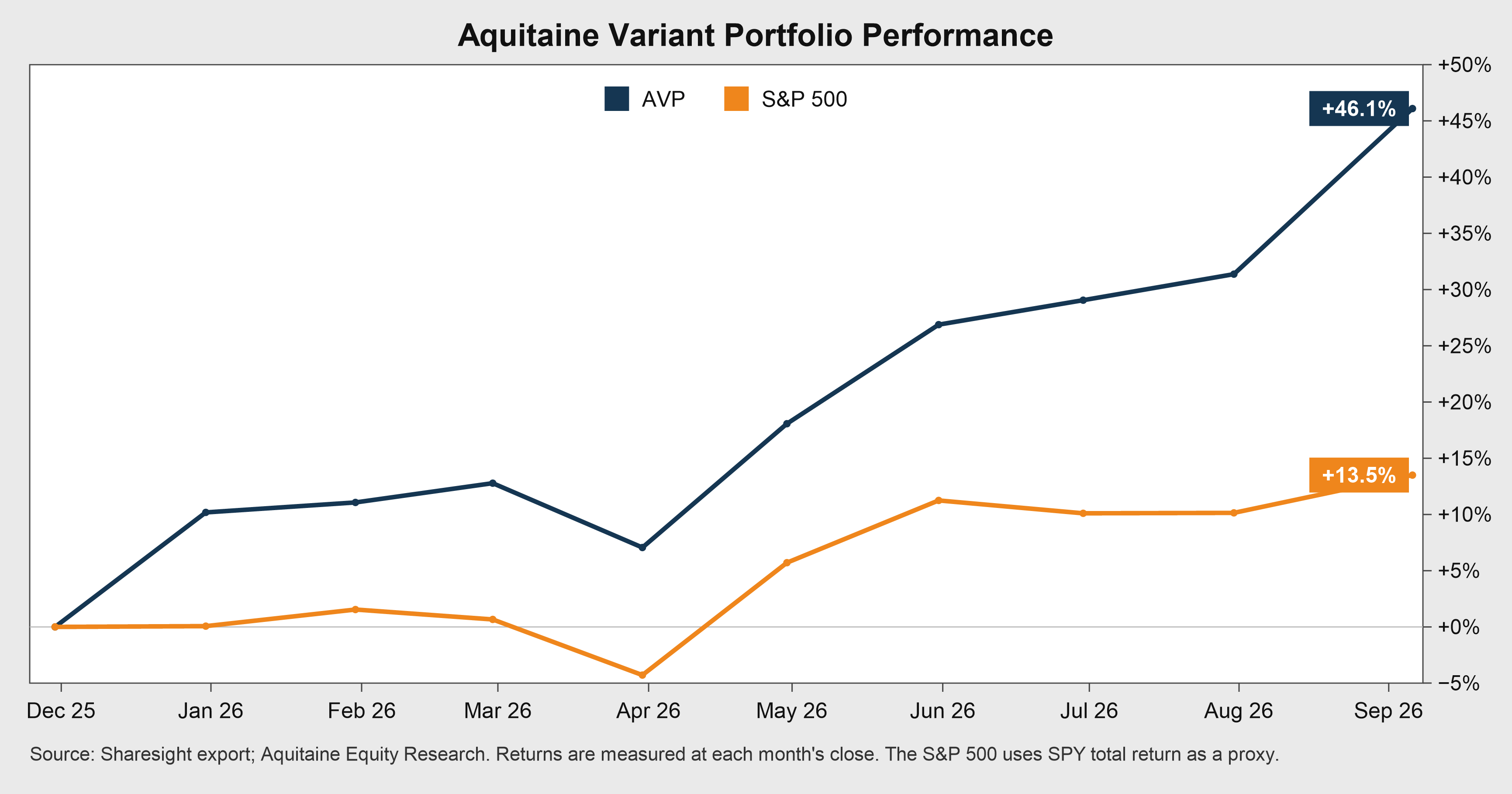
I don’t target a particular portfolio beta; I’m more interested in avoiding boring businesses than in seeking out volatile ones. Since inception the AVP has been roughly twice as volatile as SPY, 23.6% annualized against 12.3% on weekly returns, though most of that (at least so far) has been to the upside.
A Note on the Rename
For readers who were here before: the AVP was previously the Aquitaine Model Portfolio. “Model portfolio” is the language asset managers use for separately managed accounts, and although I said plainly that this was a scorecard rather than something to copy, the name invited that interpretation.
The performance record had a separate problem. It originally included Disney and Peloton, my first deep dives on Substack from 2024. When I stepped away from investing for roughly six months, I paused the benchmark alongside the portfolio, which produced an S&P 500 return that couldn’t be reconciled with the index’s actual performance over the period. Measuring each deep dive from its publication-date price was also an imperfect proxy, since my cost basis was meaningfully lower in both cases. Rather than keep patching the record, I restarted it on November 29, 2025, and took the old portfolio posts down to avoid a series of overlapping, partly outdated explanations.
Thanks for reading. If you enjoyed this post, a thumbs up or a share with your network really does help. In the weeks ahead I’ll be publishing short write-ups on each of the portfolio companies I haven’t yet covered. Paid subscribers receive the holdings, weights, cost bases, and advance notice of trades via subscriber chat. Through September 27, annual subscriptions are available at the anchor rate of 30% off, locked in for as long as you remain a subscriber.
Disclosure: Several of the securities discussed are held in accounts under my control. This is not investment advice. Readers are encouraged to conduct their own due diligence. Past performance is not indicative of future results.