

This isn’t the usual three-stocks-to-buy post, the kind thrown together over a weekend (or an afternoon) and barely skimming the surface. Each of these is the product of months of work, reduced to its essentials without – I hope – losing the substance.
Toast (TOST): $34/share • $20bn mcap • ~23× EV/EBIT (NTM)
Airbnb (ABNB): $117/share • $71bn mcap • ~21× EV/EBIT (NTM)
Match Group (MTCH): $33/share • $7.8bn mcap • ~11× EV/EBIT (NTM)
Let’s get into it.
Toast
I spend a lot of time listening to CEOs, and because I’m usually hunting for exceptional businesses at reasonable prices, they tend to be a high-caliber group. Even so, it’s rare that I stop and think: this one is exceptional. Toast’s co-founder and CEO, Aman Narang, is the most recent case, for reasons that reduce neatly to two. If I were a competitor, he’d be the CEO I’d least want to compete with; if I worked in the space, he’d be the CEO I’d most want to work for.
Founded in 2013, Toast runs a cloud-based technology platform for the restaurant industry, an all-in-one POS. Revenue has gone from under $1B pre-pandemic to around $6B today, with plenty of room ahead. The company turned profitable last year, should ultimately reach adj. EBITDA margins of 40% or more, and is projected to end 2025 with roughly $1.8 billion in net cash.
Most people (myself included, until recently) think of a POS as a fancy cash register. That was true once. As Aman frames it, it’s now better understood as a restaurant’s central nervous system, coordinating orders, payments, menus, staffing, inventory, online channels and customer data.
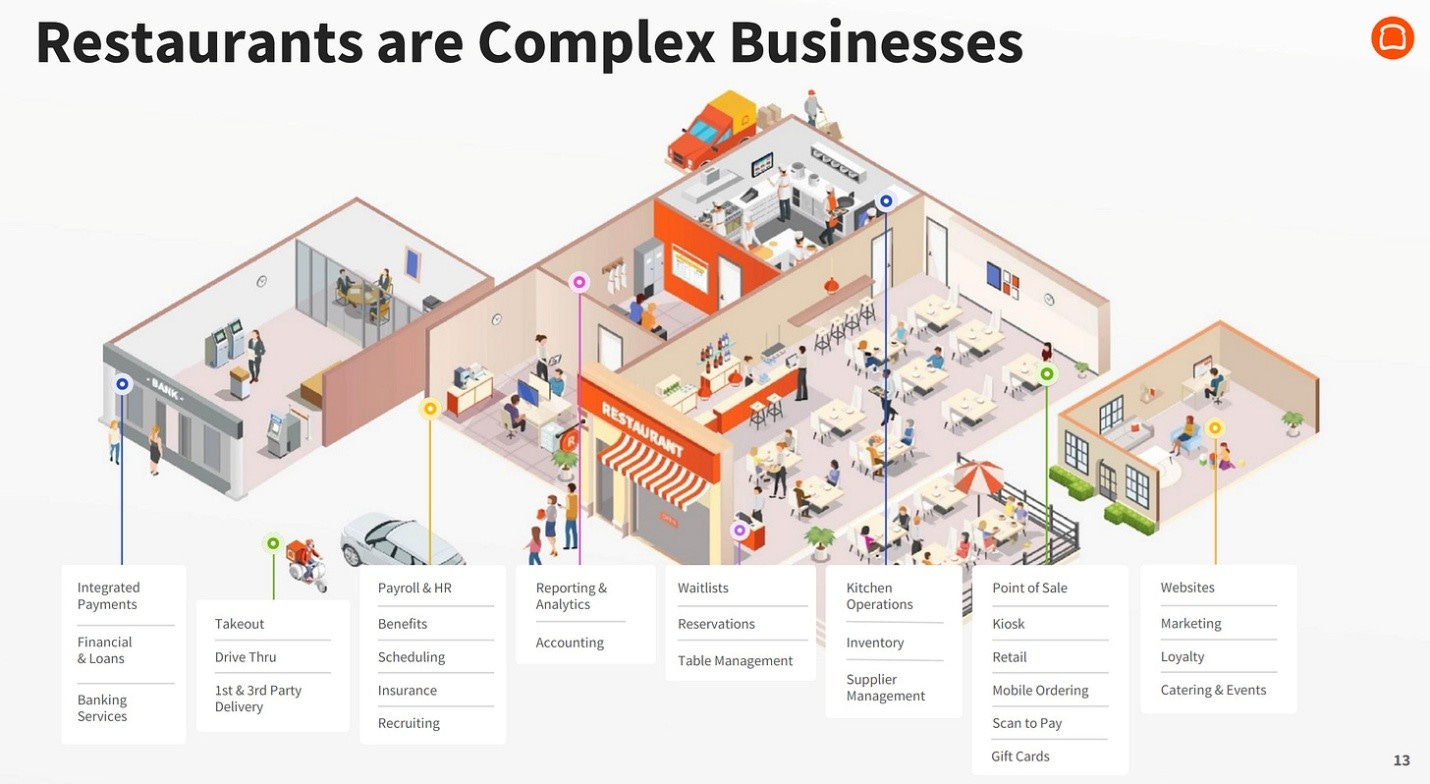
Toast now powers more than 150,000 restaurants across the U.S., primarily SMB and mid-market operators, including more than half of those with Michelin stars. As a keen observer of behavioral psychology, I’d sit with that social-proof effect for a moment. Suppose you’re opening your first restaurant and choosing between POS systems. You learn that most Michelin-starred kitchens in the country run Toast. Absent a materially lower price, what are the odds you pick one of the alternatives?
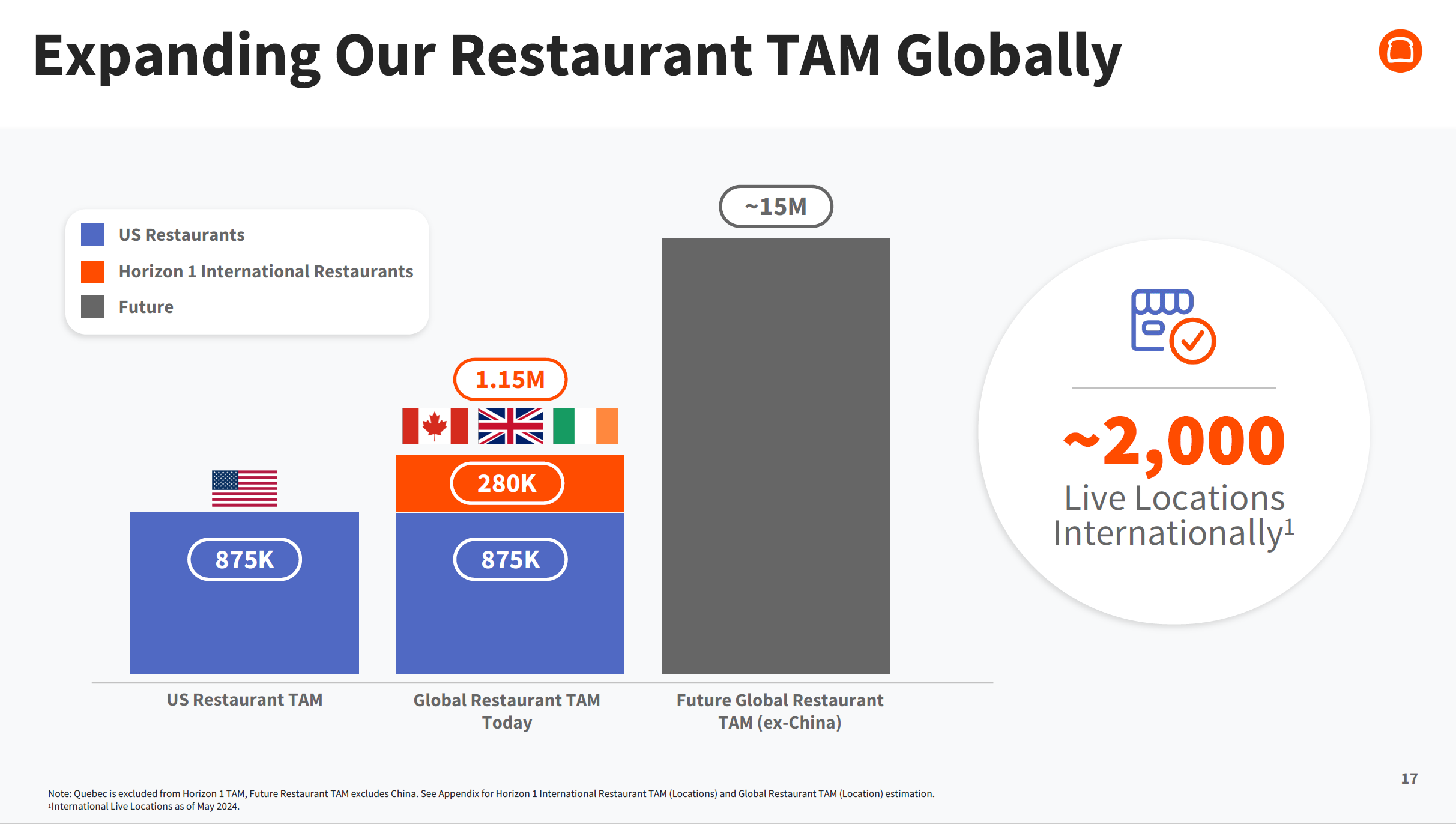
Several hundred thousand U.S. restaurants don’t yet use Toast, and the company has barely begun to scale internationally.
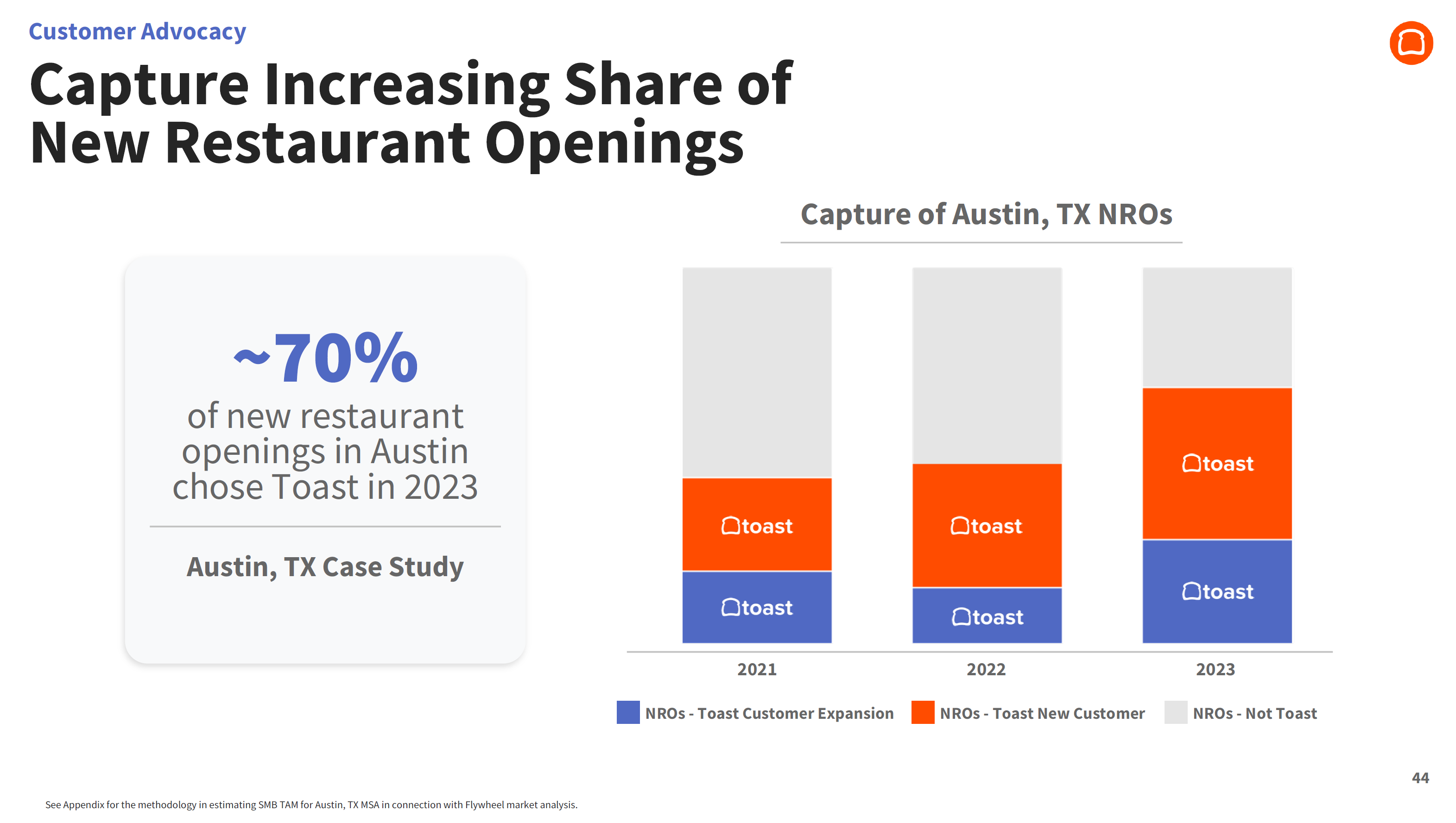
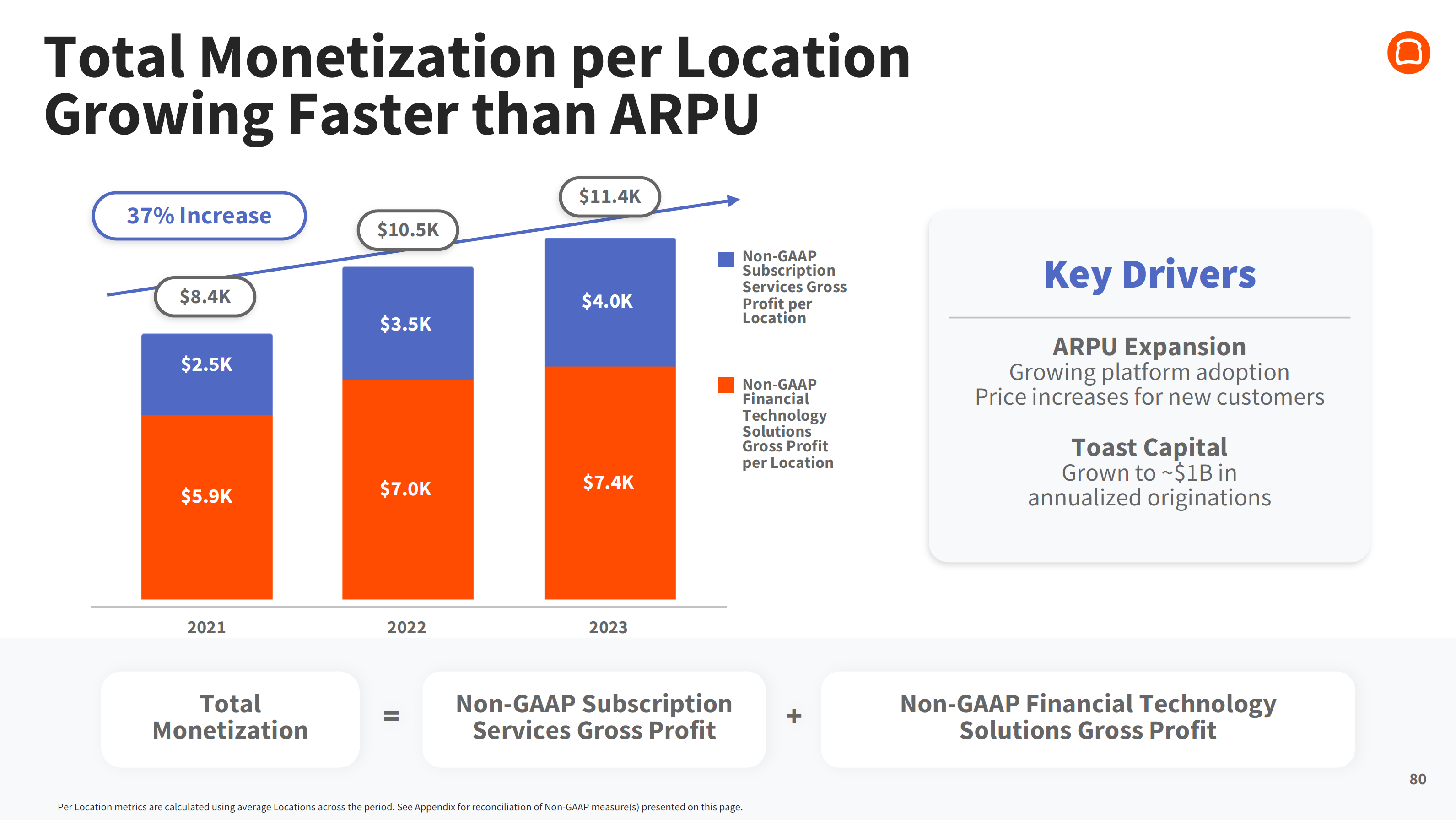
U.S. market share has more than doubled since 2021, from roughly 7% to more than 15%, an impressive climb given how sticky POS systems tend to be. (Replacing one has been compared to removing a root canal.) The national figure understates Toast’s strength in its most developed cities: in these “flywheel markets”, dense pockets of customers that amplify word-of-mouth, share often runs above 30%, with win rates and conversion meaningfully higher. In Cambridge, MA, where the company is based, Aman observed that “you’d think Toast is the only point of sale.” Its share of new openings runs higher still, and monetization per location has room to grow well beyond where it sits.
Nor is the TAM limited to restaurants. Management sees several adjacent retail categories where it believes it has a “right to win” – retail food and beverage is the notable example, still early, though traction so far has been strong – and argues that these adjacencies, together with the budding enterprise business, could eventually rival or exceed the core restaurant business.
Toast has its competitors playing catch-up, and I expect that dynamic to persist. I share management’s confidence in the growth ahead, in the core and across the emerging categories both. (In my experience, when you back exceptional CEOs at sensible valuations, the surprises tend to break your way.)
Valuation: Toast trades at 23× and 17× EV/EBIT for 2026/27 on consensus estimates, implying OI margins of ~10.5% and 12% and a 19% revenue CAGR. Assuming a stable macro backdrop, I expect the company to outperform on both growth and profitability, at 15–20% OI margins by 2027, which would put at least 40–50% upside on the table and plausibly a good deal more. The balance sheet supports continued repurchases, which limits the damage if the stock pulls back; unless the thesis changes, I’d treat a pullback as an opportunity.
Airbnb
“I keep telling people that one day this company is going to be huge - it’s going to have thousands of users.” - Brian Chesky, CEO and co-founder, recalling Airbnb’s early days.
Airbnb hardly needs an introduction. Its name is shorthand for the entire vacation-rental category, and a verb besides. (The recent marketing campaign leans into it: “Now you can Airbnb more than an Airbnb.”)
Revenue has doubled post-COVID, from ~$6B in 2021 to about $12B today, with ample runway ahead, OI margins around 22% and rising, and a fortress balance sheet carrying over $10B in net cash. The platform now has over 8 million active listings, roughly 4× Vrbo’s ~2 million, even after pruning some 450,000 lower-quality listings in recent years. Verb status, an installed base that size, and billions of reviews (roughly two-thirds of guests leave one) combine into one of the strongest moats in consumer tech, which is why ~90% of traffic arrives through direct or unpaid channels, far above Vrbo, Booking or Expedia. For the latter two, alternative accommodation remains an add-on rather than a core offering.
Most engagement has since shifted to the app, used on more than 1.6 billion devices each year, but search interest is the cleaner record of how the share war was settled.
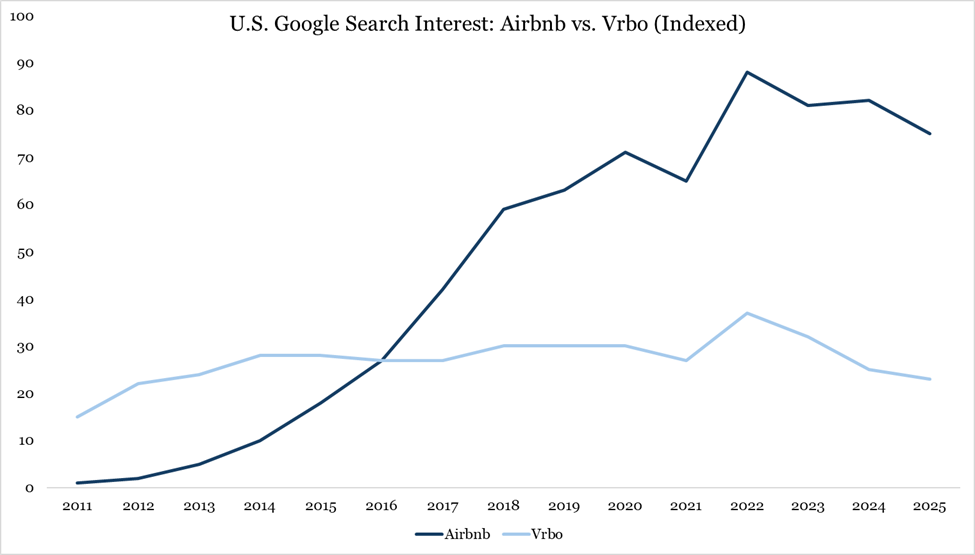
Airbnb operates in more than 220 countries and regions and over 100,000 cities. Yet its top five markets – the U.S., Canada, Australia, France and the U.K. – account for 70% of revenue. In the U.S., its most mature geography, it now accounts for roughly one in ten nights away from home: impressive, though not the existential threat to hotels many once feared. Hotels still dominate short, highly urban and one-night stays. For longer trips, and for families and groups, Airbnb’s value proposition is hard to beat: more shared space, kitchens, outdoor areas, privacy.
The international runway is the obvious part of the story. Less obvious, and in my view not priced in, is a plausible path to doubling share in mature markets. Four developments point that way.
1) Improved UI and reduced friction. Airbnb has addressed most of its persistent pain points around quality consistency, affordability and pricing opacity. New tools help hosts price more competitively, and the shift to a single-fee model, with no separate service or cleaning line items, makes the experience cleaner and far easier to compare against a hotel.
2) Co-hosting unlocking supply. Plenty of people with homes would like to host and don’t have the time; plenty of hosts would like to host more and don’t have the capital for another property. As Chesky put it, “We’re basically existing in a very narrow Venn diagram of people that have time to host and have a home.” Co-hosting widens that diagram, and since launching late last year has already generated more than 10 million booked nights.
3) Hotels to fill the inventory gap. A large share of travelers begin their search on Airbnb and defect when they can’t find a suitable home, particularly for short urban stays. To capture that spillover, Airbnb has begun listing boutique and independent hotels directly. On the latest earnings call, Chesky described his pitch to New York operators, in a market where Airbnb sees millions of searches:
“We believe that the majority of people who come to New York on Airbnb would be open to booking a hotel if there wasn’t a home available. Many of these people are subsequently opening other apps and booking hotels elsewhere. So, we said: if we added hotels, gave you a best-in-class commission, beautiful custom-built product pages, and brought you a lot of demand – often high-income, young American travelers, which are some of the most appealing consumer sets – would you be interested?”
The answer, unsurprisingly, was an enthusiastic yes.
4) Building the “Amazon for services.” The most consequential opportunity may sit outside homes entirely. Suppose you needed to book a photographer, a private chef or caterer, a makeup artist, an on-site massage therapist. Where would you start? Thumbtack and Angi handle discovery in parts of this market, but nothing combines identity verification, integrated payments and scheduling, pre-screened providers, standardized and searchable profiles, and – critically – trusted, platform-wide reviews. Airbnb has over 200 million verified IDs to build on. It launched Services earlier this year alongside a relaunch of Experiences; below are a few examples from Toronto, where I live, with the tasting menu a Service and the other two Experiences.
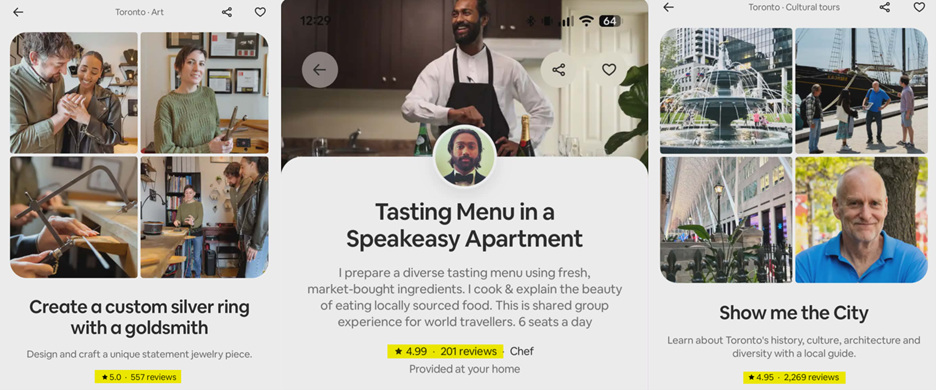
Experiences were relaunched because several frictions needed addressing: they were hard to find, poorly merchandised, and not integrated with social media. Discovery, at least, will no longer be an issue.
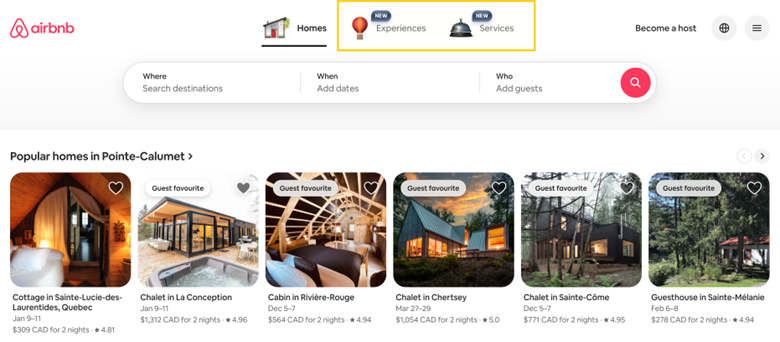
That placement is not risk-free. Putting Services and Experiences on an equal footing with Homes, Airbnb’s highest-margin and highest-volume category, may hit conversion and could frustrate hosts. Management is clearly confident the long-term upside outweighs the trade-off. (For what it’s worth, so am I.) Many guests wouldn’t think to book a chef, photographer or massage therapist when planning a trip, but when those options surface naturally in the booking flow, you’re prompting consideration at the moment the guest already has intent.
Experiences, conversely, are often explicitly searched for, so consolidating them in the same platform makes good sense. Early results support it: roughly 10% of bookings are coming from entirely new customers, and locals are engaging heavily, accounting for about 70% of Experience bookings in Paris, one of Airbnb’s largest markets.
Taken together, these should both expand the audience and make the platform stickier. As Chesky noted on the last call:
“We believe that services, experiences, and hotels could each be multi-billion-dollar businesses.”
Valuation: At ~$117/share as of this writing, Airbnb sits well below its all-time high and meaningfully under its ~5-year VWMA of ~$137, trading at about 21× EV/EBIT (NTM). Given the growth trajectory and expected margin expansion, that strikes me as very reasonable. Based on my work so far, I expect Airbnb to exceed earnings expectations in 2026/27, assuming a stable macro backdrop. Consensus implies a 2027 EV/EBIT multiple of ~17×; my base case is closer to 15×. Unless I’ve misread or overlooked something material, which as always is possible, I’d expect the stock to work its way into the $150–$200 range.
Match Group
“We need to improve the perception of the [online dating] category. And the way to do that is to prioritize user outcomes over short-term revenue and profit. That has not been the way this company has operated historically, and that’s been to our detriment.” – Spencer Rascoff, CEO, Match Group
It’s far more efficient to read transcripts, but I try to listen to as many earnings calls as I can, because the text alone leaves out a surprising amount of signal. Match is the clearest example I have of why that habit matters, and it also makes this the hardest of the three to capture persuasively in writing.
With more than 20 brands and roughly $3.5B in revenue, Match is the clear category leader in online dating, with operating margins around 25% and room to expand. Unlike the previous two ideas, it carries leverage: just under $3B in net debt, or roughly 2.3× adj. EBITDA. It owns two of the three major Western apps, Tinder and Hinge, with Bumble the third. Hinge is the growth engine; Tinder, the #1 dating app by downloads in more than 100 countries, is the cash cow with some brand baggage.
The category has been shrinking, or at best stagnating, for several years, though it remains the primary way people meet. The open question is whether the industry is structurally broken or simply overdue for a reset.
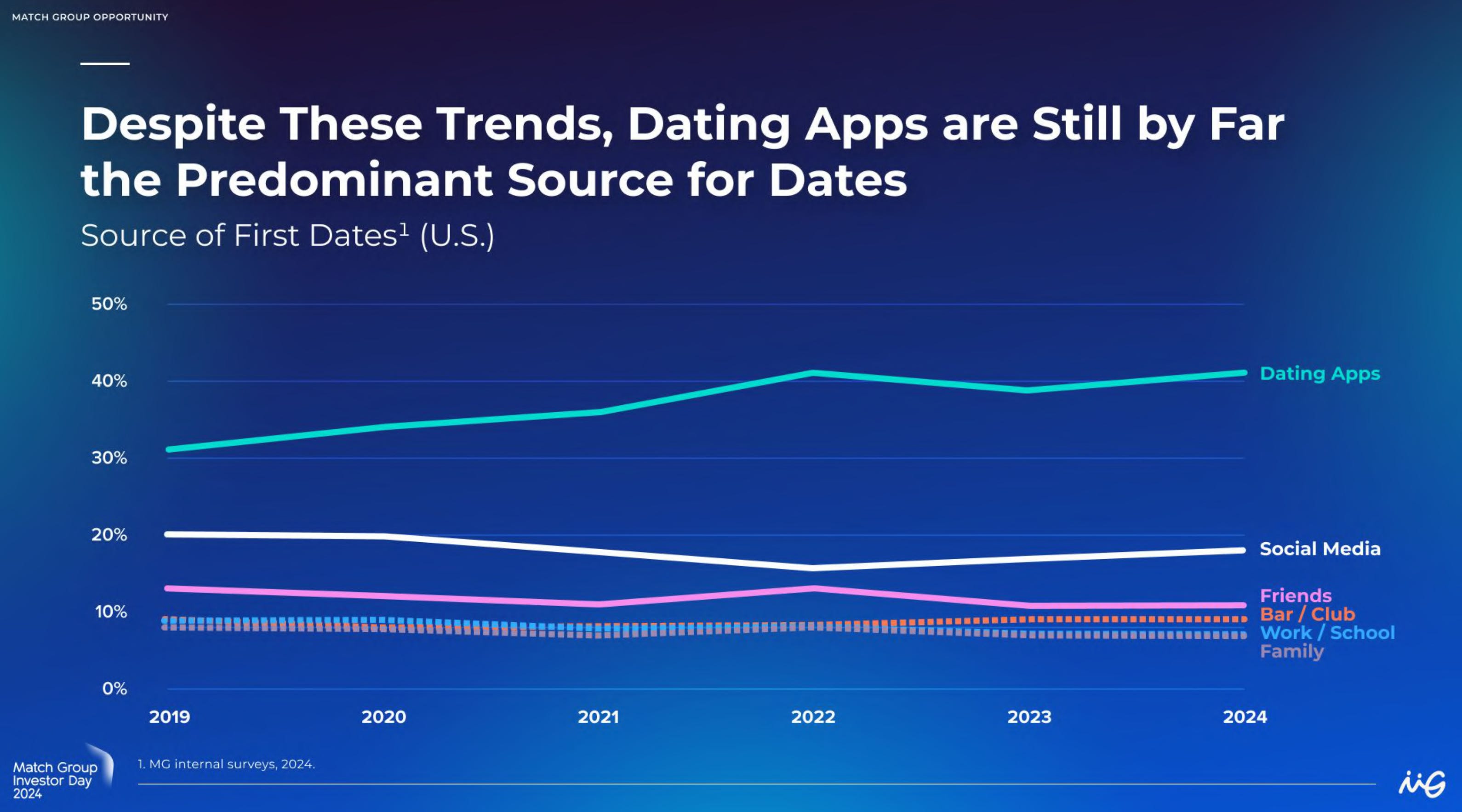
Only time will answer that. But one person who clearly believes it’s fixable (yes, you guessed it) is Match’s new CEO, Spencer Rascoff, who wouldn’t have taken the role if he thought otherwise. Spencer is the co-founder and longtime CEO of Zillow Group. Put differently: he doesn’t need the paycheck, and he wouldn’t have stepped in unless he believed he could engineer a turnaround.
I cannot overstate the contrast between Spencer and his predecessors, three CEOs since 2017. All were capable operators and, by all appearances, good people, but that doesn’t make someone a leader capable of inspiring thousands of employees to do their best work. Indeed, the contrast with his immediate predecessor is stark enough to call to mind Churchill and Chamberlain in 1940: only one was capable of rallying a nation in the face of overwhelming odds. (If you’ve listened to their respective earnings calls, you’ll know that isn’t hyperbole.)
Spencer joined the board in 2024 and became CEO in February 2025. His first priority was rebooting the culture, though he described it more forcefully as “shaking the company from a slumber.” Match, he noted, is a category roll-up spun out of IAC that never fully extracted the benefits of its combined scale; Zillow is successful in part because it did exactly that.
“When I got here 100 days ago, it was really run as 20 different companies. Each app basically as their own company with its own Head of Marketing, its own Head of Technology, its own Head of Engineering. And I’ve changed a lot of that, and I’ll continue to, because there are enormous synergies to be had by recognizing the combined power of Match Group.”
Ironically, that same independence is what allowed Hinge to thrive and maintain a “very impressive and distinctive company culture, with highly engaged employees,” as Spencer put it, in sharp contrast to Tinder.
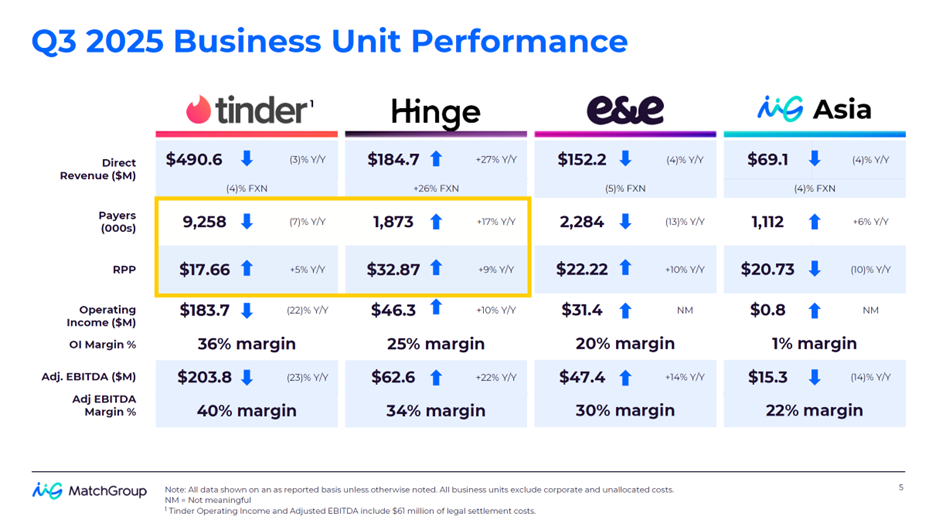
During his first quarter, Spencer reduced the workforce by 13%, including one in five managers, and was quick to emphasize that isn’t what he came to do:
“I know how to cut costs, but that’s not what gets me up in the morning. What gets me up in the morning is being a product innovator, and building cool stuff that drives user outcomes, that grows audience, that grows revenue. I’m a growth CEO.”
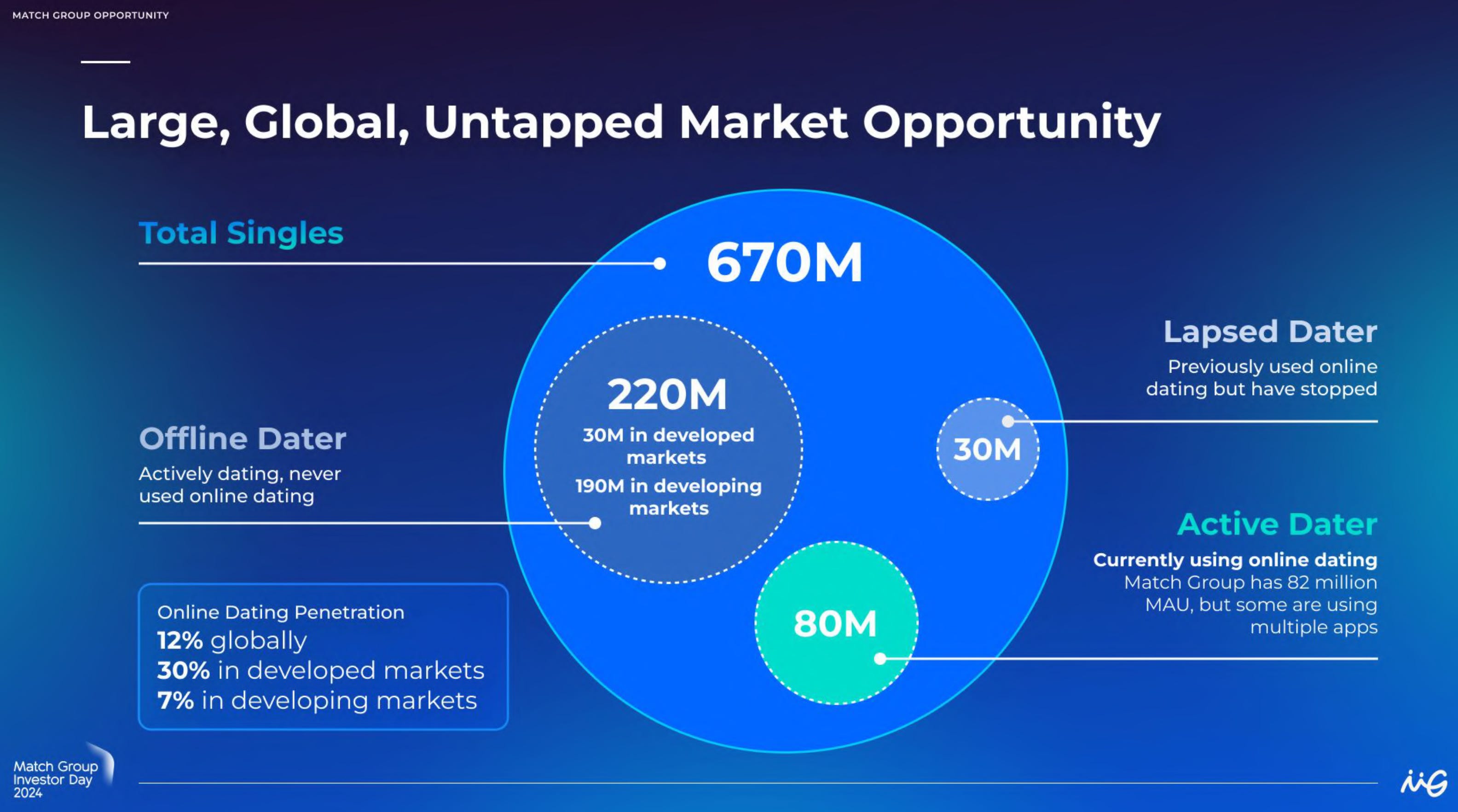
Recent data might make that comment sound out of sync with reality, as it might his remark that “I’m optimistic that one day we’ll look back and see the TAM in online dating was much larger than any of us expected.” But 220 million people who are actively dating and have never used an app is a large number to write off as a structurally dead category, and the bulk of them sit in developing markets where penetration runs in the single digits.
Conventional wisdom frames the online-dating model as a paradox: the better the product is at making the right matches, the faster it loses its customers, and the worse that is for revenue. Hinge, which dominates the “intentioned” category, is the useful counterexample. Its success comes from a precise understanding of the job it exists to solve, which is to be the last dating app you’ll ever need. It is, literally, “designed to be deleted.” That mindset is now being pushed across Tinder and the rest of the portfolio. I won’t unpack every recent feature here, though I’m optimistic about several, but the company is plainly operating with renewed urgency:
“By many measures, such as code commits or experiments that we have in-flight, we’re operating at about twice the pace as we were just a couple of quarters ago.”
I expect the products to keep improving and resonating more with users, and the perception of the category to gradually recover. As the category leader, Match has outsized influence in making that happen.
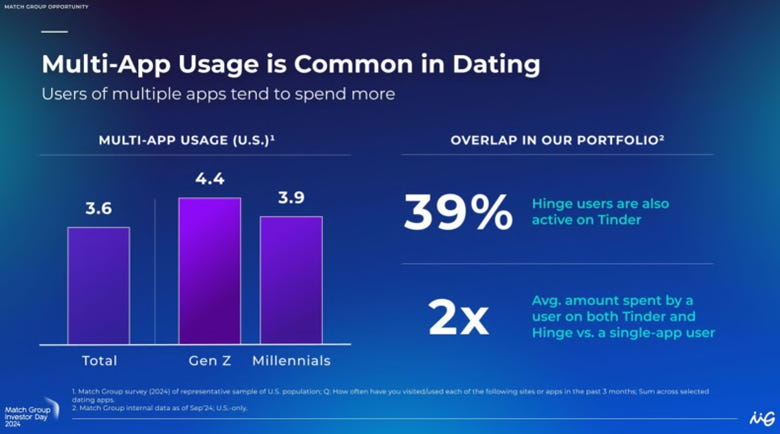
Match also holds the best competitive hand. Its primary challenger, Bumble, is also in turnaround mode, is roughly a quarter of the size, and in my view is far less likely to land the plane. The more interesting threat comes from social-media giants like Facebook, which launched its dating product in 2019 with one simple advantage: it’s free. It now claims 21 million daily users, the vast majority over 30. That’s worth monitoring, but it may sound more ominous than it is, given that dating is, and always has been, a multi-app category.
Extrapolating recent trends here would be unwise, particularly given the scale of the internal changes Match has undergone.
Valuation: Match trades at roughly 11× EV/EBIT (NTM). If the company can maintain momentum at Hinge, which still has substantial international runway, and simply stop the bleeding at Tinder, I’d expect the multiple to re-rate closer to 13–14×, roughly the three-year average. If Tinder can return to even modest growth, 15× or higher is plausible. The upside significantly outweighs the downside over the next 12–24 months, absent a fundamental change to the thesis.
If you enjoyed this post, a quick thumbs-up – or a share with your network – goes a long way. Until next time.
Disclosure: I and/or accounts under my control hold positions in the securities discussed. This is not investment advice. Readers are encouraged to conduct their own due diligence. Some quotes were lightly edited for clarity and relevance.
Based on your write-ups alone and no additional research done on my side, I'd choose Match. I love the network effects in TOST, but it is richly priced and their client base must attrit a lot... restaurants are crappy clients to have, even if new restaurants replace the old ones and toast earns new clients as a result. Why pay up for a good business whose clients are typically very bad businesses? Match, at least, has the benefit of being cheap, despite being in turnaround mode. And, if things get very bad, they can close, or merge, either Hinge or Tinder, creating operational flexibility if paying users decline.
I bought 10 of each... Let's go!!