

There have been many names floated as potential successors to Jensen Huang, following his resignation last week. Since then, I have thought about almost nothing else, and the conclusion I’ve reached is that only one of them is a real choice: Rene Haas (whom the board has already approached, according to the Financial Times). Whether he can and would take the job, if offered, is another matter.
There is, however, another compelling candidate – another outsider, and one who I believe could be just as good – whose name has (at least so far) not come up in discussions. What’s more, it would be far easier for him than for Haas to accept the job, and to start it soon. We’ll return to these two in due course.
But first, let’s look at the problems with promoting any of the top internal candidates.
“A Dramatic Shake-Up”
You need look no further than Tim Cook, Satya Nadella, and Sundar Pichai to see that the promote-from-within playbook has served Big Tech well. Add Nvidia’s deep bench of talent, and it’s entirely understandable why many think the board should run that play again. But I doubt it will (and don’t think it should), for two reasons.
The first and main reason comes from none other than the US Treasury Secretary himself. On Sunday, Scott Bessent told Fox News that Nvidia’s board needs to “go outside the company” for its next chief executive, and that the company needs “a dramatic shake-up.”
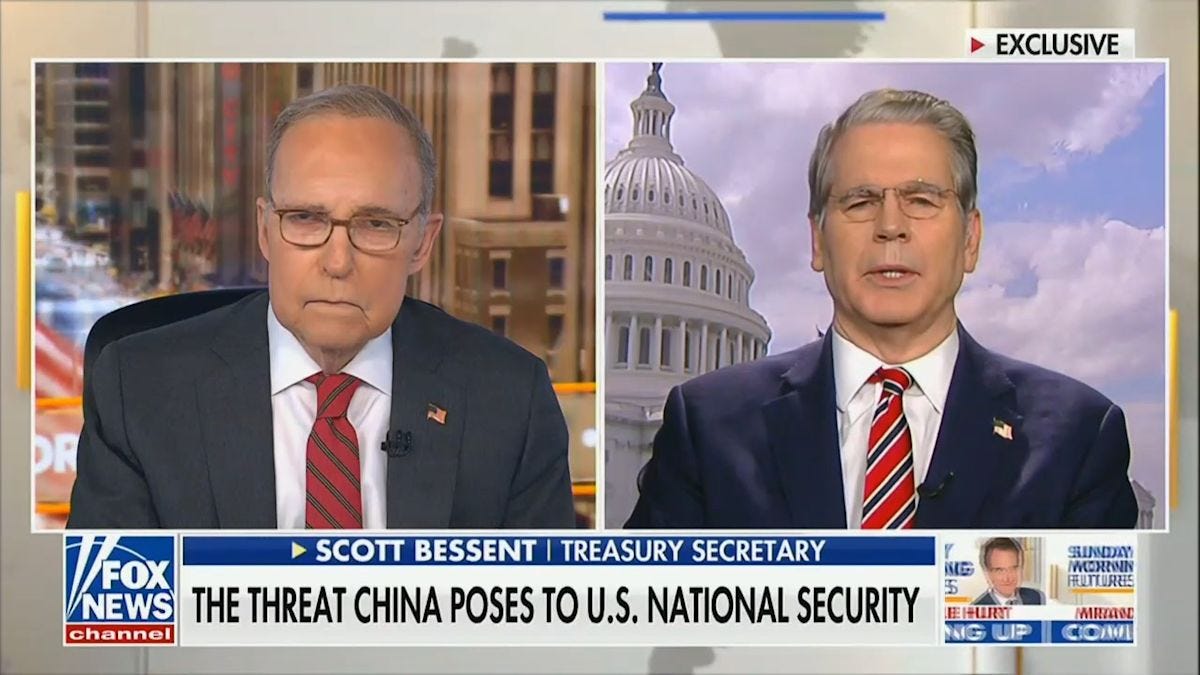
He also had some pointed questions, as reported by the Financial Times:
“Was it a low-level fail? Was it in the middle, or was it up in the C-suite? And who knew? These shell companies were obvious, they were being investigated, and did Nvidia use them as a workaround to sell chips to the Chinese?”
The best known of these shell companies is Singapore-based Megaspeed, set up by Alice Huang (the so-called “Chinese spy”), with whom Jensen has acknowledged having an affair. According to The New York Times, US intelligence agencies concluded that she was passing information to Beijing, a finding Nvidia and China dispute. (Whether that makes her a “spy” or an “intelligence asset” seems to be a distinction without a difference.)

(I mean, judging by the lobby, it looks pretty legit to me?)
So what was it about Megaspeed that so obviously said “shell company” – at least to the Treasury Secretary? When The Times went looking in October 2025, it found two employees in that office on a weekday, an owner registered at an accounting firm, and a Malaysian affiliate whose listed address was a dilapidated storefront outside Kuala Lumpur.
That Malaysian affiliate bought at least $4.8 billion of equipment built on Nvidia chips from June 2024 to February 2026, and Nvidia kept doing business with it even after The Times reported that Megaspeed was under investigation. In other words, the optics aren’t great (and the reality probably isn’t any better). Until the investigations are over, I don’t see any insider as a viable choice – fairly or not.
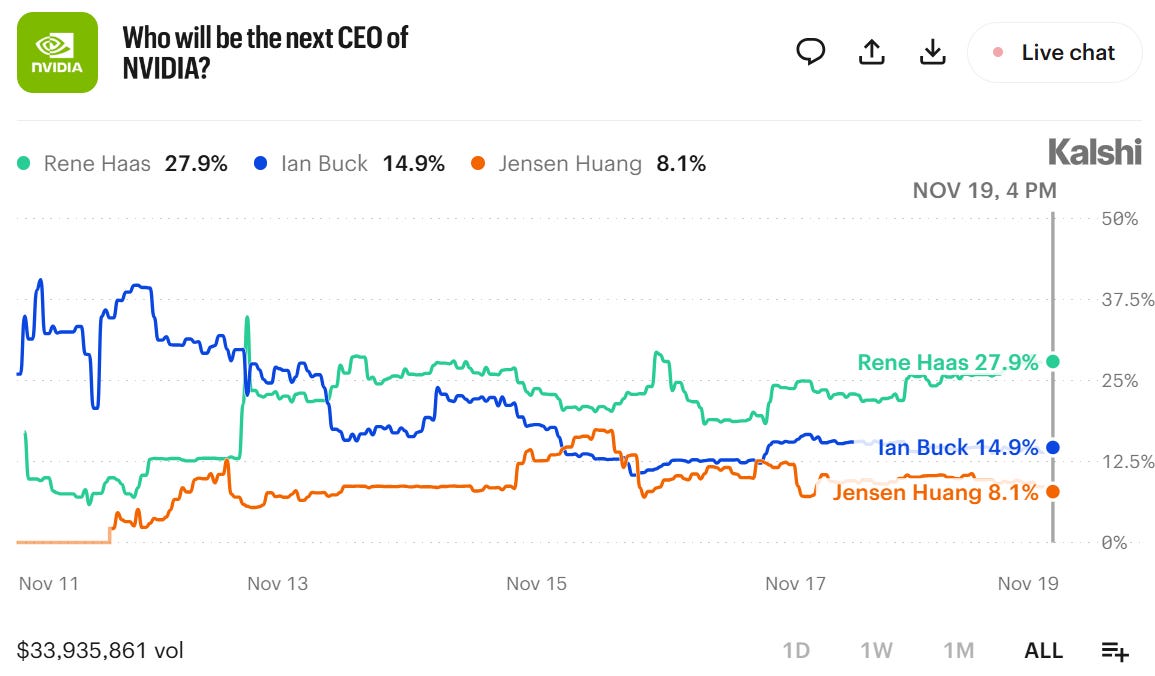
Prediction markets are less sure. On Kalshi, the internal names together carry odds of about 31%. Ian Buck, Nvidia’s VP of hyperscale and high-performance computing, is second at 15%, behind Haas at 28%. Next comes Jensen himself at 8%, just ahead of Colette Kress, the CFO and interim CEO.
One can sympathize with the many investors and employees who want Jensen back. As the VC Rory O’Driscoll said:
“Let me make a clear statement: If I had 100% of the stock of this company, in the absence of the U.S. government trying to put my CEO in prison, the person on the planet I would most want to run this company is Jensen.”
But between the alleged chip smuggling, the affair with Alice Huang (which he at first insisted, including to Nvidia’s general counsel, was nothing unusual), and a second affair with a direct report (an obvious conflict of interest), it’s hard to see what else the board could have done. And with Democrats now running both houses, it would seem Jensen’s time in Washington’s spotlight is only beginning.
Given all this, the quickest path back to some semblance of normalcy is to hire from outside.
Too Complicated for an Outsider?
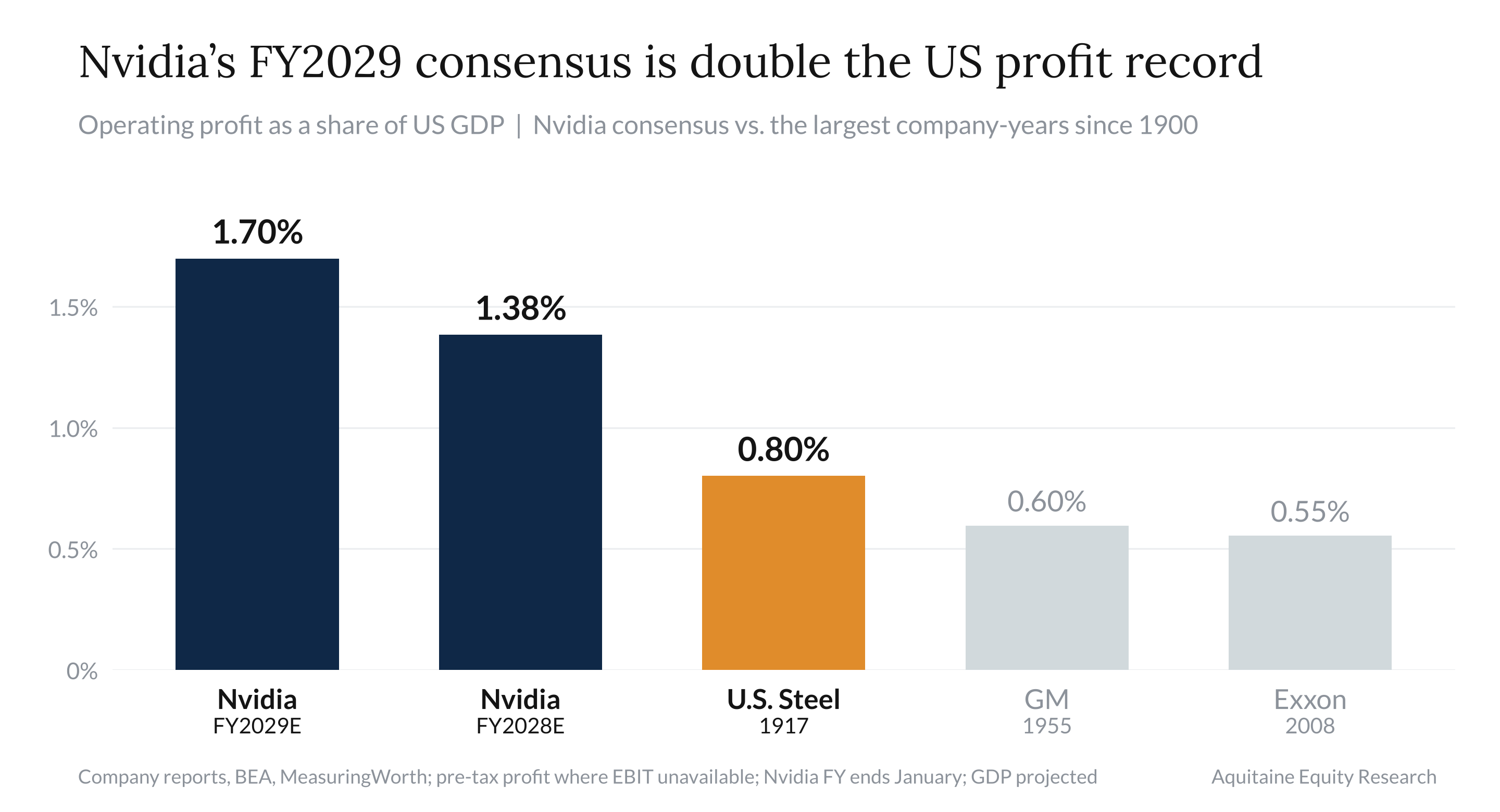
Whoever takes over will inherit something remarkable. Jensen is without a doubt one of the greatest entrepreneurs in history, and measured by profit alone, he’s on track to be without equal. If consensus is right, Nvidia’s operating profit will reach about 1.7% of US GDP in 2028 (FY29) – more than double the record U.S. Steel set in 1917:
One wouldn’t expect the greatest money-printing machine in corporate history to be simple to run, and Jeff Bezos, for one, doesn’t think an outsider should try:
“Hire internally. Like if [they’re] not going to, if [they] don’t bring Jensen back, I would not hire an outsider. Nvidia is too complicated. I think outside CEOs in a complex company have a vanishingly small chance of succeeding. And so I would always think that’s a last resort.”
And it isn’t just that Nvidia is big and complex. It’s that the company was built in a way uniquely suited to Jensen. As Ben Thompson put it:
“Nvidia’s most important moat, however, was the degree to which it was not a normal company. Huang organized Nvidia as an exoskeleton around one man: himself. There is very little management at Nvidia — Huang famously has 60 direct reports — for the same reason that there was no succession plan: Nvidia could move so quickly and so aggressively because the company still behaved as if it were a startup.
Indeed, lots of established companies — including those still led by founders — claim to still be a startup, but only one, Nvidia, really was organized that way. That paid off with all of those successful bets; it also created an environment where there were no checks on Huang. And, now that he is gone, the exoskeleton is much more poised to collapse than you might expect.”
I take both points, but I respectfully disagree in this case, considering the caliber of the top outside candidates. And the exoskeleton cuts both ways: with 60 direct reports and little management in between, no insider has had to run anything close to the whole company.
That brings me to the second reason: the candidates themselves. Over the past week, I’ve listened to many hours of interviews with each of the leading candidates, inside the company and out, so what follows is more than a hunch – though it’s still just my impression.
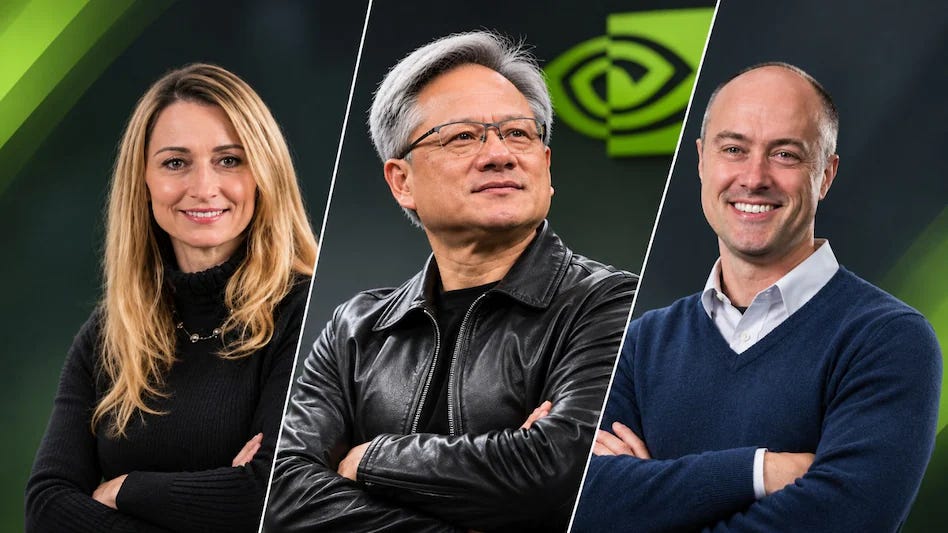
Colette Kress. She’s widely regarded as one of the best CFOs around, but she isn’t a technologist, and for the permanent job I think that’s disqualifying.
Ian Buck. Unlike Kress, Buck clearly has the technical prowess for the job (he created CUDA, after all), and he’s a likable guy. But my impression is that he doesn’t yet have the poise this moment demands. (Neither do I, for the record.) Tuesday’s earnings call didn’t change my mind. Buck joined for the Q&A, which some took as a sign he’s in the running. But after Kress mentioned he was available, we didn’t hear from him again. If Kress thought Buck might soon be her boss, I suspect she’d have invited him to add his thoughts at least once.
I’d want both of them to stay – just not in the top job. Nvidia has been remarkably good at holding on to its senior people (as the SemiAnalysis crew pointed out last week, Haas is about the only one who ever left to run something else), and keeping it that way should be high on the next CEO’s list.
No Time to Take a Risk
Whoever takes over has to steady employees, customers, and investors, field Wall Street’s questions every quarter, and negotiate deals worth tens of billions of dollars with the likes of TSMC and the hyperscalers – all while Washington watches. The board needs someone it can bank on to do all of that with confidence from day one.
That’s also why I’d pass on some of the other outsiders whose names have come up. Apple’s Johny Srouji (6% on Kalshi) and Broadcom’s Charlie Kawwas are both highly accomplished, but I’m not sure either is the right fit for Nvidia, and neither has run a public company. Going from there to running one of the largest companies in the world, from the outside, is quite a leap – especially when there are exceptional candidates who have done it before. Palo Alto Networks’ Nikesh Arora (3%) is a different case. He has been a highly successful CEO since 2018, and he’s confident and personable. But personality-wise, I don’t think he’s quite the right fit for Nvidia.
Which leaves two.
The Frontrunner
Rene Haas ran a business inside Nvidia for seven years before joining Arm in 2013, and he has led Arm as a public company since its 2023 IPO. In other words, he knows exactly what he’d be walking into, and Wall Street already knows him.
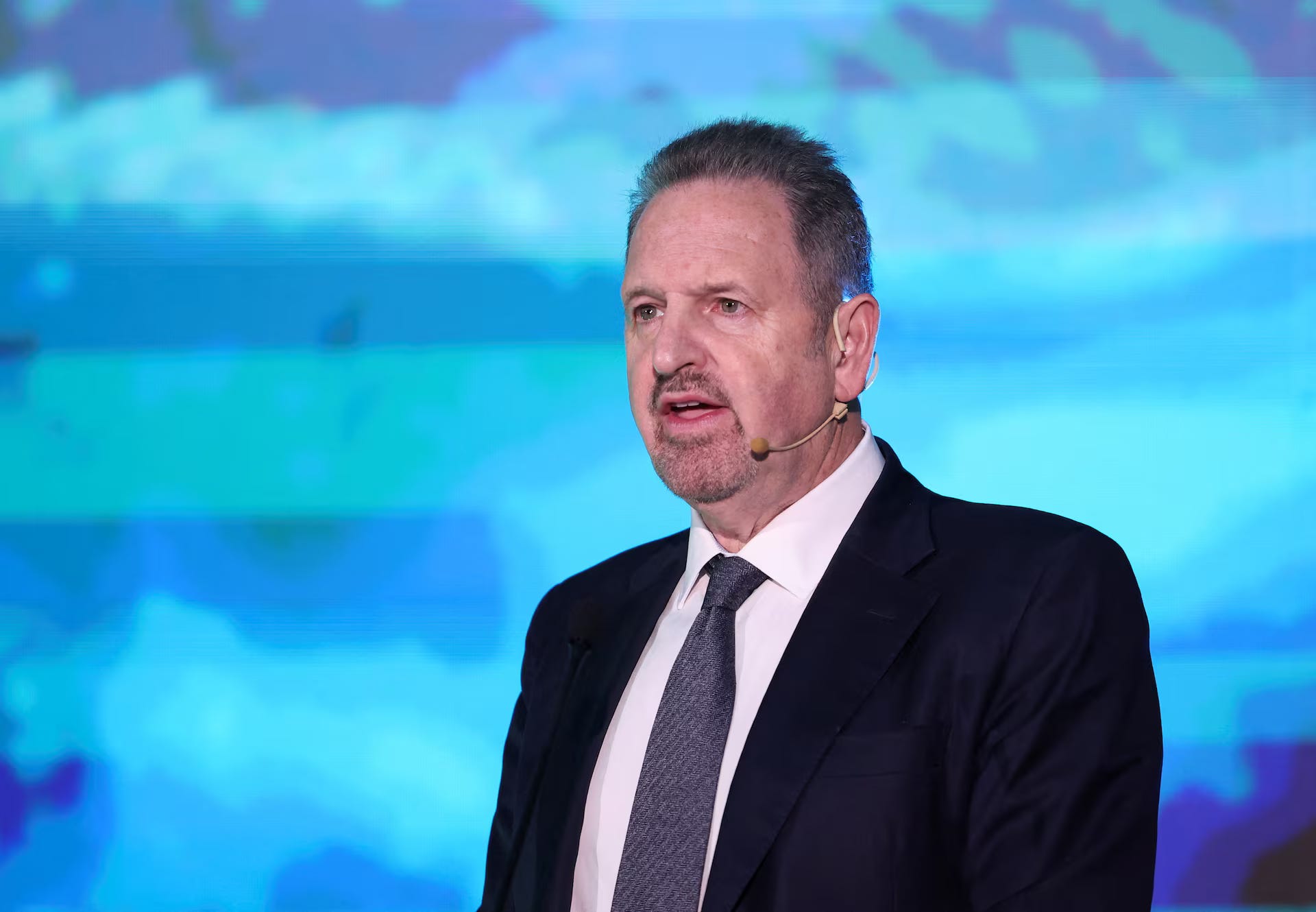
Asked what he had tried to emulate from his old boss, Haas said:
“There are so many things that Jensen does that totally resonate with me in terms of the leadership and the intellectual honesty and speed. But we’re very different, you know, we’re very different individuals in terms of how we operate. I would say I’m probably more of someone who gets everyone’s voices, you know, into the room as opposed to dominating the room in a way that maybe he does personality-wise.”
I suspect that’s exactly what Nvidia needs after Jensen: not someone to step into the exoskeleton, but someone to build a more conventional company around what he leaves behind. Haas is obviously brilliant, and people like working for him. Most importantly, he has the poise and decisiveness a job this visible requires. He’s also an engaging, confident speaker – not as electrifying as Jensen on stage at GTC, but very good, even by Fortune 500 standards.
The harder question is whether he would come. In April, SoftBank made him CEO of SoftBank Group International as well, and Arm has lined up a pay package worth up to $800 million if he multiplies its value several times over. And since SoftBank owns 86% of Arm, prying him loose probably means persuading Masayoshi Son as well as Haas.
The Dark Horse
Which brings us to the name nobody has mentioned. On November 2, Marvell (MRVL) agreed to buy Lumentum (LITE) in an all-stock deal due to close in the first half of 2028. Marvell’s Matt Murphy will run the combined company, and Lumentum’s CEO, Michael Hurlston, gets a board seat. I think Murphy is great, and Nvidia would be in good hands under him (Kalshi gives him about an 8% chance). But he has just committed to running the combined company. Hurlston, on the other hand, will soon be without a day job (assuming the deal closes).

I should declare an interest. Lumentum has been a core holding in the Aquitaine Variant Portfolio since July, and Hurlston is a large part of the reason. I consider him a truly phenomenal CEO, and if I had to choose between him and Murphy for Nvidia, I’d pick Hurlston.
Hurlston has run three public companies (Finisar, Synaptics, and Lumentum), and he’s calm, collected, and charismatic on a stage. Nvidia has also seen him across the negotiating table: in March, it put $2 billion into Lumentum and signed a multibillion-dollar supply agreement. And he could start soon. His contract lets him leave “at any time with or without cause or notice,” and in 2025 he resigned from Synaptics on a Monday and started at Lumentum that Friday.
I’ve seen no reporting that connects Hurlston to the search. But if Nvidia’s board isn’t already considering him, it ought to be.
At ~$146, the Name Is the Trade
“I can’t believe that this company hasn’t been nuked 50% yet. I think the market is wrong here. I think Nvidia is toast … Maybe I’m gonna look like an idiot saying this, but I can’t believe it’s not down more.” – Ben Carlson
Nvidia closed at ~$146 today, down from ~$158 when Carlson said that – despite the beat and raise that followed – so he certainly doesn’t look like an idiot.
Still, I believe all the bad news is more than priced in at these levels (though it could get worse before it gets better). More importantly, I think Haas and Hurlston stand the best chance of keeping Nvidia’s top team together and getting the company back on track. If either is named CEO, I’ll be buying aggressively. The same goes for Murphy, if to a somewhat lesser extent. For anyone else, I’m not so sure.
Thanks for reading. If you found this helpful, a thumbs-up would be greatly appreciated, and if you have any comments, I’d love to hear them.