

“People are crazy and emotional. They buy and sell things in an emotional way, not in a logical way, and that’s the only reason why we have any opportunity … So, if you have a way to value businesses that’s disciplined and makes sense, you should be able to take advantage of other people’s emotions.” - Joel Greenblatt
Less than a year ago, in December 2024, Jim Cramer told Lululemon CEO Calvin McDonald that he thought the company was “the best story out there in retail right now.” He added:
“Everyone I talk to says China is a disaster; there’s no selling. Everybody tells me there’s no such thing as new; it’s all old. Everybody tells me it’s the most promotional Christmas in history; you have no promotions, you have newness, and you’re doing well in China. What are you doing right that the others are doing wrong?”
It’s remarkable how quickly sentiment can flip. If Cramer’s starry-eyed tone didn’t already give it away, Lululemon was—until very recently—the crown jewel of the apparel category.
Over the past decade, the company compounded revenue at roughly ~19% annually, despite already being a multibillion-dollar business at the outset. More impressive still, it did so while sustaining ~20.5% operating margins—more than twice the peer-group average of ~8% (Nike, Adidas, Under Armour, Puma). Businesses don’t produce numbers like that at scale without a moat of real depth.
The prevailing view today, however, is that the moat has drained. Even after a roughly 65% drawdown from its peak less than two years ago, short interest remains at a multi-year high of 6.2%. That might make sense if Lululemon were truly “running out of gas and it’s not fixable,” as one analyst claimed. The evidence, though, points elsewhere.
The bear case centers on falling U.S. comps, heavier discounting, and “hot” challenger brands nibbling at the edges. These are fair concerns—but context matters. The recent declines (–2% and –4% in Q1 and Q2, versus 0% and –3% a year earlier) come on the heels of a decade of near-uninterrupted hypergrowth. They also appear more symptomatic of internal complacency than external defeat—a lapse management has acknowledged. As McDonald said:
“I now believe we have let our product life cycles run too long. We have become too predictable within our casual offerings and missed opportunities to create new trends.”
Given the company’s extraordinary run, it’s hard to fault them for sticking with a winning formula a little too long. (Most of us would have done the same.)
These declines also occurred against a softer category backdrop. “Consumers are spending less on apparel overall, spending less in performance activewear, and are being more selective in their purchases,” McDonald explained. Yet even then, Lululemon continued to gain share within premium activewear in both Q1 and Q2—just as it did in Q2 and Q3 of 2024, when comps were also slightly negative.
So while there’s clearly work to do, the notion that Lululemon is “broken” doesn’t hold up. Even a director at athleisure “disruptor” Vuori dismissed the claim outright: “I think the argument that they are getting stale is not a valid one.”1 An executive at competitor Fabletics agreed: “As a millennial myself, I don’t think Lululemon is getting stale.”2
Timing matters, too. Much of the current assortment still reflects the tail end of the former Chief Product Officer’s work, given an 18 to 24-month design cycle. The first full season shaped by the new creative director—and by Lululemon’s revamped design and merchandising model—won’t arrive until Spring 2026.
And by McDonald’s account, this design team—comprised of both seasoned and newly hired design leads—is “the best that we’ve ever had in the history of this organization.”3 If that’s even directionally true, and my research strongly suggests it is, then declaring the brand finished seems premature at best.
The question, then, isn’t whether Lululemon can course-correct, but whether it will. And if you’ve read this far, you can probably guess where I land on that question. Even if the recovery takes longer than investors might like, today’s valuation offers ample margin of safety for those willing to wait.
That margin already prices in the usual anxieties: fiercer competition, “dupes,” shifting style trends, Gen-Z fickleness, tariffs, and macro uncertainty. We’ll return to each in due course.
But before we dive in, a little historical perspective:
Jim Cramer, September 2016: “Should we be worried about Lululemon here, given the recent heinous action in the stock and the constant worry of the analyst community that athleisure has peaked?”
Professor Aswath Damodaran, April 2019: “I’d bet on Levi’s over something like a Lululemon, which will be a distant memory. The problem with brands today is that they build up really fast and don’t have roots. And millennial consumers don’t have loyalty.” (Notably, Damodaran said this despite Lululemon already being 20 years old—with a customer base among the most loyal in the industry.)
Investor anxieties, in other words, are rarely a reliable predictor of what happens next.
Thesis Overview
Highly profitable. Lululemon’s operating margins remain exceptional—roughly 16 points higher than peers—reflecting a business model that converts growth into profit with unusual consistency. (The company is also strikingly frugal for one so profitable—a rare and underappreciated trait, and not a coincidence.)
Store productivity. Despite industry-leading digital penetration among scaled players (~44%), stores generate nearly $1,600 per square foot—about four times the mall average.
Loyal, resilient customer base. Lululemon’s customers are exceptionally sticky. “Ninety-two percent of our loyal guests continue to shop with us year in and year out,” McDonald said in 2019. “I’ve never seen another [apparel] brand with that type of engagement.” They also skew more affluent and are therefore less exposed to economic shocks. Even in the depths of the 2009 financial crisis, operating margins held at 19%.
Marketing leverage. Lululemon’s stores double as brand billboards. Combined with strong brand equity, this allows the company to maintain marketing spend well below peers—a structural advantage that compounds returns and frees up capital for reinvestment elsewhere.
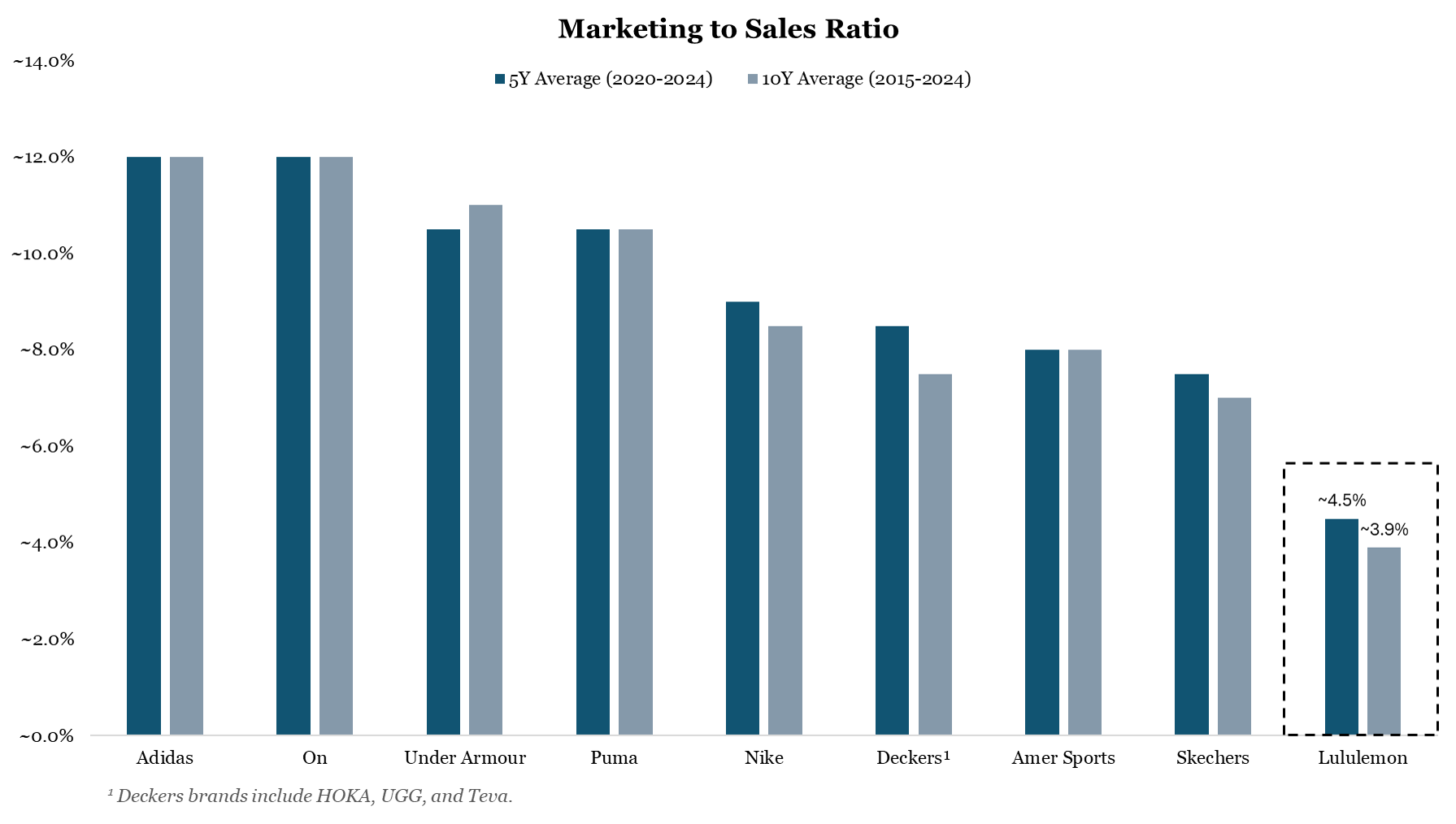
R&D edge and the flywheel. Product innovation is one of those reinvestment areas, where Lululemon invests more heavily than most. Continuous improvements sustain premium pricing and repeat purchases, which in turn fund further innovation—a self-reinforcing loop that strengthens the brand over time.
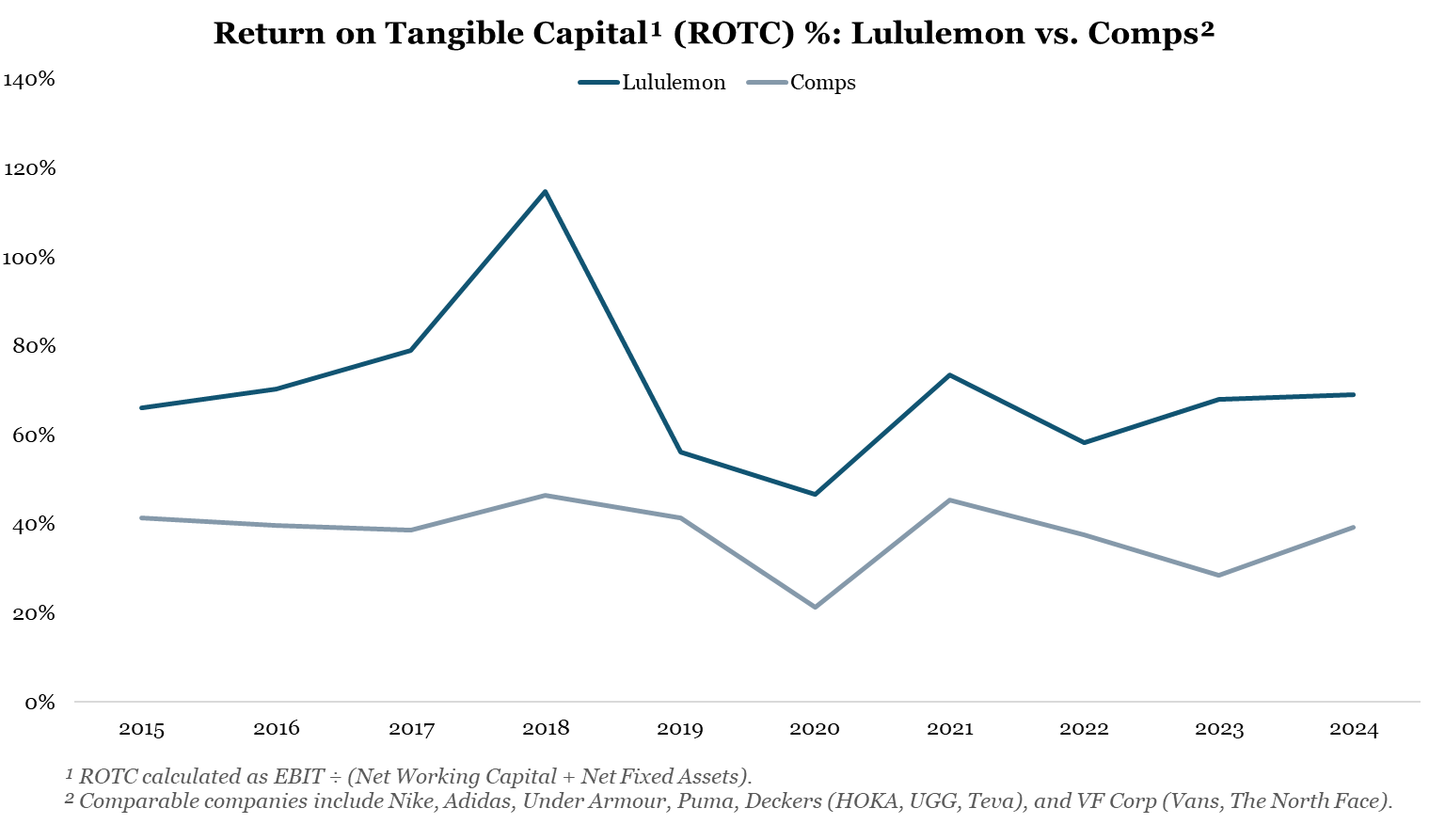
Extraordinary economics. These forces together produce exceptional returns on tangible capital, far above industry norms.
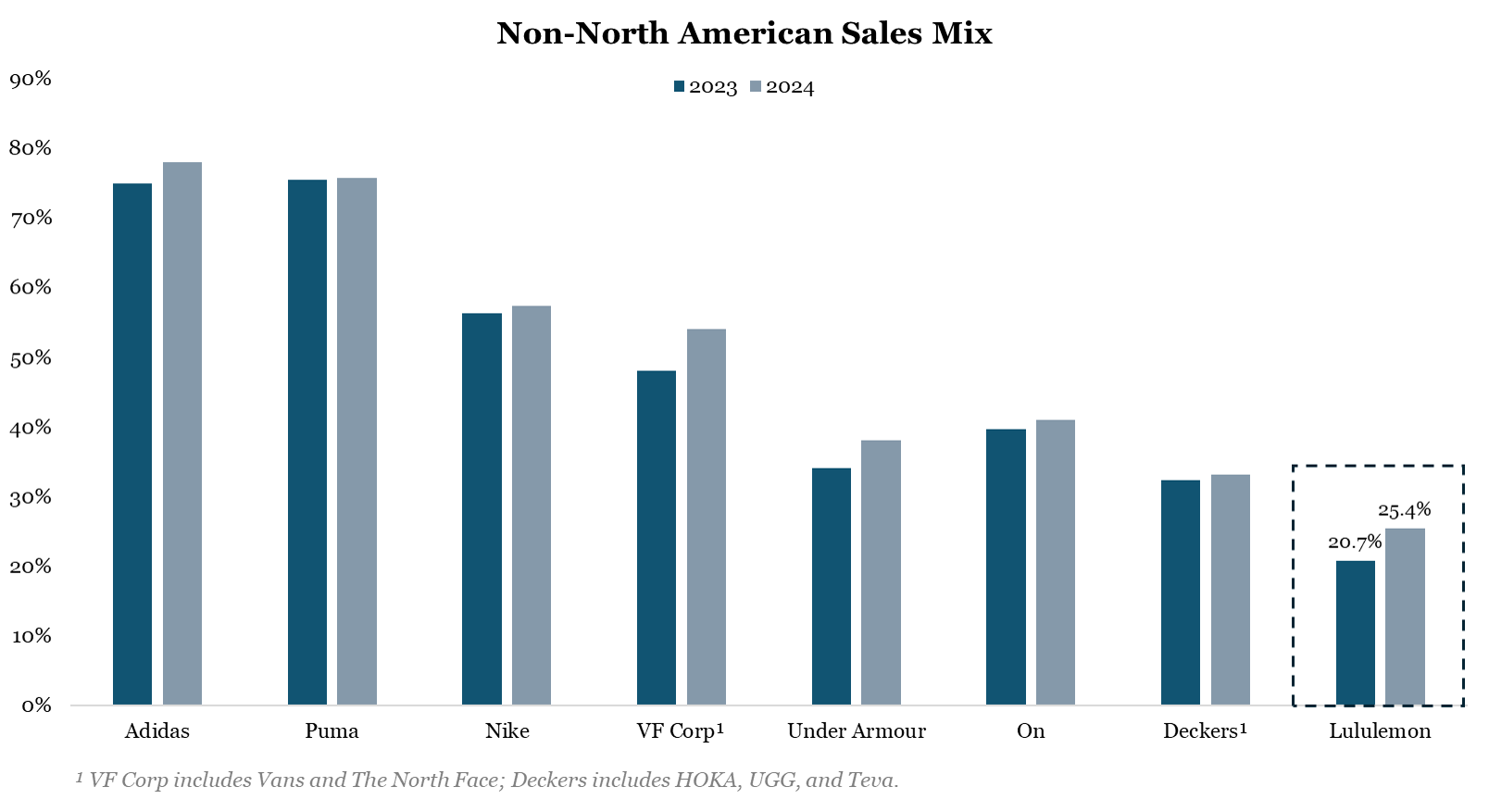
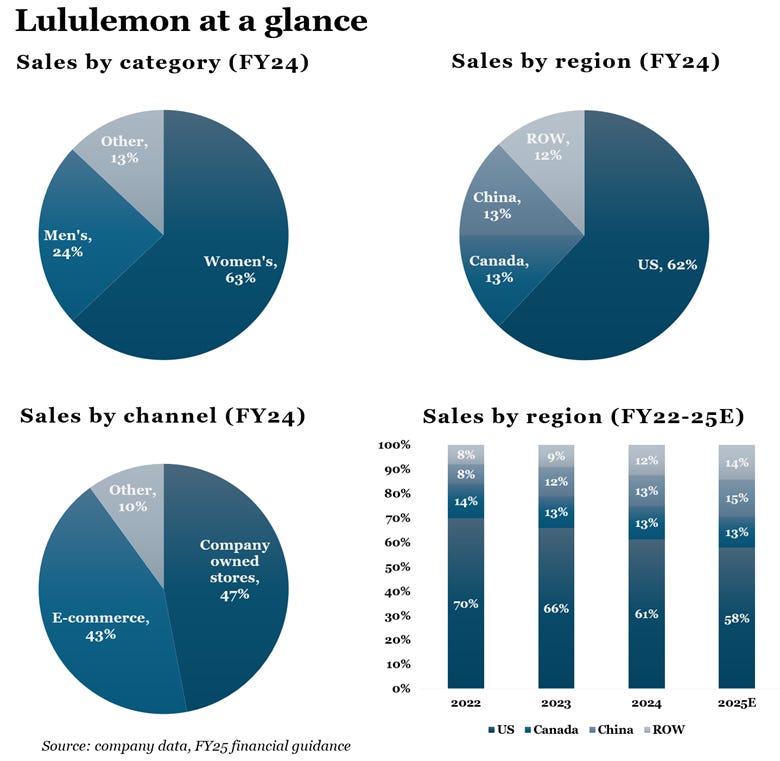
Growth runway. Only about 25% of sales come from outside North America—versus roughly 55% for comps—leaving significant international whitespace. Lululemon also remains underpenetrated in men’s, which represents just 24% of sales, well below the 50%+ typical for activewear brands (Nike is closer to 70%). Further gains are likely from co-located store expansions, which have historically driven productivity increases well in excess of the associated growth in square footage.
Financial strength and downside support. The company holds roughly $2 billion in cash, carries no debt, and continues to repurchase shares aggressively—roughly $4.5 billion since 2019—providing considerable downside protection. (The scale and prices of those buybacks have raised concerns, which we’ll address later.)
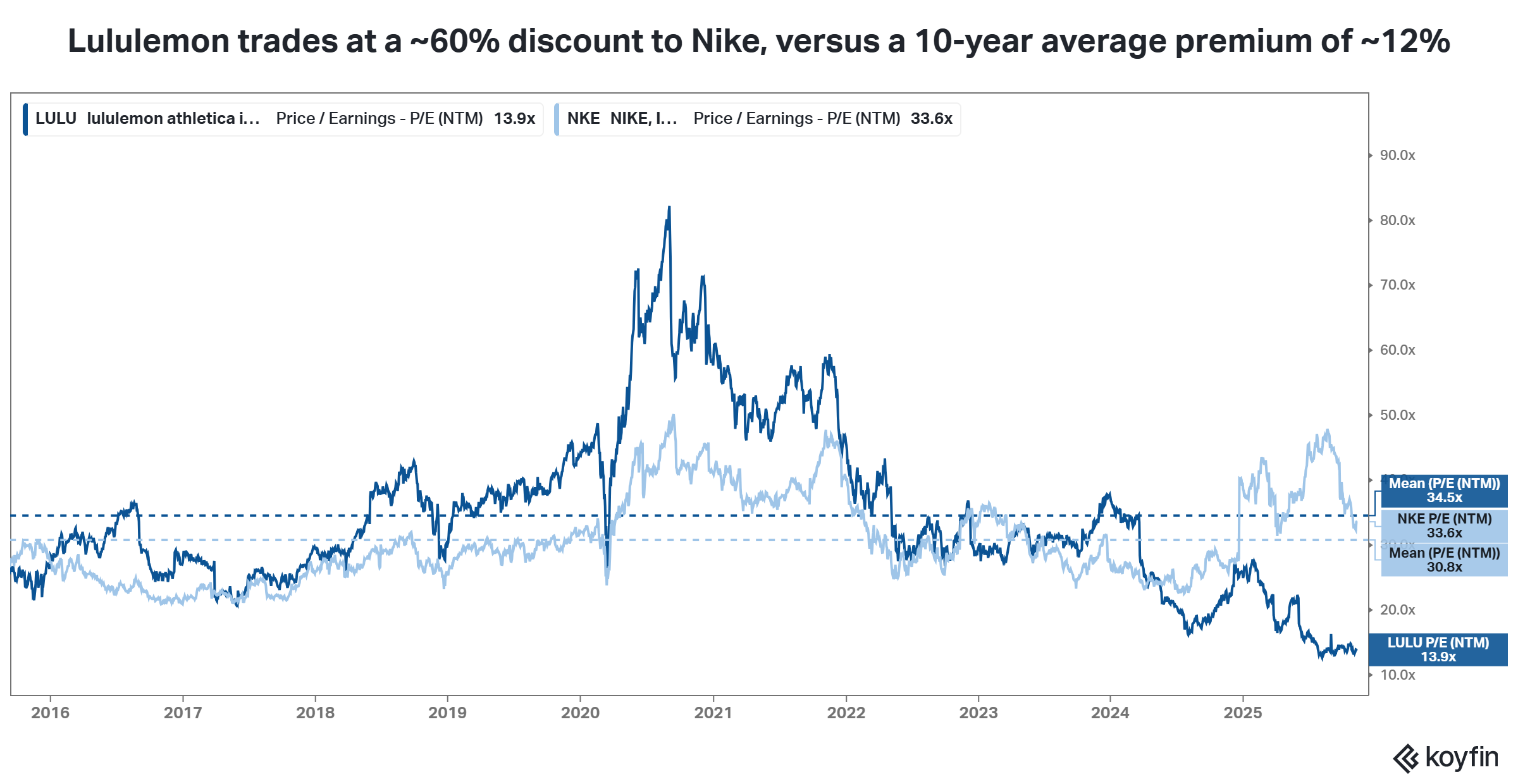
Valuation gap. Despite superior economics, vast international whitespace, and robust balance sheet, Lululemon trades at a steep discount to peers—a disconnect unlikely to last.
Lululemon also trades at a steep discount to its closest private-market competitors, Alo Yoga and Vuori, each valued in the $5–10 billion range, or roughly 5.5× sales. By comparison, Lululemon trades at just ~1.8× forward sales.
Taken together, Lululemon’s historically washed-out valuation, coupled with ample capacity for additional repurchases, provides significant downside support at current prices.
Disclosure: I and/or accounts under my control hold a position in Lululemon’s stock. This is not investment advice. Readers are encouraged to conduct their own due diligence. All figures are in USD unless otherwise noted. Some quotes may be paraphrased or lightly edited for clarity and relevance.
Brief History
“Demand and growth have been steadily up and to the right for really two decades now, and so not to say Lulu is invincible, but I have been impressed with how they’ve been able to prove their staying power over time. And I think the moment I realized that Lulu was here to stay was probably when I found myself happily spending a couple hundred bucks on their men’s clothing with many of my friends doing the same, after thinking it was a brand only for women for about a decade.” - Shawn O’Malley, The Intrinsic Value Podcast
Founded in Vancouver in 1998 by apparel entrepreneur Chip Wilson—an eccentric and occasionally controversial figure who left the company in 2015 but remains a major shareholder (~8%)—Lululemon began as a women’s yoga line, a notable inversion in an industry long geared toward men.
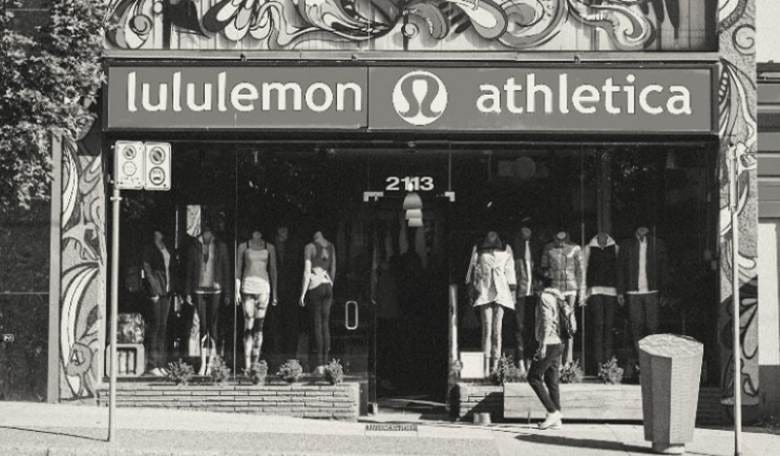
Until then, leggings were simply something you wore to work out. Wilson’s billion-dollar insight was to make them look good, too. By merging form and function, Lululemon’s leggings were technical enough for the studio yet stylish enough for the street—helping ignite the trend of what would soon be called athleisure.
The company broke convention in other ways as well. It sold exclusively through its own stores, allowing it to “own” the customer relationship and cultivate an aura of exclusivity. Its refusal to discount—almost heretical in retail—only reinforced that mystique, aided by an unusually generous return policy.
Then there were the bags. The brand’s red-and-white reusable shopping totes—“the first grocery bag, at least in New York, for sure,” as one former executive recalled—became ubiquitous, doubling as both status symbols and walking advertisements.
Together, these elements gave Lululemon something rare in fashion: genuine cross-generational appeal. Ordinarily, being cool to soccer moms and cool for their daughters is mutually exclusive—but Lululemon managed both.
Over time, the company expanded well beyond women’s yoga wear—broadening its athletic range (tennis, golf), adding lifestyle apparel, and moving into men’s clothing (2014), accessories, and footwear. It would, of course, also make its mark internationally.
Company Overview and Business Model
Fast forward to today: Lululemon operates roughly 800 stores—about two-thirds in North America—generates around $11 billion in annual sales, and counts 30 million members. Its product mix skews about 60% performance and 40% casual, anchored by durable core franchises; around 40% of styles sell year-round.
About 90% of revenue comes from company-owned stores and e-commerce. The remainder stems from temporary pop-ups, select wholesale accounts (including university retailers), and outlets for slower-moving or prior-season inventory—52 globally, mostly in the Americas—plus a handful of international licensees.
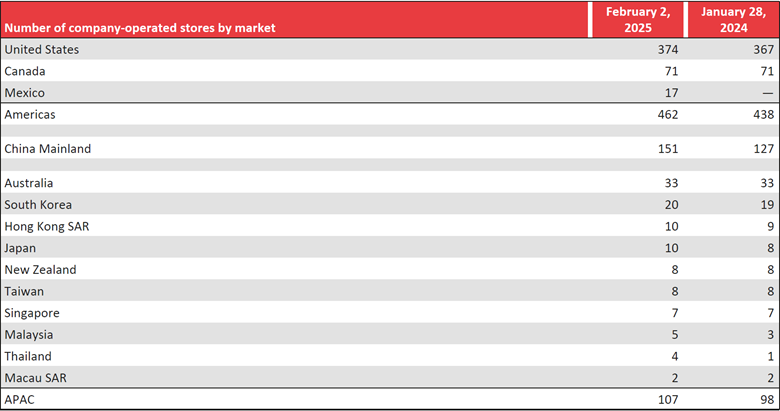
Over the five years ending 2024, Lululemon added 276 net new stores, roughly two-thirds of them outside North America.
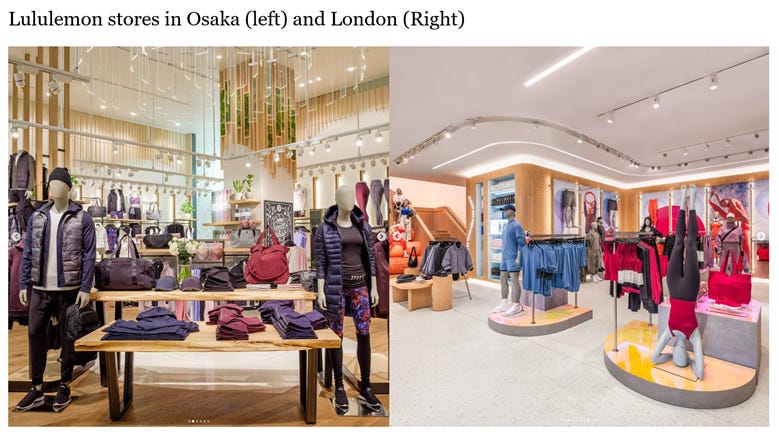
Stores are concentrated in premium retail corridors—street-front locations, tier-one malls, and other high-traffic zones. Designs can vary significantly by region, but the brand identity is unmistakable.
Average store size has expanded about 50% over the past decade—from 3,000 to 4,500 square feet—through a mix of new builds and co-located remodels. While sales per square foot have remained roughly flat in nominal terms, e-commerce penetration has more than doubled—from ~21% of sales in 2016 to ~44% today (two-year average). That places Lululemon among the highest digital-mix apparel brands at scale.
It’s also one of the most profitable, with operating margins in the low 40s. That profitability reflects three structural advantages:
Unusually high customer retention
long-lived core franchises (Align, ABC, Scuba)
Highly consistent fits—once a customer knows they’re a size 30 in ABC, they can reorder online with confidence
Fit consistency, in turn, drives cross-category purchasing, while in-store returns help minimize reverse-logistics drag on margins. Lululemon’s near-pure direct-to-consumer model carries a structurally lighter net-working-capital load than wholesale-heavy peers, offset by a heavier fixed-asset base tied to its owned-store footprint. Taken together, the differences tend to net out.
Style
Lulu describes its product as “high performance, high style”—always in that order. “It all starts at the fabric level for us,” McDonald explained. “We obsess over the performance and feel of fabrics.” We’ll return to performance shortly; first, the aesthetic.
You might think of “high style” as a kind of refined minimalism—tailored fits and a quietly polished look. While more adventurous competitors might lean into bright neons or bold tri-color patterns, Lululemon’s palettes stay simple: cool or warm (not hot or cold), and rarely both. The payoff is versatility—pieces that move easily from one activity to another.
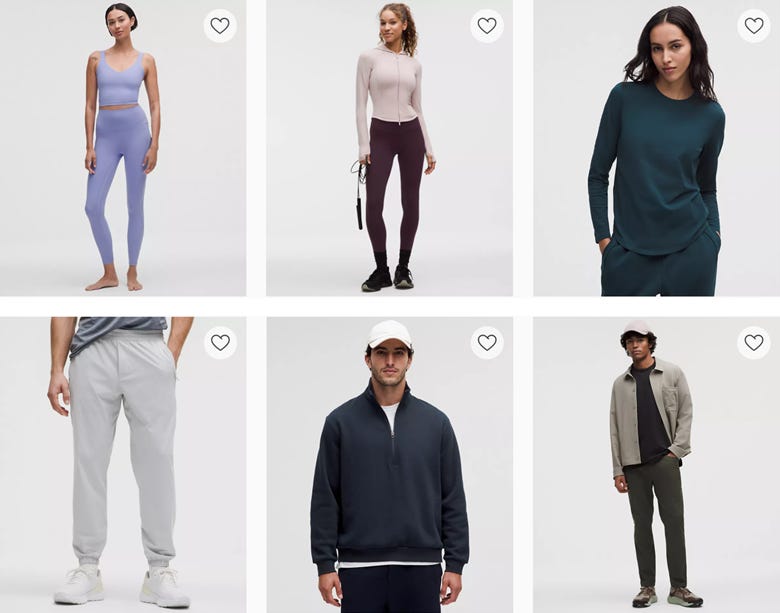
Internationally, Lululemon may adjust its assortment to local tastes, tweaking color and fit on a portion of its global line to better resonate with regional guests. In China, for instance—its most localized market—these adaptations account for roughly a quarter of sales, with another 10–15 percent designed and developed locally.

Over the past year, new styles—“newness” in industry parlance—have made up about 23% of the assortment globally. (Newness can also refer to new colors or prints applied to existing silhouettes.)
“The Bread and Butter”
“I think the fabric; that’s the bread and butter. Working at Under Armour, we had a lot of consumer insights that our fabric wasn’t where it needed to be. We used to look at Lulu and Nike and say like, “How can we replicate this?” With Lulu’s fabric, it was just impossible.”4 - Former Senior Manager at Under Armour
Lululemon sits at the frontier of technical apparel innovation—and for good reason. The company employs hundreds of specialists devoted to product development through its Whitespace Lab and dedicated R&D facilities. To put that in perspective, a director at Gap-owned Athleta explained:
“Athleta had a couple of raw materials people, but they were servicing the entire business, whereas Lulu has PhD-level scientists working on fabric innovation. That’s going to make a difference if you’re bringing your own research to the table with the mills and actually developing proprietary fabrics.”5
As implied above, most of the scientific heavy lifting in apparel happens at the mill level, not within the brands themselves. Brands typically request adjustments to an existing mill construction—tweaks to fiber ratios, yarn counts, gauges, or finishes—rather than commissioning a fabric from scratch. Any exclusivity they receive is usually brief, often limited to a single season.
Lululemon’s scale, deep supplier relationships, and collaborative development model extend that advantage dramatically—often securing exclusivity windows of 18 to 24 months or more. In many cases, it goes further still, owning the patents outright.
Supply Chain
Lululemon’s supply chain is built around a network of about 52 manufacturing partners and 67 fabric suppliers. Roughly half of total production comes from its top five vendors, with manufacturing concentrated in Vietnam (40%), Cambodia (17%), Sri Lanka (11%), Indonesia (11%), and Bangladesh (7%).
Material sourcing is similarly concentrated: about 52% of raw materials come from the top five suppliers, the largest of which accounts for 18%. Roughly three-quarters of fabric originates from Taiwan (35%), China (28%), and South Korea (11%).
Lululemon’s scale and deep, long-standing supplier relationships give it real operational leverage. By committing to massive yardage and paying premium prices, it secures access to top-tier mills and manufacturers—and priority production slots—allowing it to ramp output quickly when demand spikes.
The company operates multiple distribution centers across the U.S., Canada, and Australia to handle both e-commerce fulfillment and store replenishment. Distribution in all other markets is outsourced.
Grassroots Marketing
Lululemon may be the only apparel brand in history to reach global scale without the help of major celebrity endorsements or superstar athlete sponsorships. More remarkable still—it did so while spending next-to-nothing on traditional advertising.
Instead, the brand built its identity around an unconventional ambassador network: local yoga instructors, trainers, and “sweat leaders” who embodied the lifestyle rather than merely sold it. The strategy worked hand in hand with its focus on experiential marketing—community workouts, in-store yoga sessions, and other events that remain central to its playbook today.

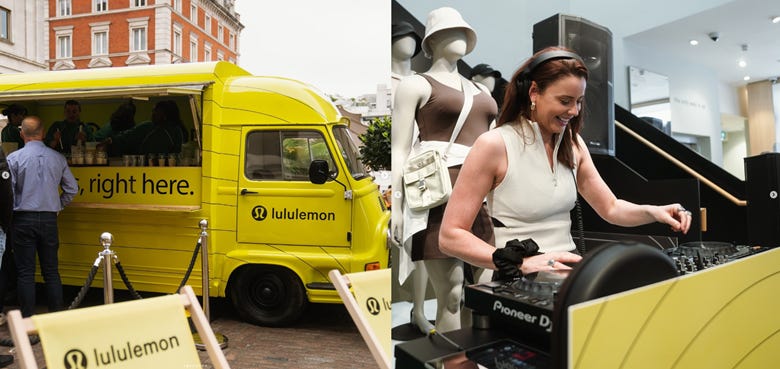
When opening new stores, most retailers rely on the usual playbook—discounts, giveaways, and opening-week sales. Lululemon, by contrast, takes a different tack: it makes the event feel like an experience rather than a promotion. At its Covent Garden opening in London, for instance, the company hosted a live DJ and parked a bright yellow, retro-style coffee van out front.
Over time, this community-first strategy evolved. The company layered in a global tier of ambassadors—higher-profile athletes and wellness personalities, though still short of household names. That changed this year, however, with Formula 1 champion Lewis Hamilton, Lululemon’s first truly global celebrity partnership.
Even so, the partnership marks an evolution, not a departure, from its ambassador model. According to Chief Brand Officer Nikki Neuburger, the company intends to maintain a “tight roster” of values-aligned athletes.
Competitive Landscape
Lululemon competes across two segments: premium activewear, which accounts for roughly 60% of sales, and casual or lifestyle apparel, which makes up the rest. The latter label, however, is somewhat misleading—these are still performance fabrics, not true substitutes for conventional leisurewear.
Within activewear, its mid-tier competitors include Nike, Adidas, Under Armour, and Puma. Its closest rivals, however, are Alo Yoga and Vuori—both priced similarly and chasing the same active-lifestyle overlap. Athleta and Fabletics sit lower on the premium spectrum, both in price and quality.
Across core categories—leggings, joggers, hoodies—the top three brands cluster tightly between $98 and $144. Alo skews $10–20 higher on basics, though its fashion-forward drops can run north of $1,000. Lululemon rarely crosses $200 outside outerwear. Nike and Adidas price roughly 25–35% lower, while Athleta and Fabletics sit 10–20% below that—frequent discounts widen those gaps even further.
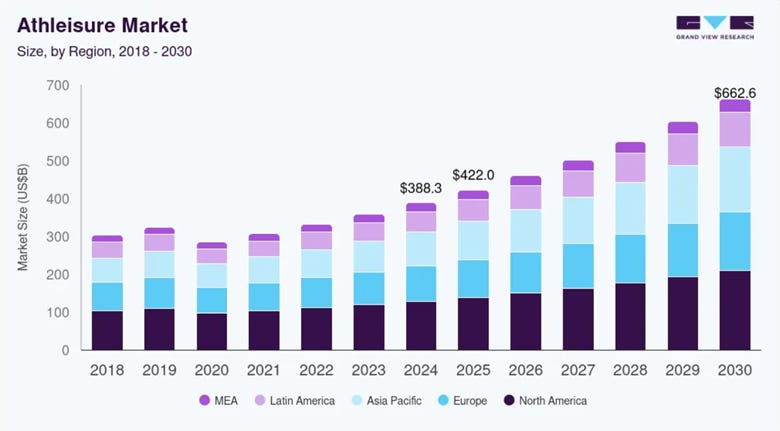
While apparel is, by nature, a low-growth industry, activewear has been a bright spot—a trend expected to continue through 2030–33. According to Grand View Research, the global athleisure market is projected to grow at a 9.3% CAGR through 2030 (see footnotes for more on secular trends6).
Within activewear, the premium tier continues to take share. Hard data are limited, but the chart below offers a reasonable proxy.
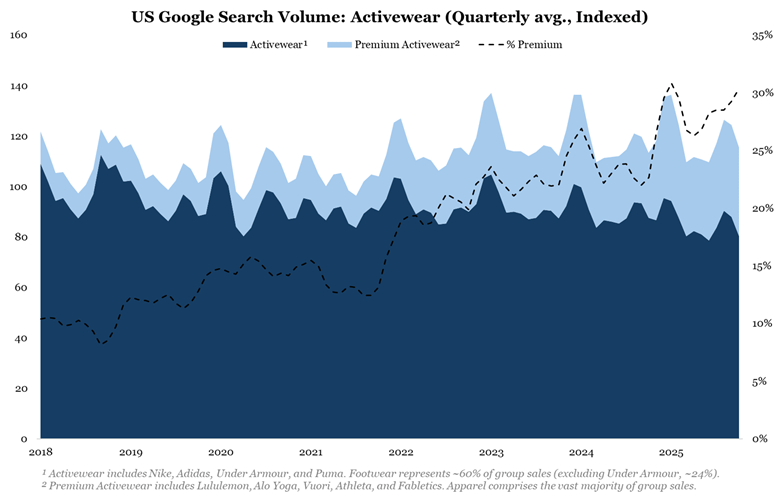
Isolating the premium segment:
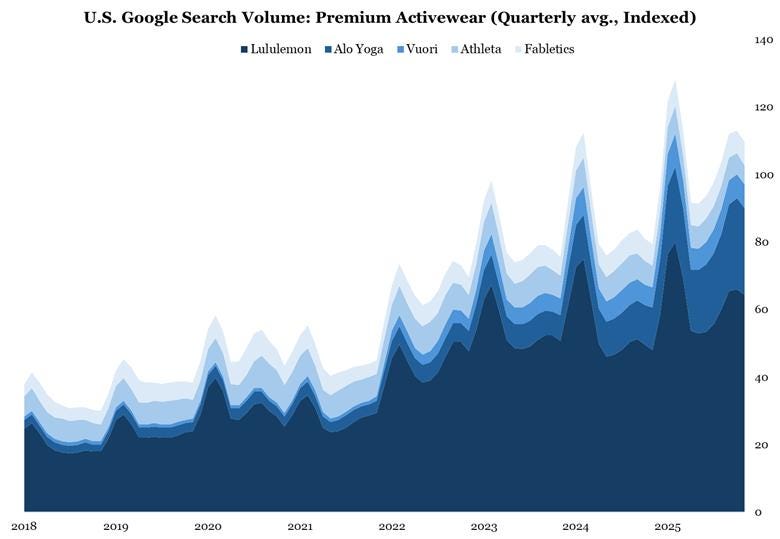
Lululemon’s U.S. business has nearly tripled since the late 2010s, but Alo and Vuori have been the biggest relative gainers. Some of that came at Lulu’s expense—maybe a few points of share, on average—but most was drawn from Athleta and Fabletics, whose combined share has fallen sharply.
Google search data provides a rough proxy. In 2018–19, Athleta and Fabletics made up roughly 30% of total searches in this group versus about 10% for Alo and Vuori. Today those numbers are nearly reversed (~12% and ~30%). Lululemon still leads with about 60%, only a touch below its long-term average.
Our focus here, then, is on Alo and Vuori—Lululemon’s most serious challengers.
The Athleisure “Disruptors”
Alo Yoga — Founded 2007. Roughly 170 stores or “sanctuaries,” with ~65% in the U.S. Estimated $1.5–2 billion in revenue. Customer base skews heavily female (likely north of 85%).
Vuori — Founded in 2015 as a men’s brand. Roughly 120 stores, ~95% in the U.S., with revenue near $1 billion. Since launching women’s apparel in 2018, that segment has grown to ~50% of sales.
Brand Positioning
Both brands lean more fashion-forward than Lululemon—especially Alo, which differentiated itself early on with a looser, streetwear-inspired aesthetic. (The kind that plays especially well on TikTok and Instagram.)
Alo has, in effect, positioned itself as the “cooler” Lululemon—and among Gen Z, it’s largely succeeded. That said, it markets itself less as a performance brand than a luxury lifestyle label. That’s evident in its celebrity ecosystem—anchored by the Jenner sisters, Hailey Bieber, and Bella Hadid—and notably light on athletes.
The contrast in brand DNA is obvious from their respective Instagram feeds.
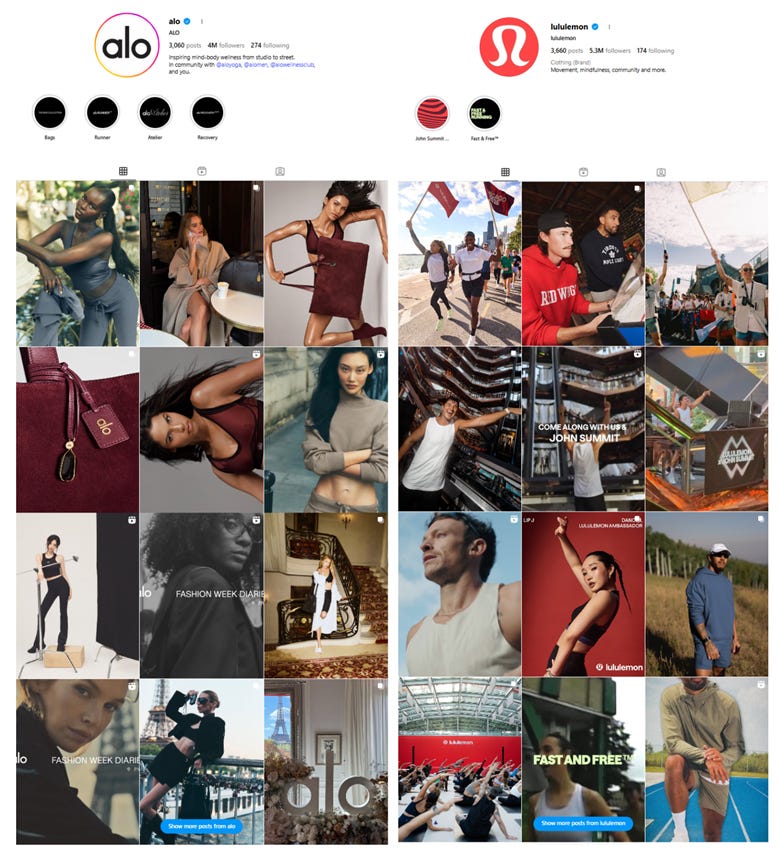
Alo’s identity is also distinctly feminine, unlike Lululemon’s. So while the two brands share some audience overlap, their core customers are not the same (more on this shortly). Vuori, meanwhile, is equally aspirational but more grounded in performance and versatility. Some liken it to a California version of Lululemon.
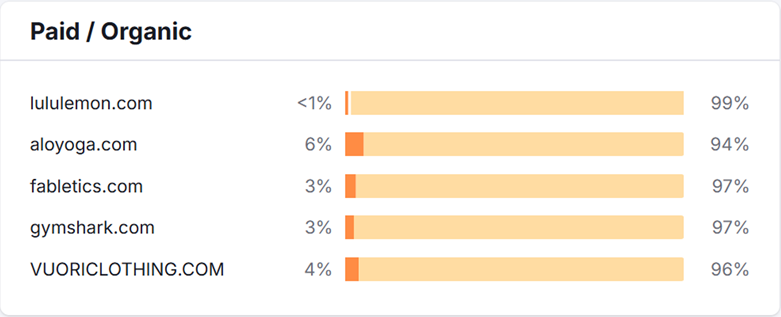
Both spend meaningfully more on marketing as a share of sales—as you’d expect from younger brands still buying awareness—especially Alo. Their paid web traffic (per Semrush) runs several times higher.
Stores
Their store fleets are newer and larger (on average), with roughly 85–90% of locations sitting within a mile of a Lululemon. The assortments are tighter, with fewer SKUs, and merchandising leans heavily on color coordination—especially at Alo—to encourage matching-set purchases.
Lululemon’s stores, by contrast, were historically organized by “destinations” (leggings here, bras there), though they’ve become more outfit-driven in recent years.
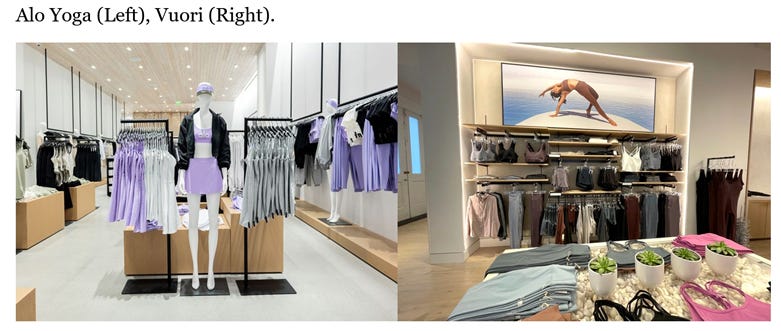
Some shoppers find Lulu’s stores as more cluttered by comparison—an impression likely amplified by smaller, legacy locations. The trade-off is breadth: Alo and Vuori may look cleaner, but they offer less selection.
“[Lulu’s] brick-and-mortar store performance is unbelievable,” observed a director at Vuori. “They have just sheer volume going through these stores. They’re fully stocked with literally thousands of SKUs, whereas an Alo store has a lot less selection.”
Lululemon’s U.S. stores average more than $8 million in annual sales, compared with an estimated $2.5–5 million for Alo and Vuori.
Design and Product
On trendiness, Alo has led the pack lately. But that doesn’t explain its higher pricing—nor does product quality, for that matter. As a VP at Fabletics put it:
“When I look at someone like Alo, it’s obvious that the quality of fabric that they’re composing and manufacturing is different. That’s where I believe [Lulu] really has a leading edge on everyone.”
Alo’s quality is widely viewed as the weakest of the three, with recurring complaints of pilling, stretching, and premature wear—sometimes so extreme they strain belief. The issue, though, is less about quality alone than perceived value. As one fashion YouTuber observed:
“I honestly don’t see why this hoodie should cost over $200. If you told me that it was from Walmart, I’d believe you.”
(She did, however, praise Alo’s Airbrush leggings and overall design aesthetic.)
Shift Fashion Group, a fashion studio and manufacturing consultancy, reached a similar conclusion after a detailed teardown: Alo’s products, they found, are “designed to sell, not to last.”
Vuori performs better on that front but still trails. While difficult to quantify, Shift’s comparative scorecards for two of each brand’s top-selling items provide as close to an objective benchmark as you’ll find. (For those interested, teardown videos are linked [here] for Lululemon and [here] for Vuori.)
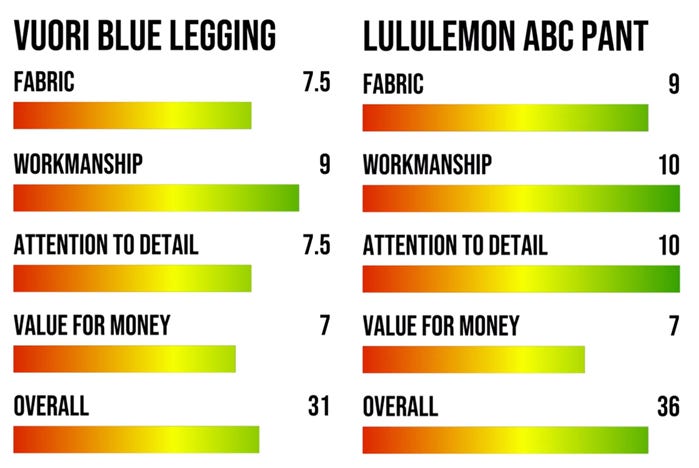
Note: given the evidence already presented regarding Lululemon’s quality edge—from premium peers falling short to the former Under Armour executive calling its fabric replication “impossible”—I’ll assume most readers don’t need a primer on why simply matching a yarn blend (e.g., 81% nylon, 19% elastane for Nulu) won’t yield the same result. For those curious, see footnotes.7
Further proof of Lululemon’s quality advantage shows up in its retention data.
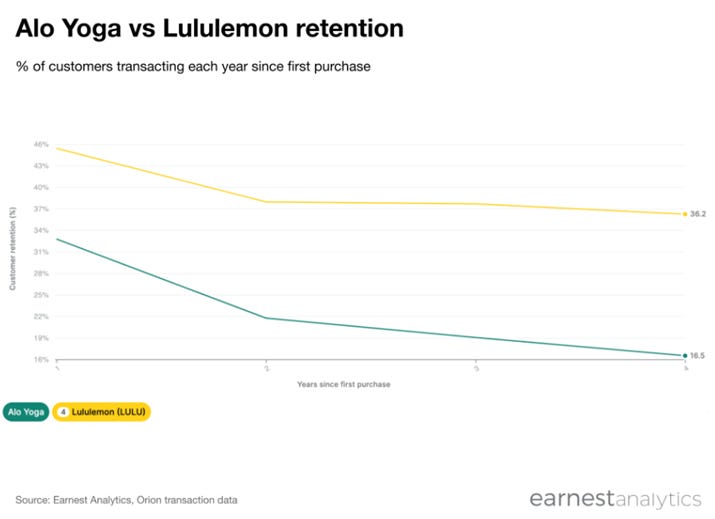
Customer experience likely plays a role as well. In the four states with the highest store density—California, Texas, New York, and Massachusetts—Alo averages just 3.2 stars across 3,800+ Google reviews, versus 3.85 for Lululemon (8,000+) and 4.15 for Vuori (1,000+).
(Note: Lululemon’s newer stores score higher on average. In London and Paris, for instance, stores average ~4.3 stars across 1,600+ reviews.)
Employee sentiment mirrors this pattern. On Glassdoor, only 45% of Alo employees would recommend working there, compared with 81% at Lululemon and 68% at Vuori.
To be clear, that doesn’t mean Alo’s customers or employees are unhappy; it simply underscores a meaningful gap in two key indicators of long-term business health—one that’s unlikely to close without significant leadership change on either side.
Market Share
Still, there’s no question Alo has taken some share from Lululemon. The simplest test is counterfactual: if Alo didn’t exist, where would most of those sales have gone? Probably to Lulu.
According to Earnest Analytics, 63% of Alo shoppers also shopped at Lululemon in the 12 months ending April 2024. However, the overlap runs mostly one way: only 4% of Lululemon customers shopped at Alo during the same period.
The takeaway: Alo’s audience overlaps with Lululemon’s, but it isn’t the same. Alo’s customer skews younger, more trend-driven, and less performance-focused. Lululemon’s base, by contrast, is older on average, more affluent, and markedly more loyal.
When asked in September about the relationship between these “hot” challengers and softer U.S. results, McDonald hardly sounded like someone conceding ground. On the contrary:
“There’s still a lot of share for us to gain and grow [in the U.S.]. When I look at the competition, we know when we deliver, we win.”8
We’ll return to Lululemon’s remaining U.S. growth potential later.