

Last month, Evercore’s John Saager put a question to Rivian’s (RIVN) head of investor relations. Another deal “very similar to Volkswagen,” he noted, was “one of the biggest opportunities for Rivian to surprise people and outperform.” Were more coming?
Between early September and mid-October, Rivian’s answers to versions of that question grew steadily more suggestive. None is conclusive on its own, but read in sequence, they have convinced me another deal is all but certain.
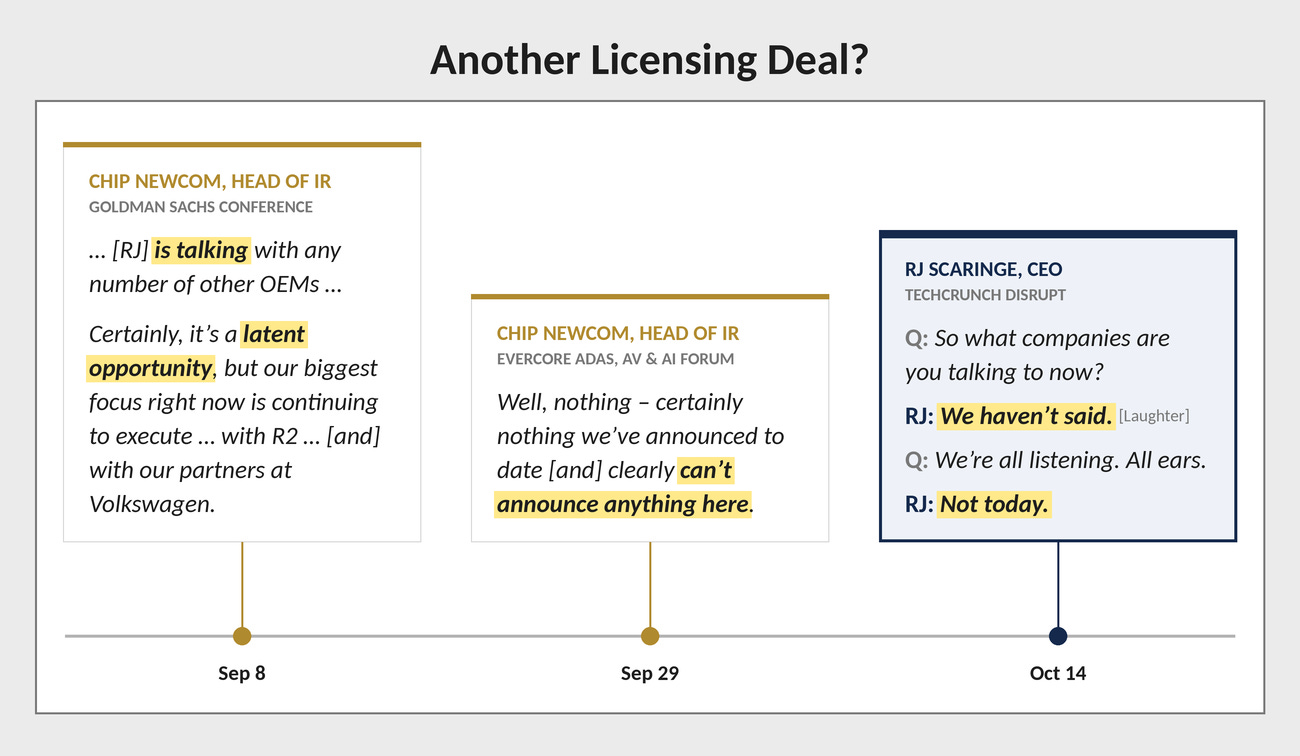
“We haven’t said” would be an odd response if the talks were merely casual. (It also implies that, eventually, they intend to say.) “Not today” reinforces that impression: it sounds more like when than whether.
Meanwhile, the stock has fallen from roughly $16 to $11.50, and Rivian has become Aquitaine’s largest position. But another deal is only part of the reason. Across this two-part series, we’ll explore why (among other things):
The R2 is apt to be a commercial hit. By this time next year, I expect the narrative to have shifted from “reservation conversions exceeding expectations” to “we cannot keep up with demand.”
Profitability is likely to arrive sooner than consensus expects, and plausibly at a lower annual production volume than Tesla needed – even without the federal EV credit.
Production capacity available to Rivian could meaningfully exceed the headline ~515,000 vehicles a year by 2028-2029. If demand for the midsize platform (R2 and R3) is as strong as I expect, Rivian may be able to tap existing capacity beyond its own factories, both in the U.S. and abroad.
Consensus revenue estimates for 2028–29 are probably at least 40% too low. The assumptions behind that claim are far from heroic, in my view – though you can judge for yourself when we get there.
With that, let’s begin with the R2, and a rivalry from six decades ago.
“Model Why?”
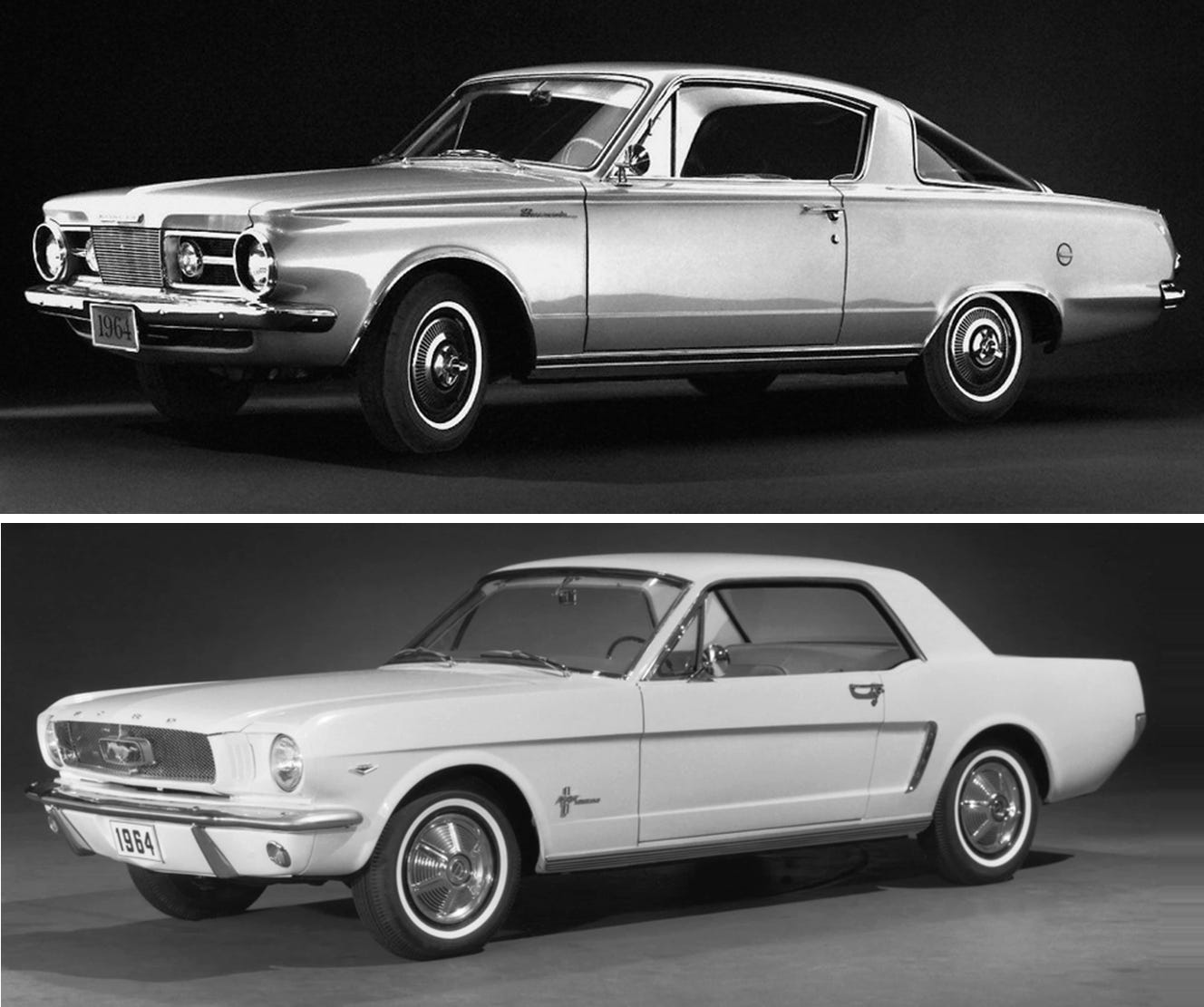
On April 1, 1964, Chrysler unveiled the Plymouth Barracuda, a sporty compact built to compete with the Mustang, Ford’s worst-kept secret, which debuted 16 days later. Trim for trim, the two were nearly identical in price and performance. Yet only one would become an icon. That spring, a Car and Driver editor warned a Chrysler official:
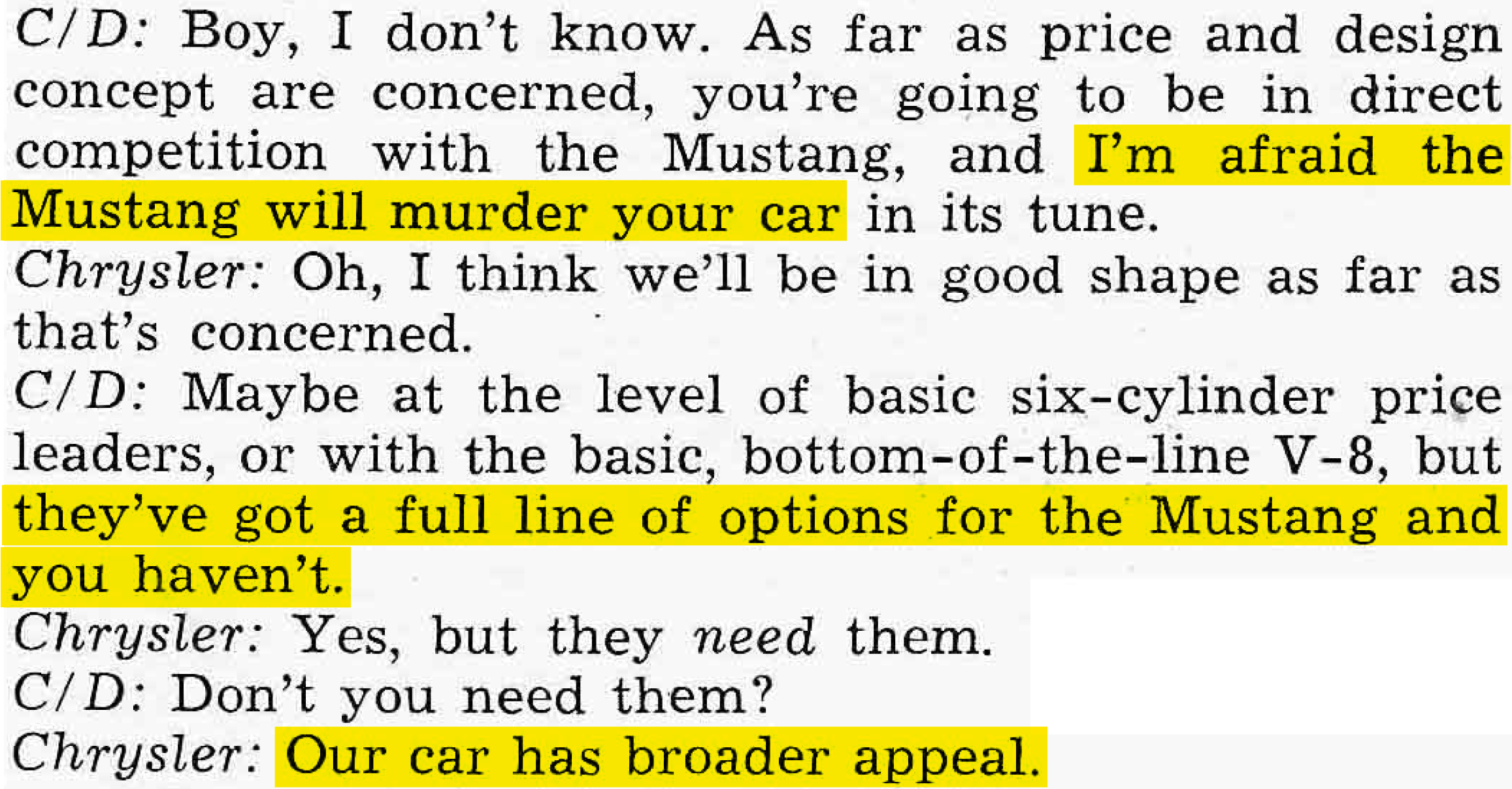
By the end of the 1966 model year, Ford had built roughly 1.29 million Mustangs to Plymouth’s 126,000 Barracudas. So, what explains a tenfold gap between two cars this alike? Ford’s larger dealer network and marketing budget helped, as did the options list Chrysler insisted buyers didn’t need. But the biggest reason is simpler: the Mustang looked cooler.
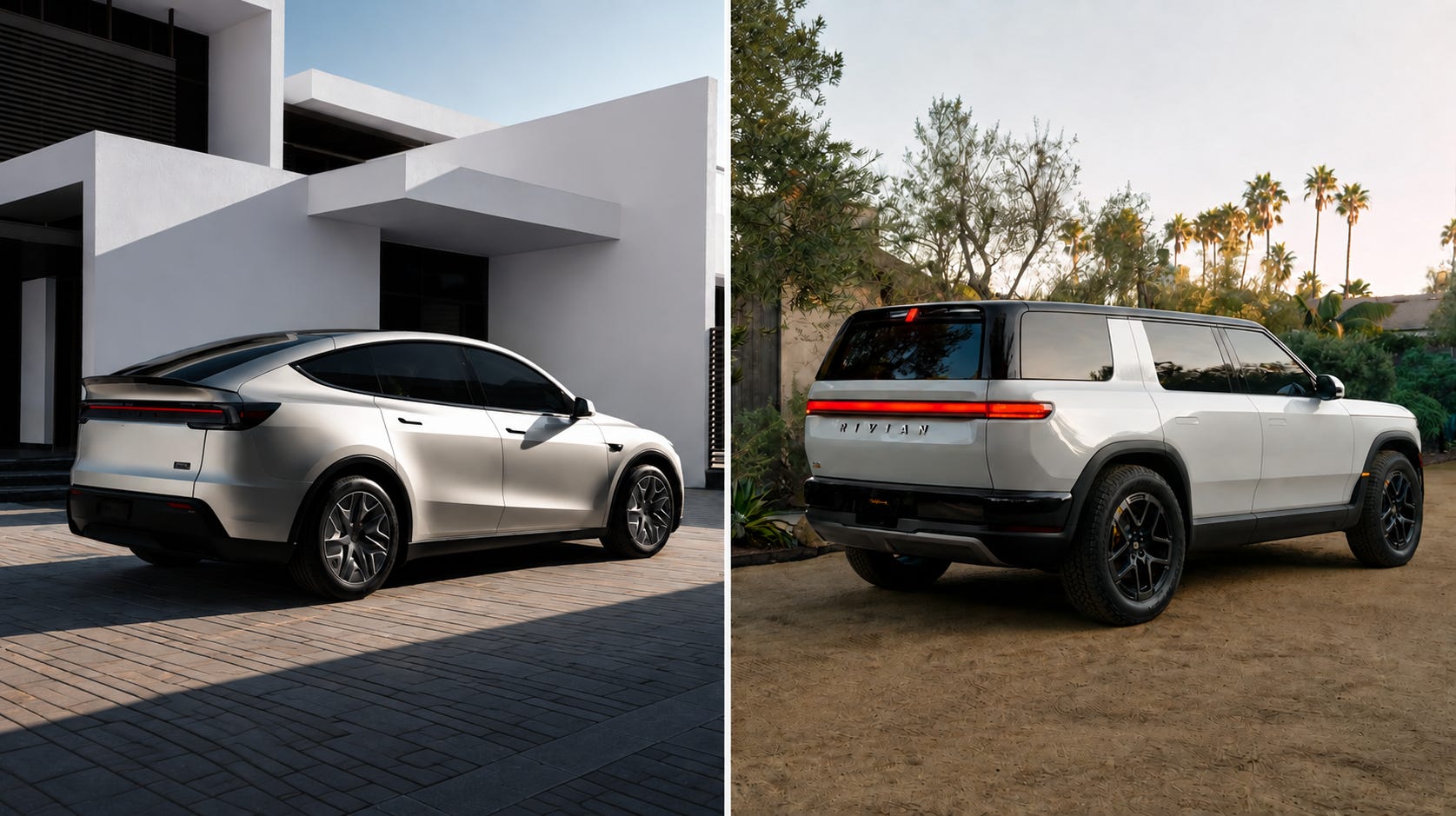
A similar contest is now taking shape between the Tesla Model Y and Rivian’s recently launched R2, with one important difference: this time, the “icon” is the incumbent, and its appeal is indisputable. Since 2023, the Model Y has cumulatively outsold every other car in the world – roughly 4.6 million units through 2026 if current trends hold, versus about 4.2 million for the second-place RAV4. And if not for Elon’s foray into politics, it almost certainly would have sold more (much more).
“The Model Y pretty much wins every comparison test we’ve ever put it through, and that’s because it is truly a great vehicle,” said Kyle Conner of Out of Spec Reviews. “But many are looking for an alternative.”
Until now, if you wanted a mass-market midsize SUV with excellent technology but didn’t like the way the Model Y looked or (for some reason) weren’t drawn to the brand, you had no real alternative. Now you do, and one that is better in (almost) every way.
I first looked into Rivian in February, more out of curiosity than any expectation of investing. Until then, I had spent little time on the auto sector – known for its structurally poor economics – and had no particular interest in cars. In other words, the odds that a sub-scale, unprofitable automaker would become Aquitaine’s largest position several months later were not especially high. Yet here we are.
My research involved watching dozens of R2 reviews (spaced out, of course). That may sound like overkill to some, but I believe it’s always wise to gather as many perspectives as possible – especially on something central to the thesis. Among my favorite reviewers is Doug DeMuro, who is as enthusiastic as he is analytically rigorous. He is also scrupulously independent: he accepts no sponsorships from automakers and doesn’t invest in their stocks. (That combination is why I consider the “Doug Score” the single most valuable piece of “alt-data” in the sector.)
A week after reviewing the R2, he said this on his podcast:
“This is a fantastic car, especially for the price point. I truly think one of the very best EVs – probably the best EV I’ve ever been around … The Teslas when they first came out were also unbelievable cars. But this reminds me of that: this is like a Tesla without the played-out styling.
Imagine a 4Runner, except, like, in the modern era, with better ride, similar off-road capabilities, much more power, better technology, and styling … I was truly astonished by the overall level of competence that this pre-production car that I was driving had, and I can’t imagine they don’t sell a zillion of these.
The Model Y is the best-selling car in the world. How is this not a Model Y, but better?”
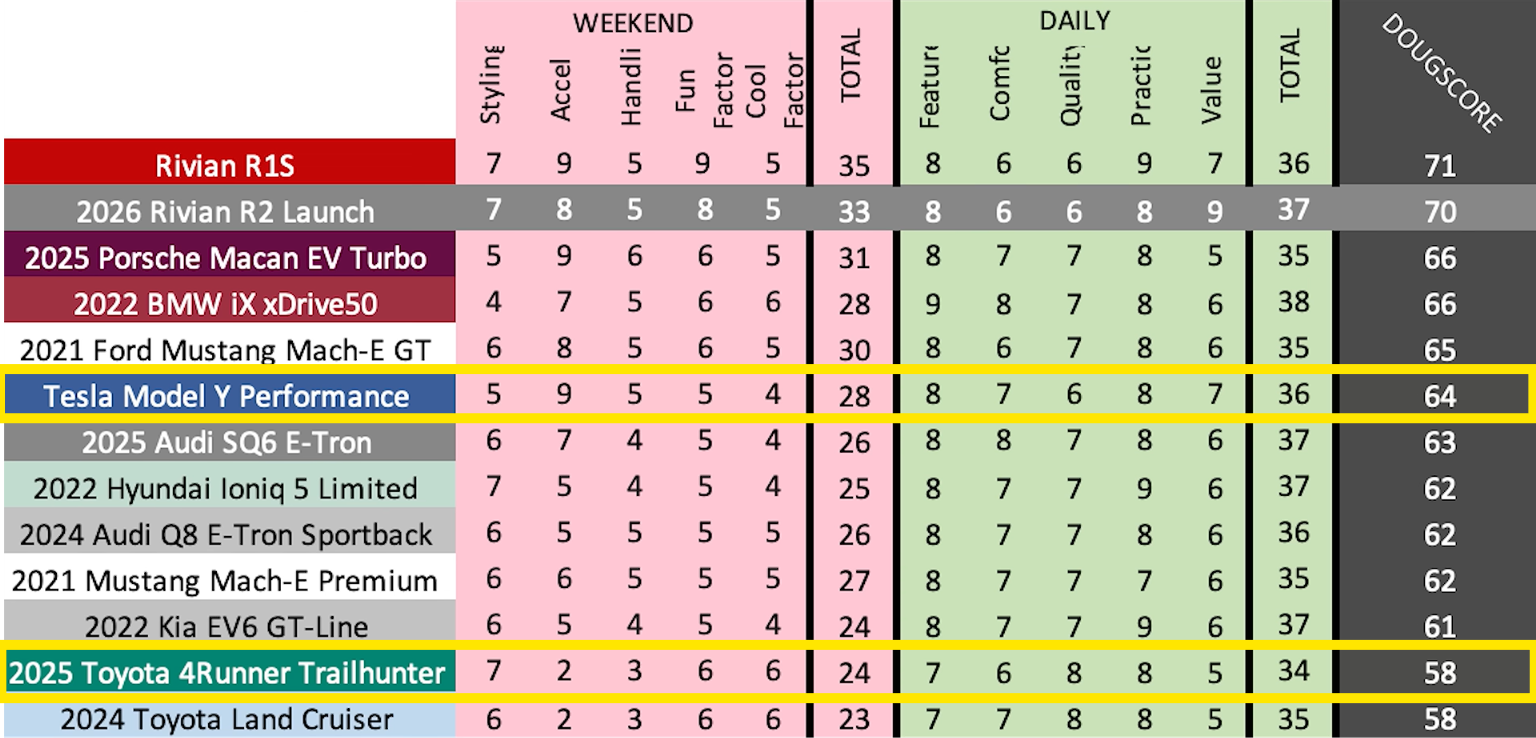
Of course, not everyone would use the same criteria, weight them equally, or agree on the scores – least of all on styling. Rivian’s “stadium” headlights are a case in point: some people love them, others hate them. (For what it’s worth, I didn’t like them at first – nor the name “Rivian” – but both have since grown on me.)
Still, the Model Y holds a few significant advantages over the R2 (and, for that matter, over just about every other car on the road):
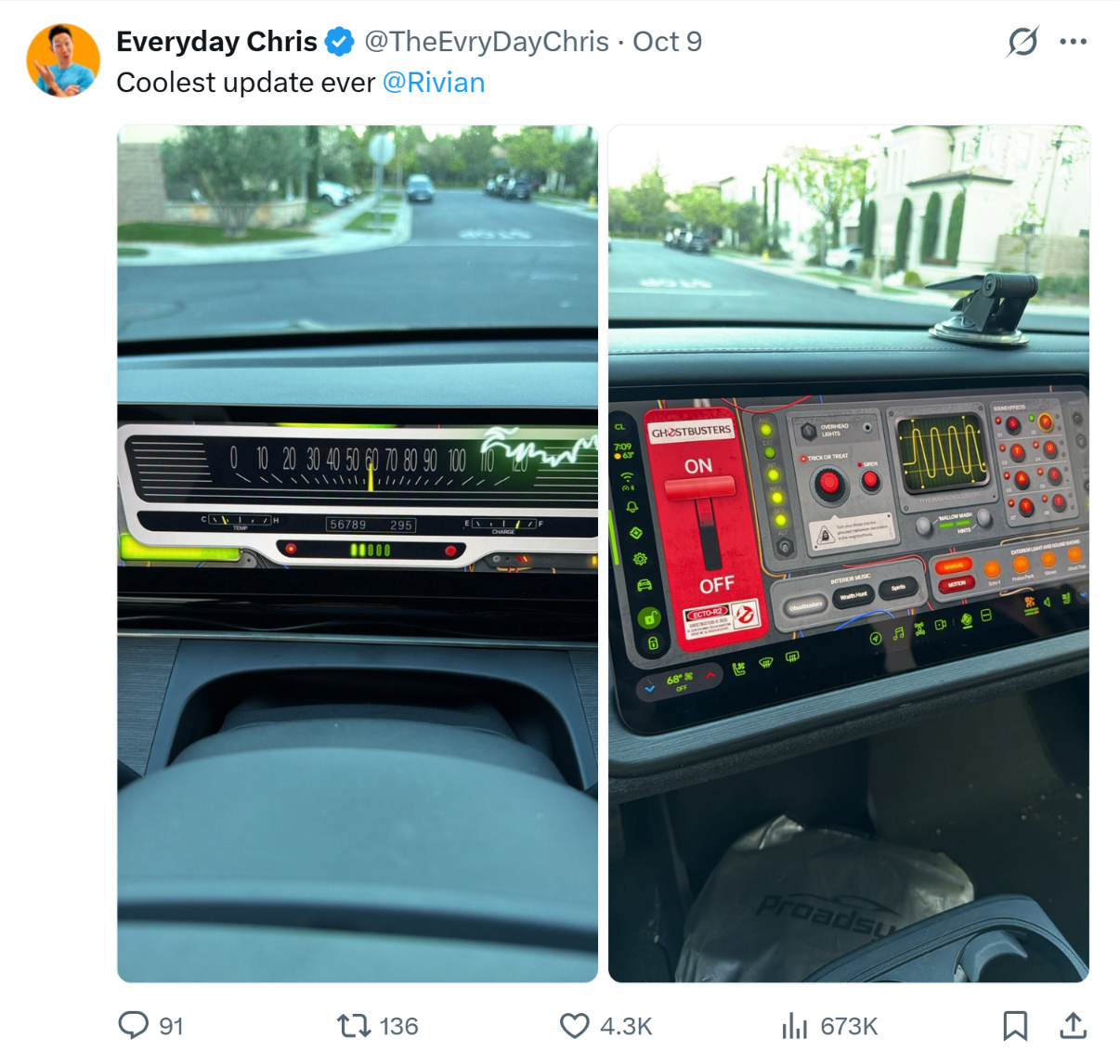
1) Software. Tesla’s software, from infotainment to the app, is the benchmark – not because it looks better or runs faster than Rivian’s (it doesn’t), but because everything just works. Rivian is a close second, still ironing out the kinks, though the gap continues to narrow. Rivian’s software is also more fun (Tesla’s “Bioweapon Defense Mode” air filtration setting notwithstanding):
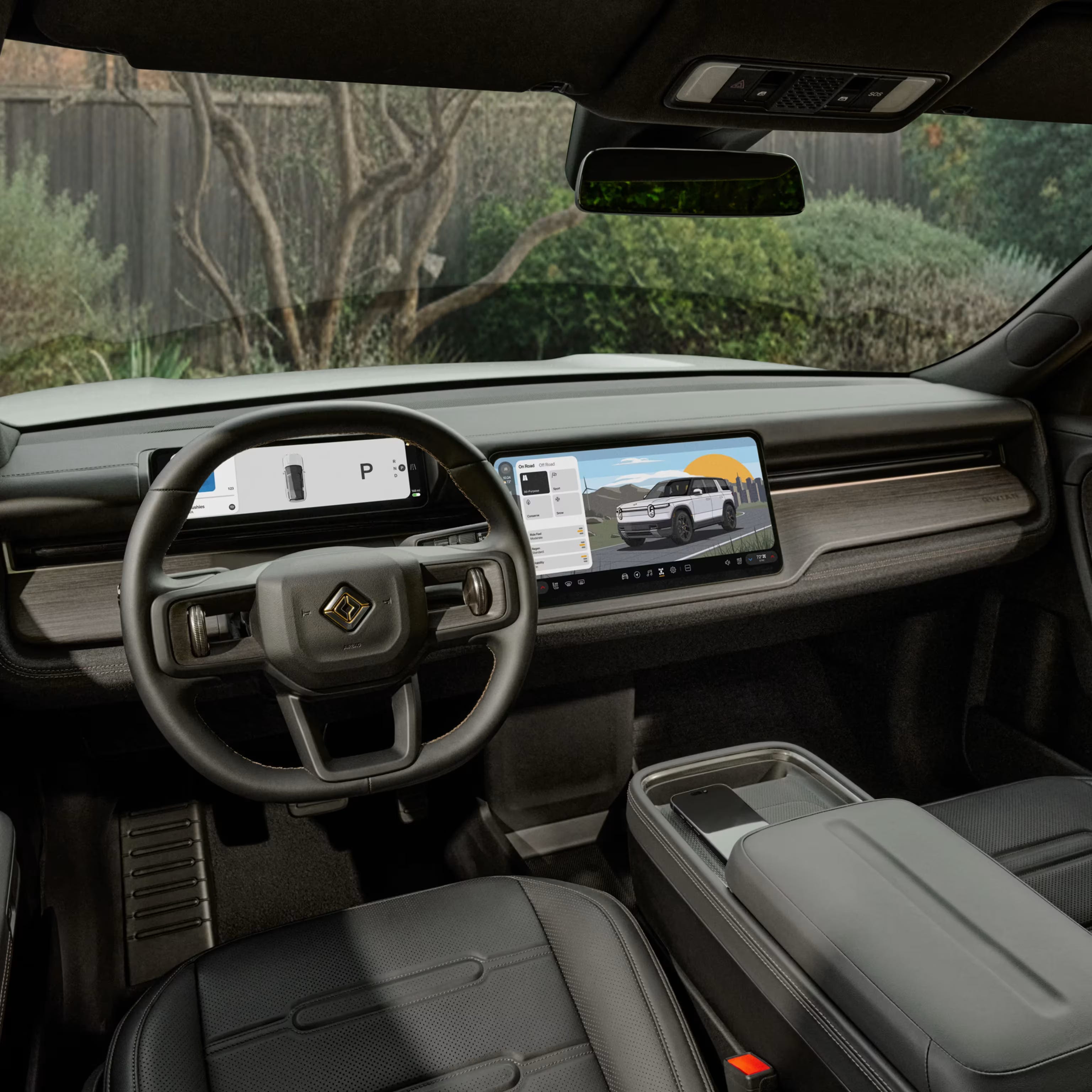
For comparison, here’s the standard display, which, like the rest of the interior, most reviewers find warmer and more inviting than the Model Y’s.
2) Efficiency. The Model Y’s teardrop shape gives it a drag coefficient (Cd) of about 0.22, against roughly 0.28 for the R2, which is still remarkably slippery for a boxy vehicle. (By comparison, the electric Mercedes G580, a box on wheels, has a Cd of 0.44.) The R2’s larger battery closes most of the gap in range, though not in energy use, and the R2 charges faster.
3) Autonomy. “It is really Tesla or nothing right now,” says Conner, whose friend recently went 12,000 miles on FSD without intervening once. Self-driving isn’t yet a deciding factor for most buyers, but it is fast becoming one: those who have tried FSD (v14) invariably can’t imagine living without it. (At least those who drive a lot.) Rivian is again the next-best option, and with its own version of FSD due for early adopters by year-end, it could reach parity sooner than most expect.
What I’ve come to appreciate about cars is how much their appeal depends on choosing the right compromises. The R2’s extra 3 to 3.6 inches of ground clearance, for example, helps make it an excellent adventure vehicle, but its taller stance also leaves it feeling less planted on the road than the Model Y.
On balance, though, I think it offers considerably more car for the money. And as Rivian closes the software and autonomy gaps, buyers choosing it over the Tesla will soon face only one real concession among the three above: efficiency.

Demand for the R2 is already strong, with launch-edition reservations converting ahead of management’s expectations despite being priced at the top of the range. That’s also with many prospective buyers still waiting for the LiDAR-equipped version expected in 2027. Its upgraded hardware is designed to support personal Level 4 (L4) autonomy, which Rivian is targeting for 2028. For buyers who eventually want to use L4, or are simply concerned about resale value, waiting makes sense.
If demand does outrun production by this time next year, as I expect, that will be a far more palatable narrative for investors worried about Rivian’s cash burn.
Capital Destroyer?
Few things capture that worry better than a chart of cumulative free cash flow among EV makers that made the rounds on X in February. “Rivian beats Tesla in cash flow generation!” its author, @alojoh, announced – provided you “remove the minus sign.” The conclusion: “Rivian continues to be the undisputed capital destroyer in U.S. financial markets.” Then, for good measure: “Congratulations to @RJScaringe 👏.”
This needs addressing early, because if the chart proves what its author claims (it doesn’t), nothing else I say matters. The post attracted plenty of agreement, but I found little substantive pushback, much less a thorough rebuttal. So I feel obliged to supply one here, while filling in some of the history behind Rivian’s cash burn. (Two birds, one scone.)
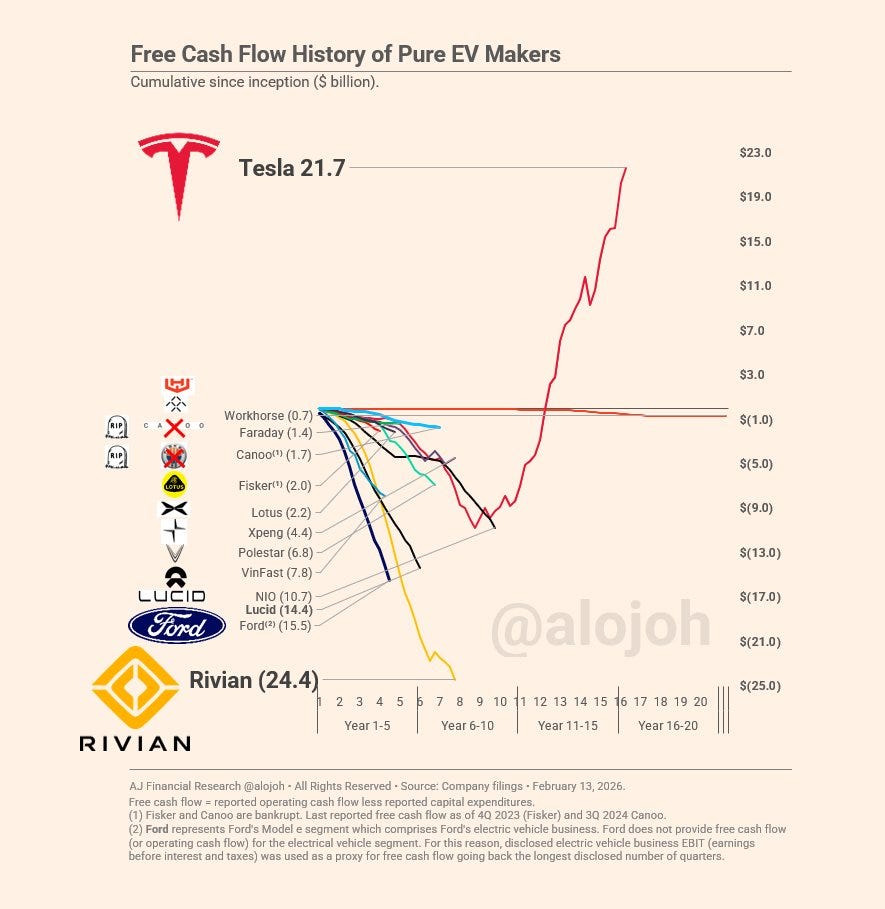
There’s just one problem with @alojoh’s argument: it doesn’t follow basic logic.
First, read the chart as what it actually is: a survival table, inverted. Among the American startups, the two deepest burners, Rivian and Lucid (LCID), are the only ones still in the race, plus Tesla. It would seem, then, that insufficient burn was the fatal condition, not excessive burn. And of course, a startup can only burn what it can raise (presumably the others would have burned still more if they could have), so the chart measures access to capital at least as much as “waste.”
Second, on the day @alojoh posted the chart, the market valued Rivian at roughly everything it had burned (~$22 billion). Lucid was worth less than a quarter of its burn (~$3.3 billion), and is now worth under a tenth (~$1.3 billion). So, if the chart crowns anyone the capital destroyer, it’s Lucid.
Third, Tesla’s burn and Rivian’s were not remotely like for like:
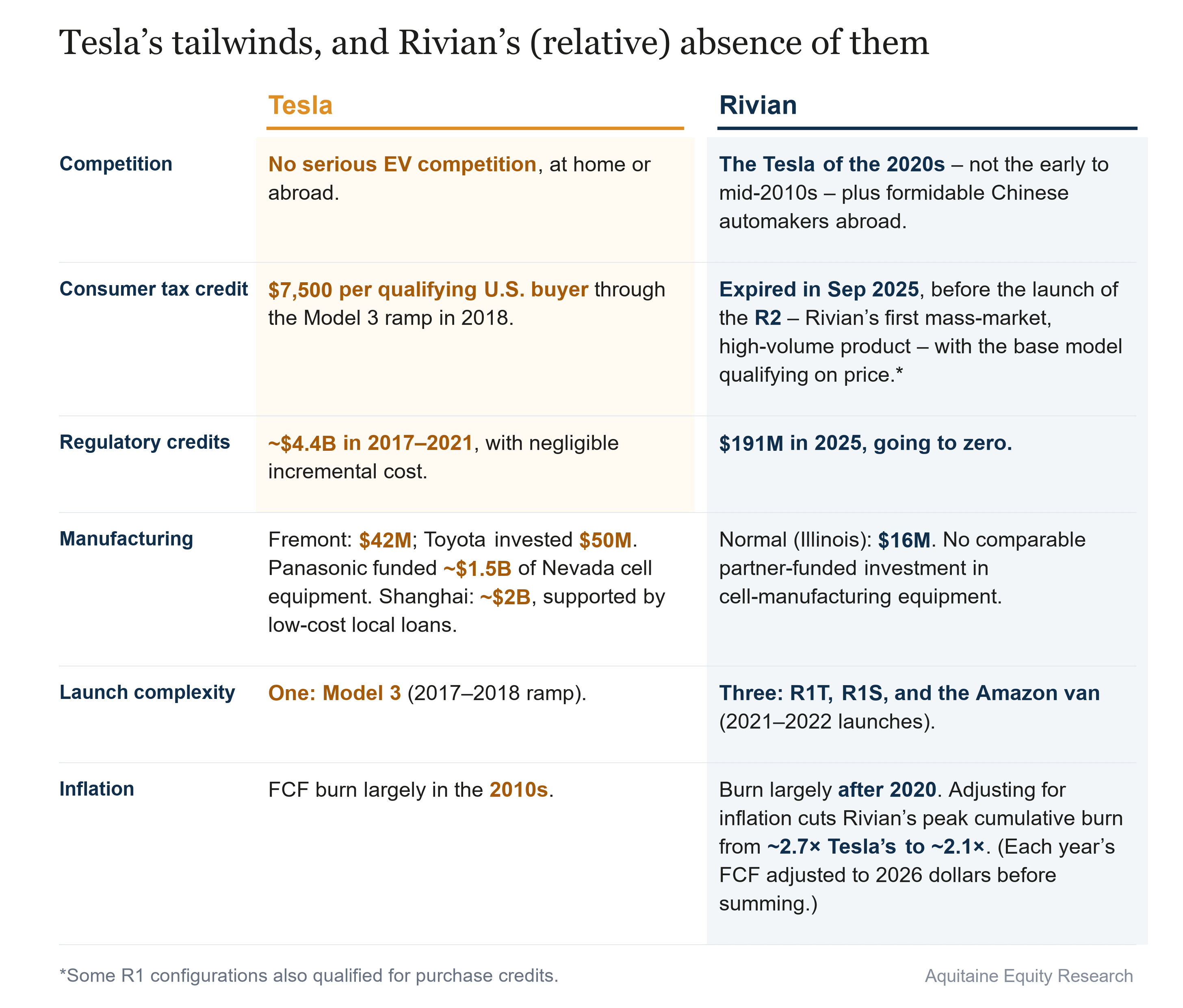
Nor does the chart account for timing. Rivian locked in its R1 supplier contracts in 2018 and 2019, at the top of the auto cycle, accepting premiums it expected volume to renegotiate away. Then COVID sent costs the other way. So a meaningful slice of the deficit is cyclical rather than structural, and largely self-correcting.
That said, some of the excess was self-inflicted, as RJ Scaringe, Rivian’s founder and CEO, has admitted. Launching three vehicles at once is the obvious example. But a costlier path is not the same as a wasted one, and these were not three ordinary launches: each vehicle was widely considered the best ever in its category (more on this later).
Credit where it’s due: Lucid also launched what was arguably the best ultra-luxury sedan ever made, the Air. But it launched only that one vehicle – a far lighter engineering and manufacturing burden – and the Air has been plagued by reliability issues. As Jason Fenske of Engineering Explained lamented after less than six months with his Lucid Air:
“A front trunk that won’t open, software that won’t update, speakers that won’t play music, coolant pumps that won’t get up to speed, and generally speaking, a myriad of software glitches that never stop surprising you.”
Rivian’s customers have fared better, though they’ve had their share of reliability headaches too – which is precisely what makes the table below so striking.
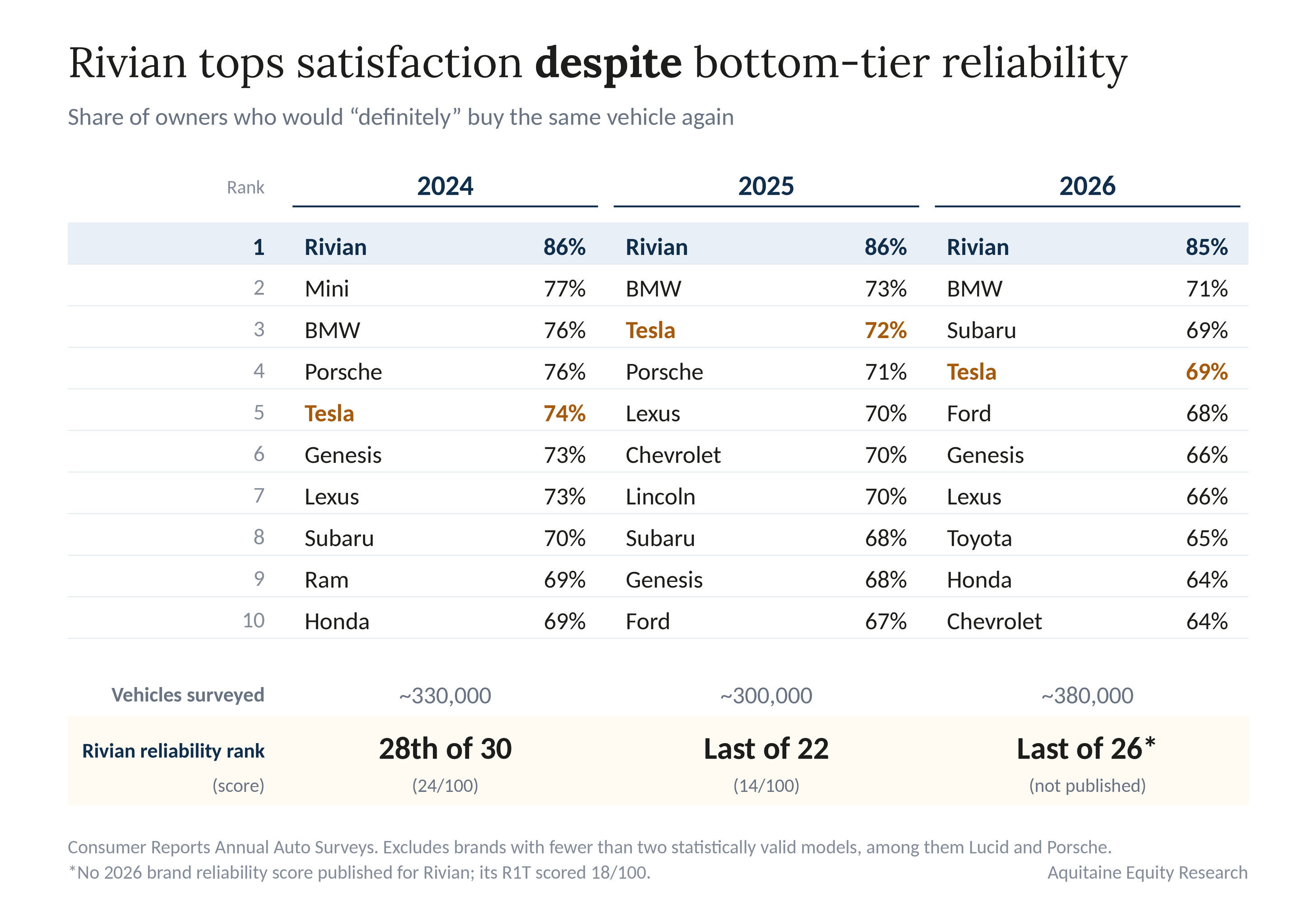
In other words, owners whose vehicles have (at least so far) been among the least reliable in America would, overwhelmingly, buy the same vehicle again.
Such details were clearly beyond the scope of @alojoh’s post. Also missing:
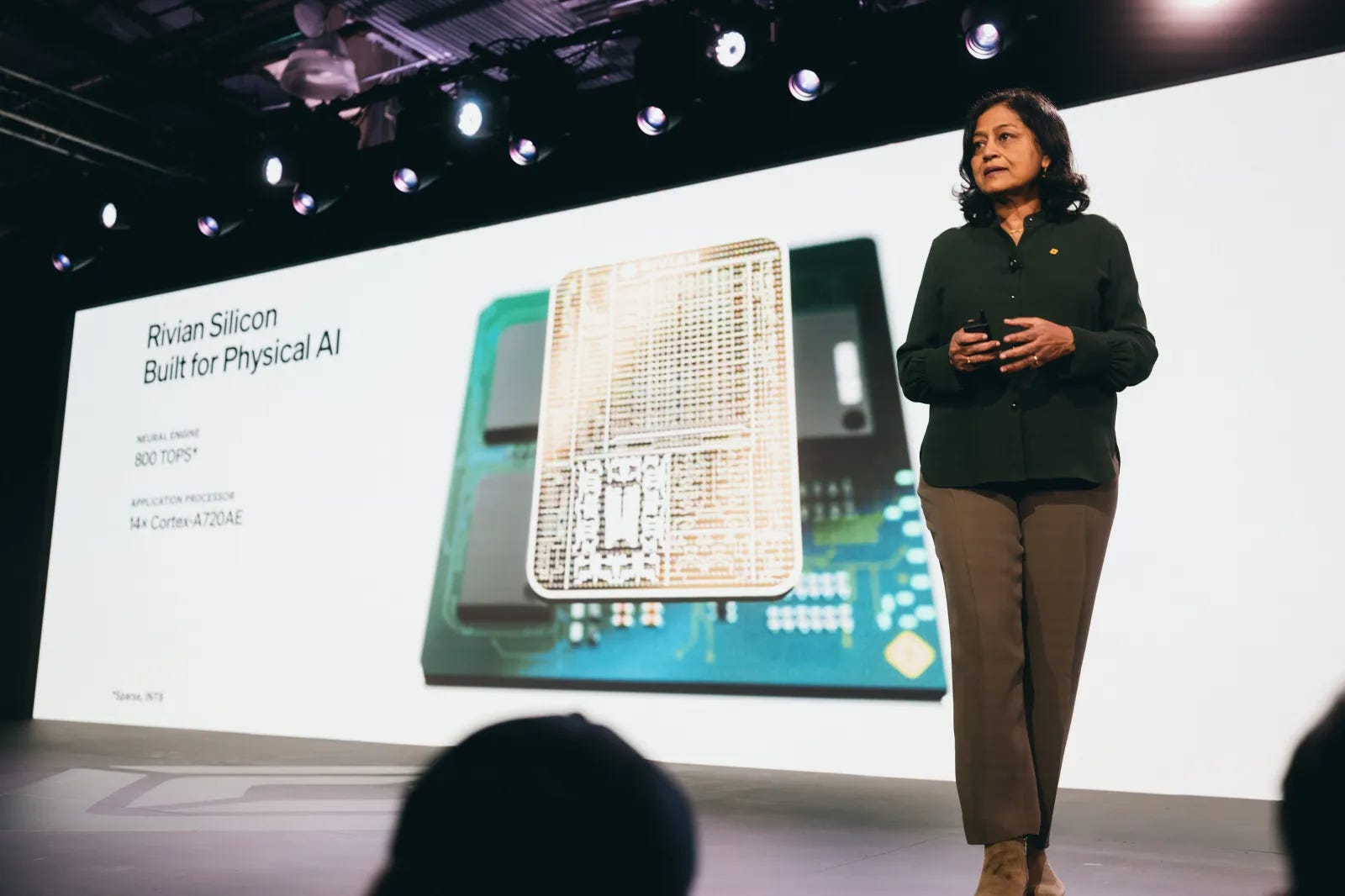
Rivian’s “many hundreds of millions” investment in its own silicon, which begins to pay off only in 2027, with the R2’s hardware upgrade.
The staggering EV write-downs by several major OEMs – including ~€22.2 billion at Stellantis and ~$19.5 billion at Ford, each roughly the size of Rivian’s entire cumulative free cash flow deficit.
And yet, we still haven’t reached @alojoh’s worst omission.
Throwing Good Money After… Good?
The year is 2024. Volkswagen Group is Europe’s largest industrial company and the world’s largest automaker by revenue. Over the previous three years, it sold more than 26 million vehicles, booked roughly $940 billion in revenue, and spent more than $60 billion on R&D, more than double what Toyota or GM each spent. A large share went to CARIAD, the unit charged with building the software and electrical architecture for every brand in the group, from Škoda to Porsche.
But it was not going well. CARIAD lost €2.1 billion in 2022 and €2.4 billion in 2023, and its problems pushed back launches such as the electric Porsche Macan and Audi Q6 e-tron by roughly two years. VW’s CEO, Oliver Blume, would later concede that the plan for CARIAD to build everything itself “was not successful.”
So Volkswagen does something without precedent. Rather than keep building the technology itself, it commits up to $5.8 billion to a joint venture with Rivian – one of the world’s smallest automakers, and one that delivered just 71,000 vehicles over those same three years – to put Rivian’s electrical architecture and software in vehicles across the group. Around $2 billion of that headline consideration was for background IP licensing.
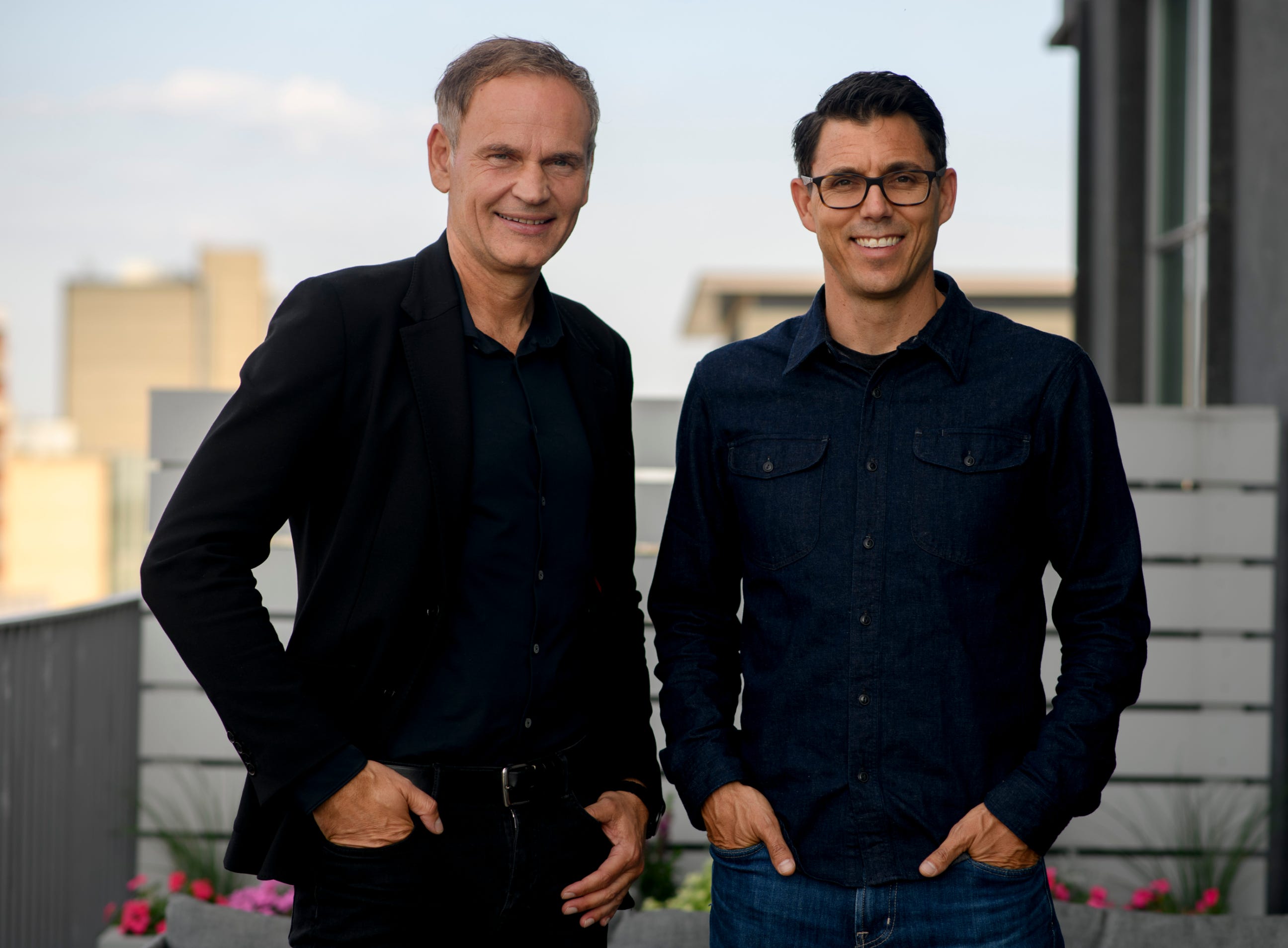
That is an arm’s-length, third-party price for a slice of the research the chart records as waste. Nor are those assets anywhere near fully monetized: the VW relationship will likely expand and, as alluded to earlier, I expect more deals like it to follow.
Yet remarkable as the VW deal was (and remains), it was arguably a smaller leap than the one Amazon took five years earlier. As RJ recalled:
“It’s one of the largest companies in the world, certainly the largest e-commerce company in the world, and imagine they go out and say, ‘We’re going to build our future logistics network around a van that’s being not dual sourced, but single sourced to one company’ – this is in 2019 – ‘a company that has never built a car before at scale, and they’re like a startup.’ But that was born out of a great relationship that I had with Jeff [Bezos].”
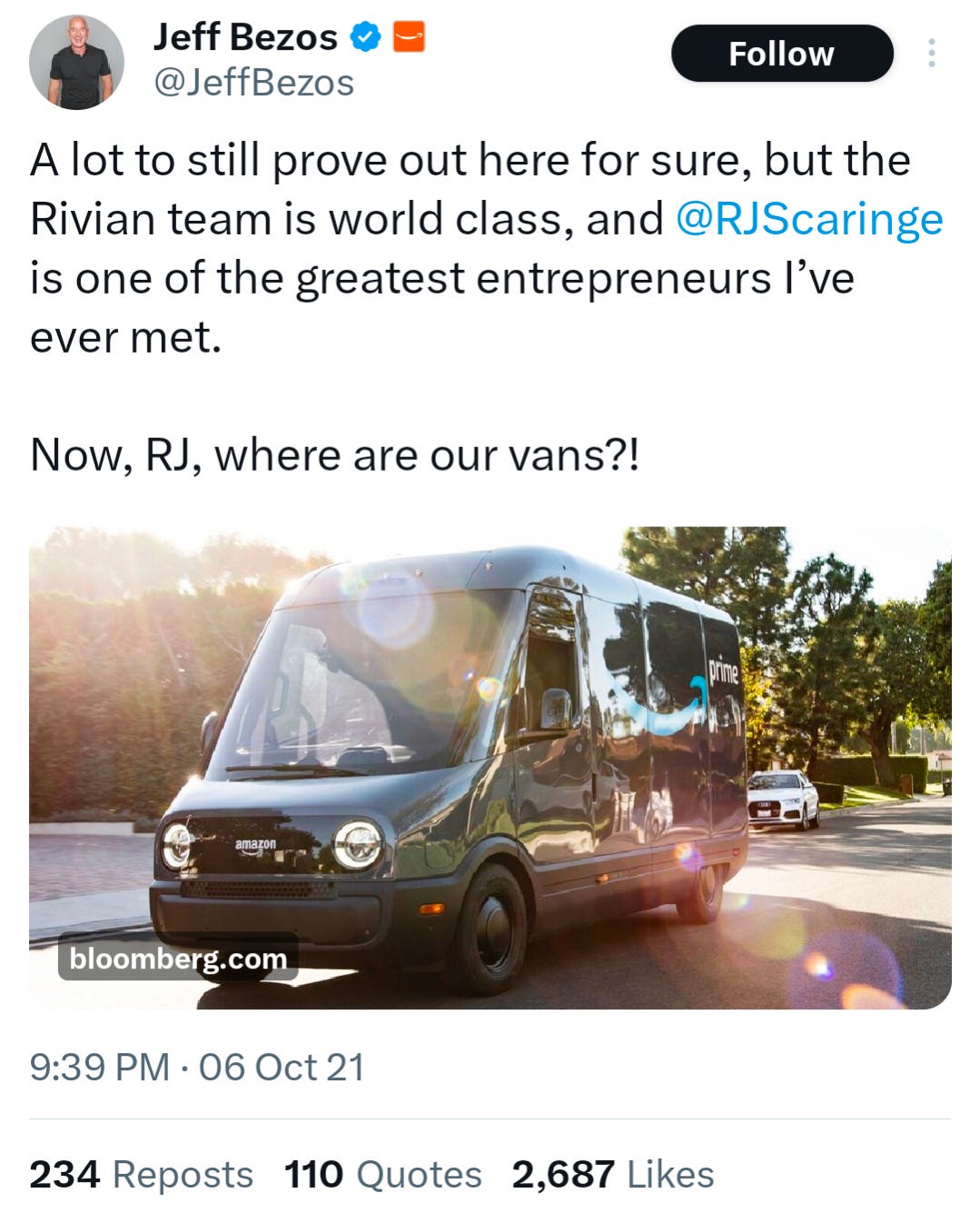
Bezos doesn’t dispense such praise lightly. The only comparable instances I could find are his 2009 explanation of his early Google investment (“I just fell in love with Larry and Sergey”) and his 2021 email to employees about his successor, Andy Jassy. (Yes, skeptics might point out that this tweet came a month before Rivian’s IPO – at which time Amazon was its largest shareholder – and Bezos was therefore a conflicted party. This is true, but the causality is backward: his esteem explains the investment, not the other way around.)
Now, to recap: RJ clearly failed to win over @alojoh, but he made a decidedly better impression on Bezos and Blume, whose companies remain Rivian’s two largest shareholders, with more than a quarter of the company between them. So, yes, “Congratulations to @RJScaringe 👏” indeed. (Oh, and Amazon got its vans.)
So, what exactly did they see in RJ and the “world-class” Rivian team?
Maniacally Focused
“The crazy thing about RJ is he knows so much about so many different topics. He can have an intelligent conversation with experts in many, many different fields. And that was one of the things I was most blown away by. I was like, ‘man, this guy is super, super smart.’” – Max Koff, Chief Engineer, Rivian R2
Aquitaine readers know that I weight management quality – above all, the CEO – far more heavily than most, and Rivian’s doesn’t disappoint. The best way to illustrate this is to compare RJ with his Detroit counterparts, Jim Farley (Ford) and Mary Barra (GM). The comparison goes a long way toward explaining how Rivian has achieved far more in EVs with far fewer resources, and why that is likely to continue. (And yes, I’ll come back to Elon later.)
Farley and Barra both hold MBAs from top-tier universities, and Barra also has an undergraduate degree in electrical engineering. Still, neither is particularly technical next to RJ, who holds a PhD in mechanical engineering from MIT. The more telling difference, though, predates any degree.

Had you walked into ten-year-old RJ’s bedroom, you’d probably have found “a literal car engine,” along with a host of other components waiting to be dissected. As a childhood friend told the WSJ: “He developed an encyclopedic knowledge of cars and their specifications, much the same way others might memorize baseball statistics.”
Farley, whose grandfather worked at Ford, and Barra, whose father worked at GM, also recall an early attraction to cars. But neither showed anything quite like RJ’s obsession or technical bent. (RJ, for the record, dislikes the word “obsessed,” which he says has “a negative connotation to it,” and prefers “maniacally focused.”)
In the same piece, the WSJ reported that former GM CEO Rick Wagoner “was struck by how much Mr. Scaringe, then in his late 20s, knew about both the auto industry and the engineering of the cars themselves, especially since he never worked for one of the big auto makers or a parts supplier.”
I could go on, but the point is clear: RJ is the most technical of the three, and by a wide margin. But of course, Farley and Barra can hire all the domain experts they need, so why does it matter? For two reasons.
The first is that RJ can add value where they simply can’t. On a podcast in 2025, he explained that he has designed the company so he can focus where he is uniquely positioned to contribute – product and technology – because of his expertise, his experience, and, crucially, his visibility into the whole technology stack:
“Of course I stay linked to other aspects of the business, but I’m not as in the weeds. Like, earlier today, I was reviewing electrical board designs and power electronics, and at a detailed level, like – down at the board level. I’m not doing the parallel of that in, say, our G&A functions.”
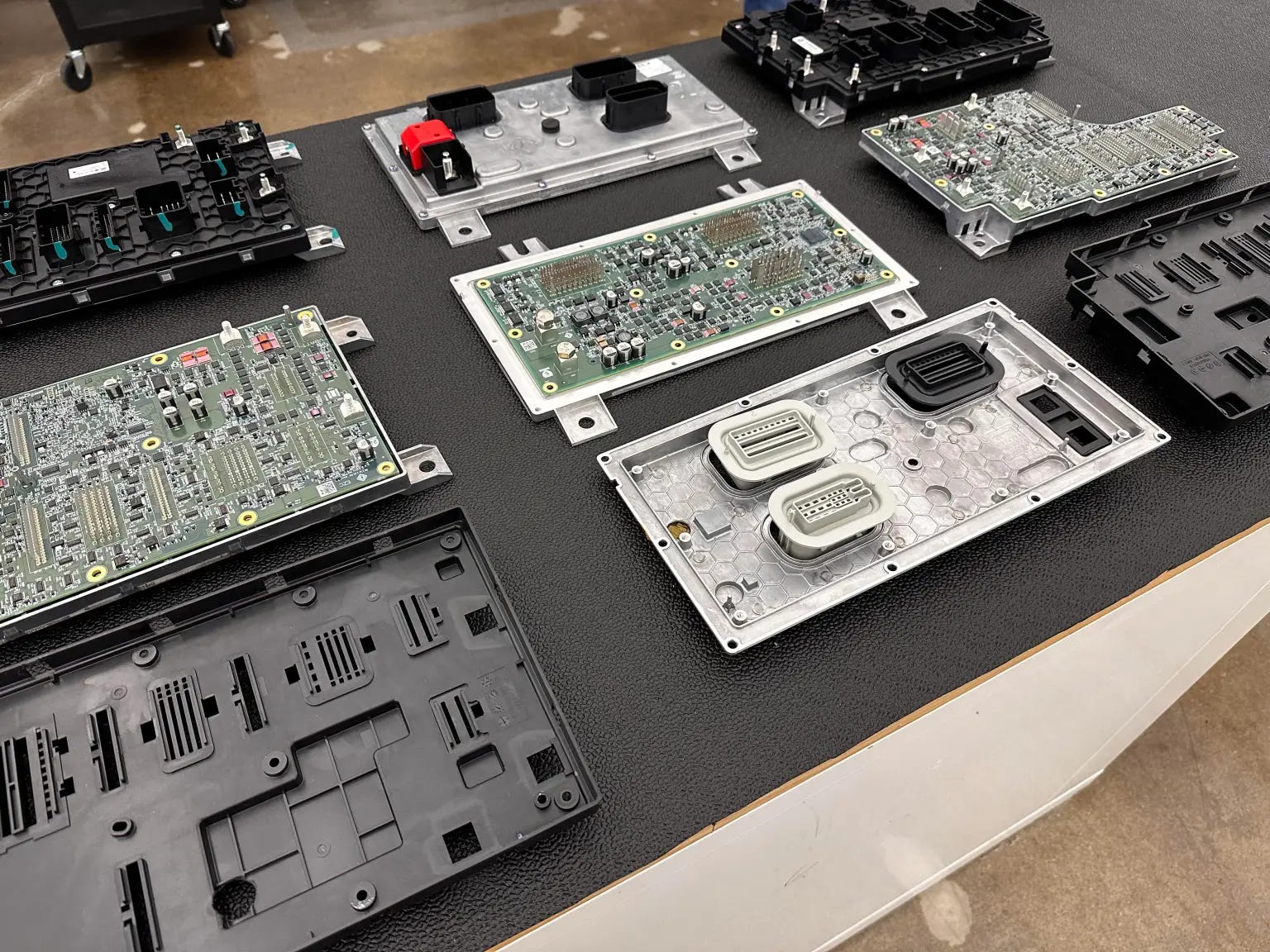
The second is talent. Beyond RJ himself, three Rivian technology executives stand out: Vidya Rajagopalan (SVP of Electrical Hardware), James Philbin (SVP of Autonomy and AI), and Wassym Bensaid (Chief Software Officer, known internally as the “Chief Reddit Officer” for his habit of responding to owner feedback on Reddit). All three are exceptionally sharp, all three clearly love what they do, and all three are likable (a rare trifecta).
Executives like these are rarely content unless they’re pushing technological boundaries – not trying to catch up to them – and working with RJ gives them ample opportunity to do precisely that. They also attract one another. As Paul Graham observed in What Happened to Yahoo, “Good programmers want to work with other good programmers.” By “good,” he meant elite. Yahoo, after all, “preferred good programmers to bad ones” (obviously); what it lacked was “the kind of single-minded, almost obnoxiously elitist focus on hiring the smartest people that the big winners have had.”
The result is a virtuous cycle. A company with exceptional engineers finds it easier to attract more of them, while one without them has to pay up – and even that may not be enough. And there aren’t many to go around. As Farley himself put it when discussing top EV and electrical-architecture talent, “there’s only a few people on the planet that can do it” – so if you’re going to compete, “you got to find them.”
Yet even finding them is harder than you might expect. In basketball, you need not understand the game to see that Michael Jordan was better than everyone else on the court. In technology, you do.
Sir Peter Beck – founder of Rocket Lab, the only launch startup besides SpaceX with nearly 100 launches to its name – made a version of this point about space companies that keep getting funded despite being “objectively terrible.” Space is hard to understand, he explained, so people “can stand up and make these claims, and it’s really, really hard to corroborate unless you go five layers deep into the rocket equation.”
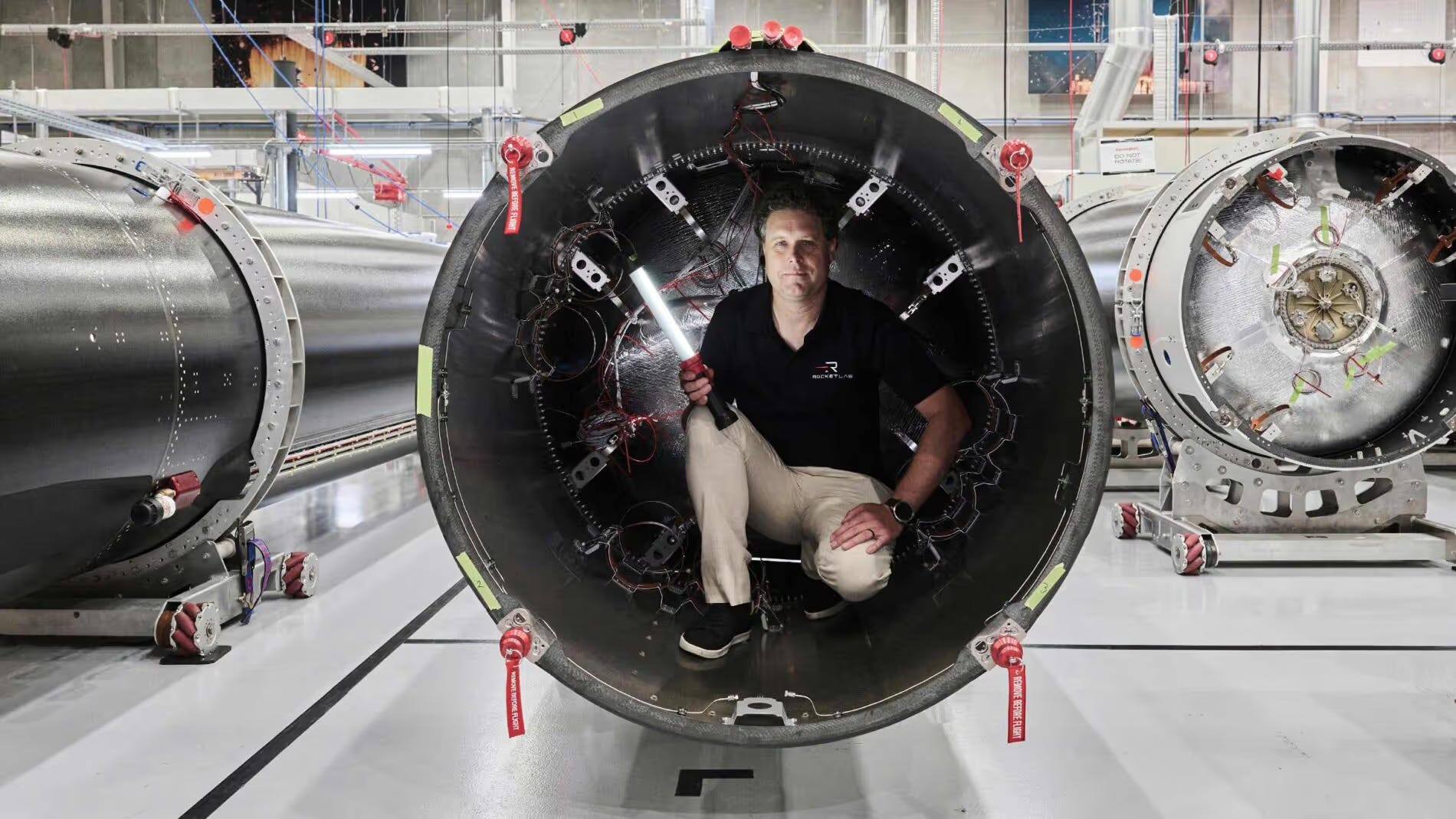
Asked whether investors are any good at that kind of diligence, Beck replied, “Not really,” adding that “sometimes, even the firms that you think are really good at it actually are the worst.”
(Beck is a case in point for why a résumé – the right degrees, the right former employers – is an imperfect guide to talent at best. Bill Gates and Mark Zuckerberg famously dropped out of Harvard. But they still went to Harvard. Beck never went to university at all. But I digress...)
The point is that a CEO who can’t go five layers deep into the technology is in much the same position as those investors. Consider Barra’s record. In 2021, she said GM had all the pieces in place to become the EV market leader in North America by 2025, despite having sold fewer than 21,000 EVs the year before. It didn’t quite get there: in 2025, GM took just 13% of the US EV market, against Tesla’s ~46%. And the gap has widened in 2026, to ~11% versus ~53% through September.
Software tells a similar story. In February 2024, Barra told a Wolfe Research conference that GM’s new software chief, Mike Abbott – whom she wished she had recruited earlier – had “brought in just an incredible team.” GM had “already revamped the software development process,” she said, and 2024 would be “the year of execution.” (Translation: problem solved.) Abbott left soon after for health reasons, but that October she sounded just as confident: GM had “the right software talent in the company with Dave [Richardson],” an Apple veteran, and his team.
In July 2025, she touted the hiring of Barak Turovsky “to lead our [AI] efforts under Dave Richardson,” adding that he was “building a world-class team.” Within five months, Richardson, Turovsky, and fellow software executive Baris Cetinok had all left, and software had been folded into a new organization under chief product officer Sterling Anderson.
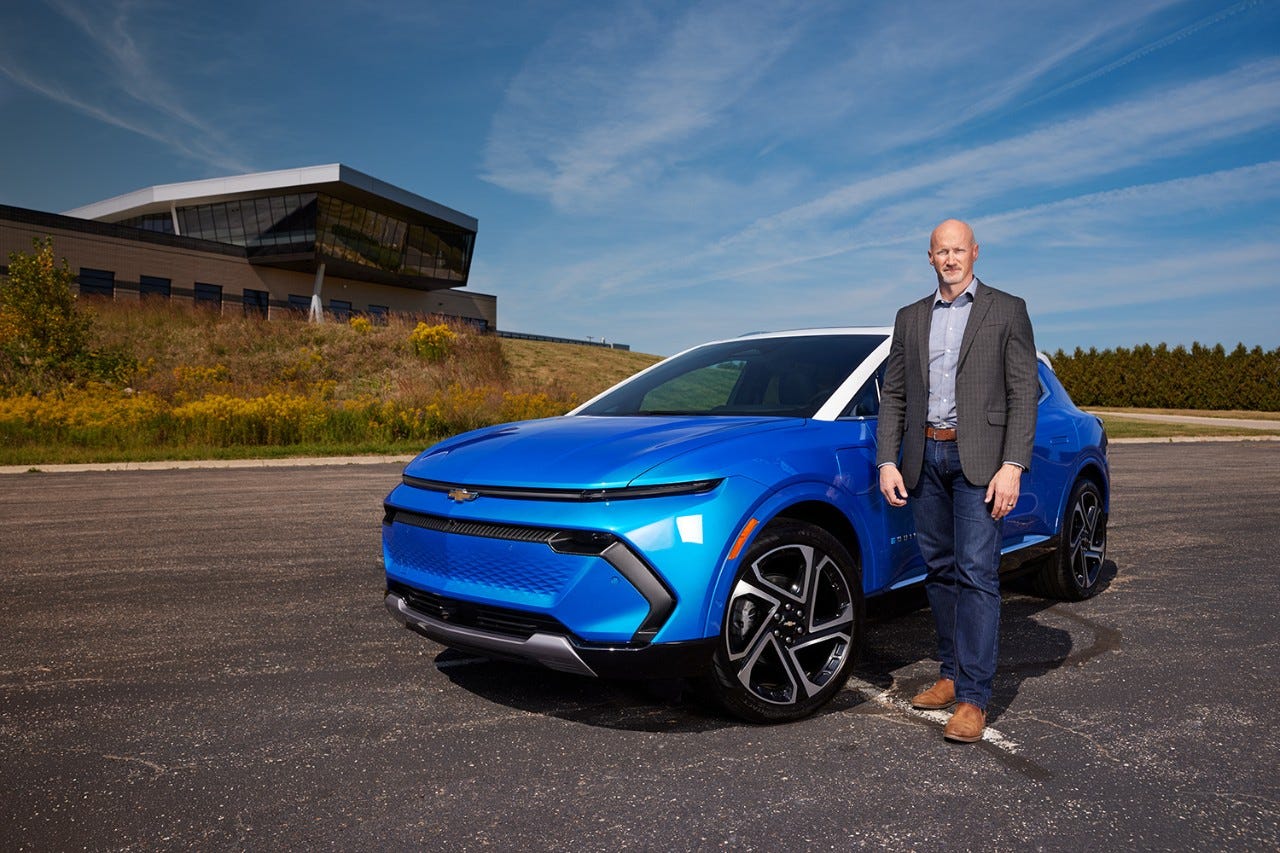
On GM’s Q3 call in October 2025 – 20 months after she had all but declared the problem solved – Barra (implicitly) conceded that a gap remained. GM’s next-generation software-defined vehicles, she said, beginning with the Cadillac Escalade IQ in 2028, would “put us at parity or potentially better than the best in the industry today.” (Sound familiar?)
Given GM’s substantial resources, and with Anderson – a Tesla alum who, like RJ, holds a PhD from MIT – now leading technology, it’s understandable that she thinks this time will be different. But GM has a lot of catching up to do, and neither Rivian nor Tesla is standing still. (Forgive my skepticism, but I’m taking the under.)
“A Massive Step Forward”
Enter the ID.1. Launching in 2027 at around €20,000 – some 20% below the entry-level ID.Polo – it will be Volkswagen’s most affordable EV and the first built on the joint venture’s architecture. When a Morgan Stanley analyst called it VW’s “answer to China” at a fireside in September 2025, RJ agreed, and went further:
“When that car launches, as is the case of any car that’s pushing technical boundaries, every car company in the world will buy it, BYD will buy it. Xiaomi will buy it. XPeng will buy it. They’ll take it apart, and everyone is going to be impressed with how elegant the network architecture is, the ECU layout and importantly, the associated wiring and electrical systems to support that. It’s really a massive step forward relative to anything that’s been done before.”
Note who RJ expects to be impressed: not GM, Ford, or any other legacy automaker, but the companies at the frontier of software-defined vehicles.
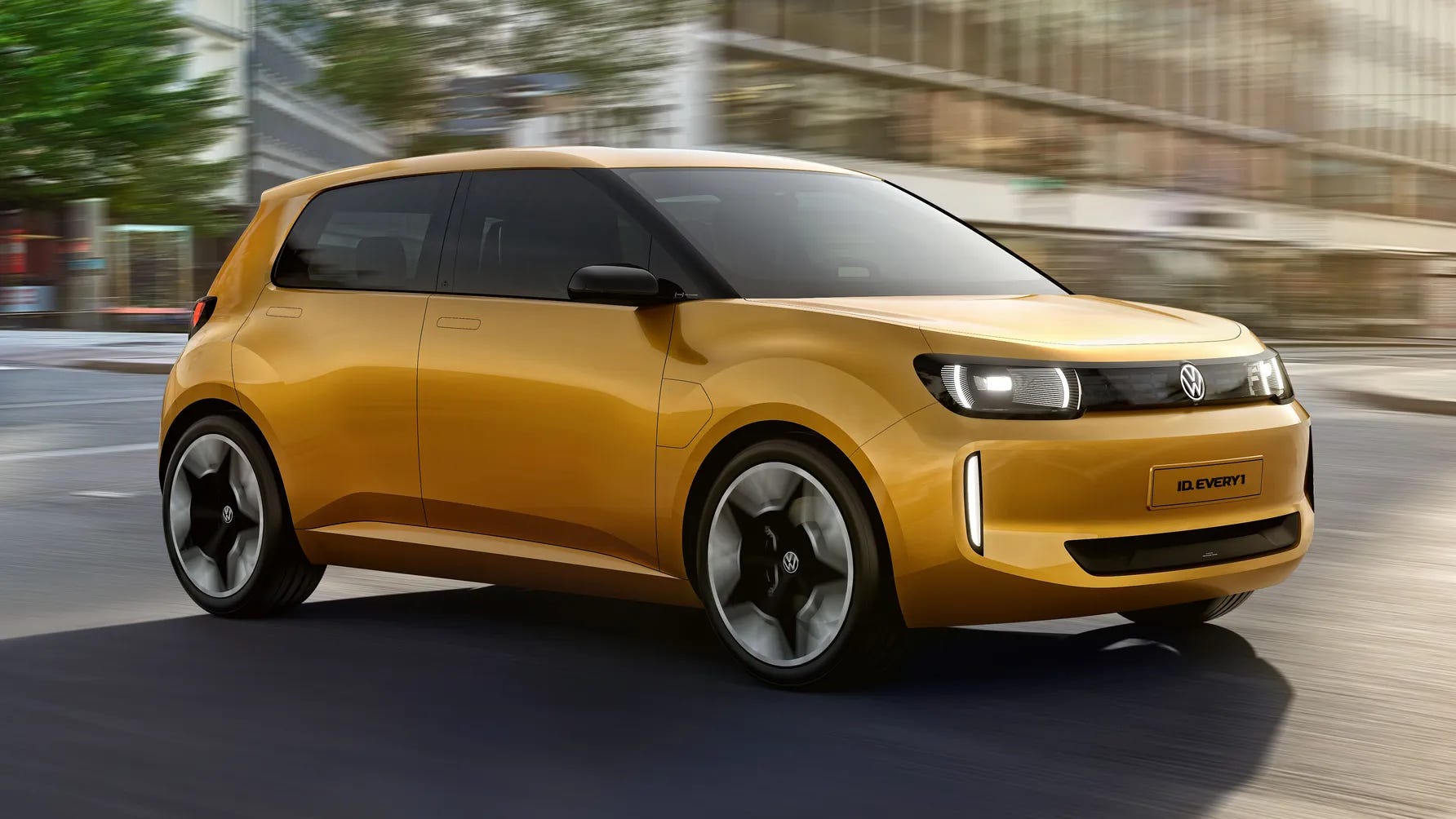
As RJ told Out of Spec in March, the ID.1 “takes everything that we’ve done with the zonal architecture and … takes it to the extreme. It’s like very, very heavily consolidated compute.” By eliminating dozens of the computers a comparable gas-powered car would need, along with their wiring and connectors, the architecture dramatically lowers the vehicle’s cost. As a result, he says, “people are going to be shocked at what it can do” at that price.
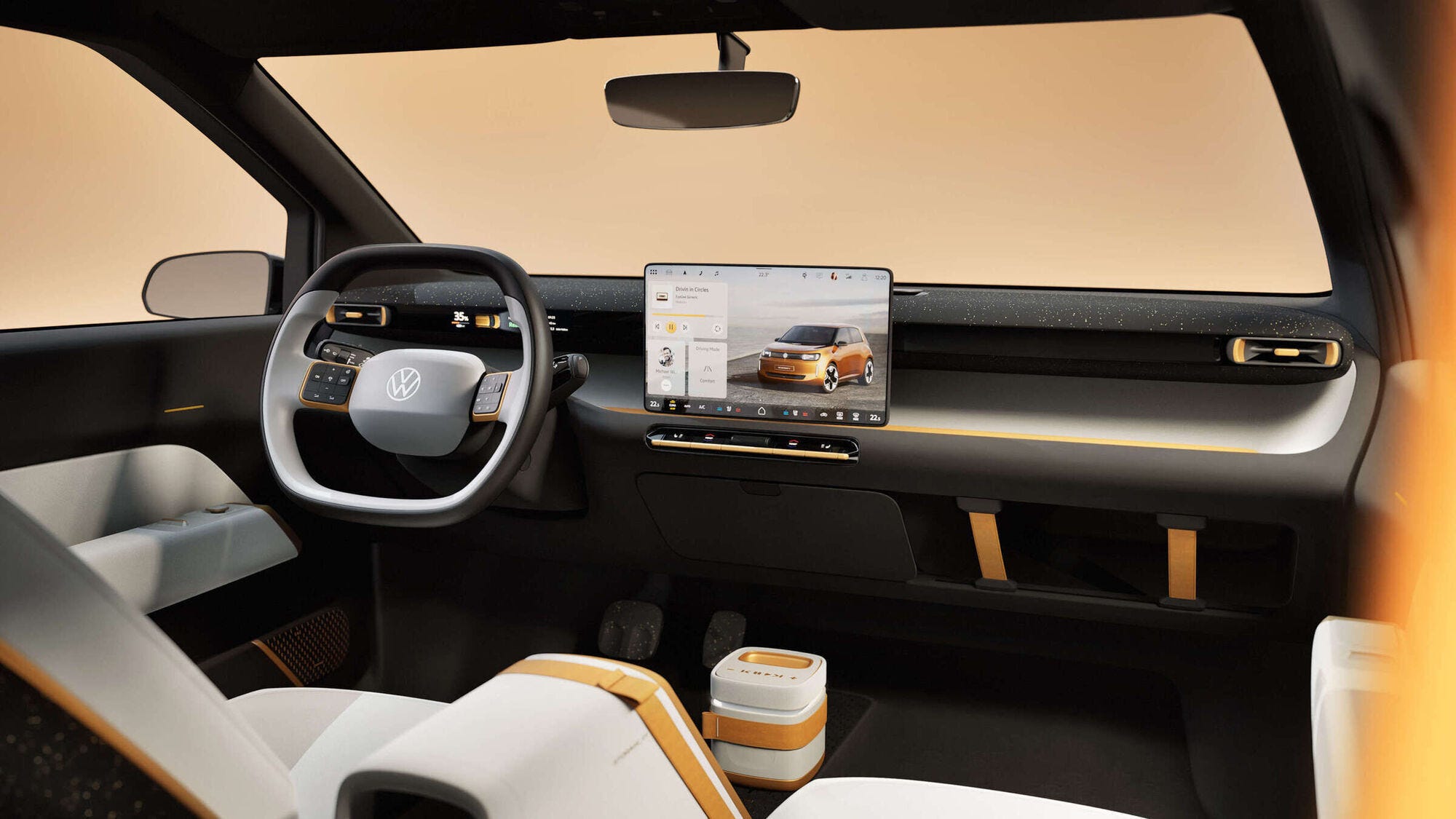
The ID.1 will be the first proof that Rivian’s architecture works across very different sizes and price points – from an R1 (a full-size SUV) that averages in the low $90,000s to a ~€20,000 compact. If it’s the hit many expect, Rivian could soon have hundreds of thousands of mobile billboards for its technology across Europe.
“Not Today”
Which brings us back to John Saager’s question, and the answers from Chip Newcom and RJ in the chart at the start of this piece. Here is the fuller context behind each.
September 8 (Goldman Sachs). Asked about licensing Rivian’s electrical architecture to other automakers, Chip said Rivian was “always open to have conversations.” He continued:
“And I think RJ being a very prominent member of the automotive leadership community is talking with any number of other OEMs … And so certainly, it’s a latent opportunity, but our biggest focus right now is continuing to execute with R2 [and] with our partners at Volkswagen.”
Hardly noteworthy, except for the tense: “is talking.”
September 29 (Evercore). Three weeks later, when Saager asked essentially the same question, Chip was more hesitant: “Yes. Well, nothing – certainly nothing we’ve announced to date [and] clearly can’t announce anything here.” Beyond the hesitation, this caught my attention for two reasons:
Both he and Saager knew he couldn’t selectively disclose anything material, so why spell it out – right after saying nothing had been announced?
There was no precedent for it. I went back through every substantive public remark from his time at Rivian and, before that, Equinix – roughly 18,000 words – and found several variations of “nothing we’ve announced to date,” but nothing resembling “can’t announce anything here.”
My suspicions rose considerably.
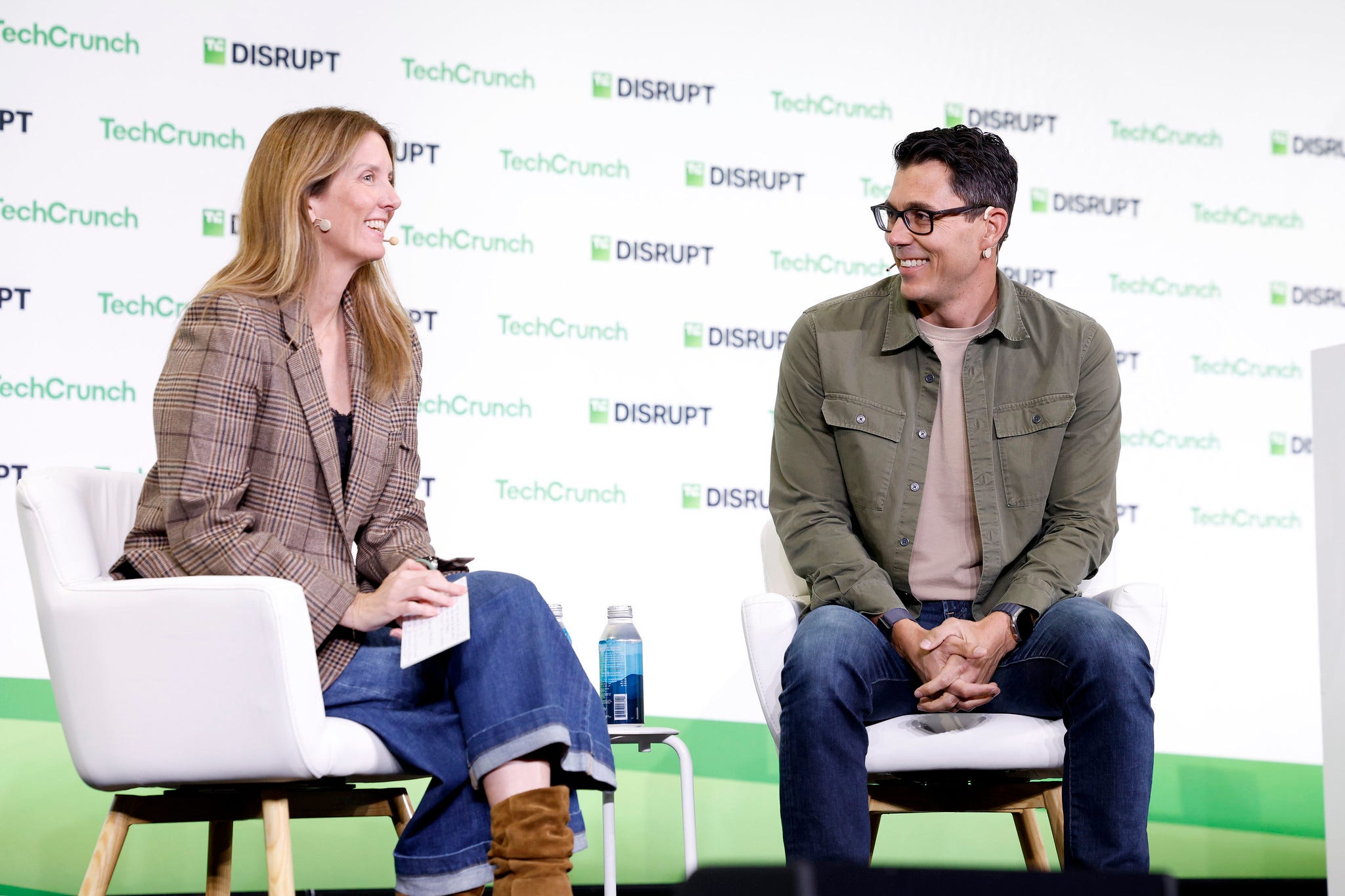
October 14 (TechCrunch). Before his interview with TechCrunch’s Kirsten Korosec, RJ had asked her: “So, what are you going to try to get me to say that I’m not supposed to say today?” She duly opened with: “So what secret project are you working on now?” RJ recounted their earlier exchange but kept his answer vague: “there’s lots of things we’re working on that we haven’t shown yet.” About 20 minutes later, her persistence began to pay off, though the clues were easy to miss.
First, he said he thinks the VW relationship “will continue to expand and grow.” Still vague, but a step beyond his earlier language: elsewhere, he had acknowledged the possibility of expanding its scope; now he was expressing an expectation. More revealing were his two answers in the chart, which came right after he said that “we also see opportunities to sell this type of technology … to many different brands.”
KK: “So what companies are you talking to now?”
RJ: “We haven’t said.” [Laughter]
KK: “Well, we’re all listening. All ears. All ears.”
RJ: “Not today.”
None of this proves a deal has been signed, of course, but it’s hard to read the sequence as anything short of advanced talks.
To Be Continued
We’ve covered a lot of ground, so this seems a good place to pause.
Part two will cover the rest of the thesis – profitability, production capacity, and why consensus estimates look far too low – along with the risks, the remaining debates, and the catalysts, including December’s Autonomy & AI Day. (In the two weeks after the first one, in December 2025, the stock climbed from roughly $16.40 to $22.70. I doubt Rivian would hold another just a year later without something new to show.)
Thanks for reading. If you enjoyed this piece, please give it a like or share it with your network. It really helps.
Until next time.